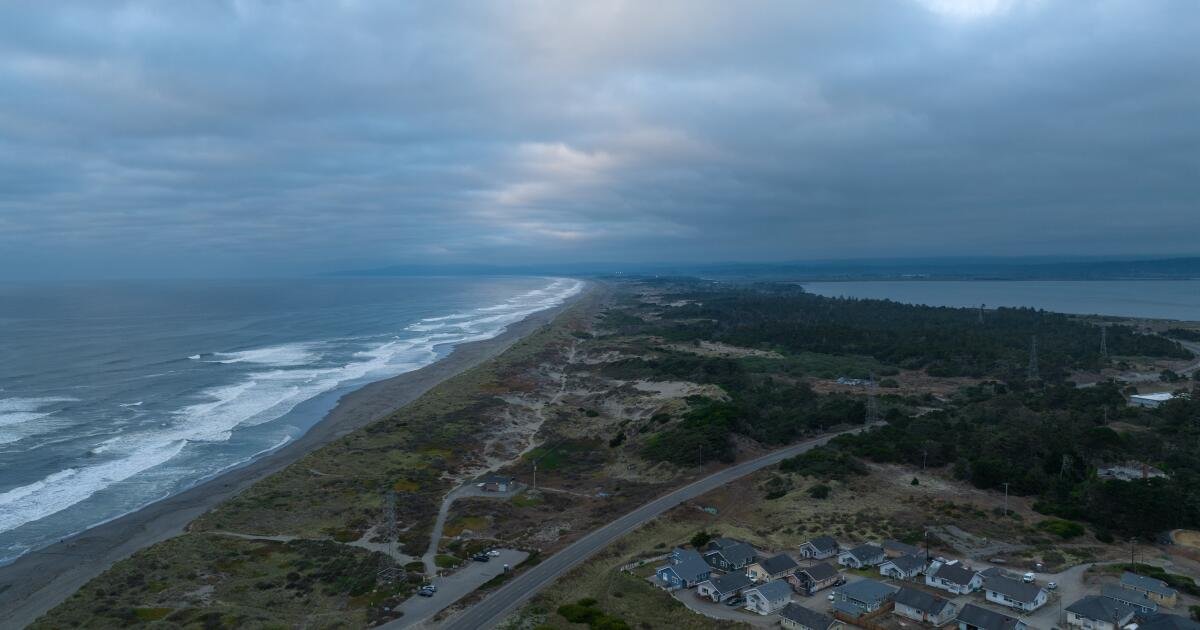
Trigger warning for sweaty Californians: In recent days, the foggy timber town of Eureka on the Humboldt Bay has tied records for the daily high temperature twice. It got (barely) into the 70s!On July 22, the mercury hit 73 degrees, tying the record set on July 22, 2007.Three days later, the high temperature in Eureka was 70 degrees, matching the record daily high recorded on July 25, 1984. You’re reading the Essential California newsletter Sign up to start every day with California’s most important stories. By continuing, you agree to our Terms of Service, which include arbitration and a class action waiver. You agree that we and our third-party vendors may collect and use your information, including through cookies, pixels and similar technologies, for the purposes set forth in our Privacy Policy such as personalizing your experience and ads. “That’s warm for us,” Johnathon White, a meteorologist for the National Weather Service in Eureka, deadpanned Wednesday, noting with a chuckle that many folks there spend their summers in hoodies.I often wistfully check the forecast there, one of the most reliably cool places in California during the dog days of summer.There, the average summertime highs are in the low 60s, White said, cheerfully adding that it was a little drizzly Wednesday morning. This weekend, daytime highs in Eureka will be in the mid-to-upper 60s — cooler even than San Francisco, so famed for its chilly summers.This summer is sticky and muggy for many of usFor huge swaths of California, the National Weather Service has issued extreme heat warnings through this weekend, and much of the state is perspiring through an unusually humid summer thanks to warmer ocean temperatures, tropical storms offshore and surges of monsoonal moisture.Wildfires are raging across much of the American West — including Oregon and Washington — and in Canada.And while scientists say a so-called “super” El Niño brewing in the Pacific could, in the coming months, bring much-needed precipitation, the Western U.S. still is “suffering the consequences of a hot winter and meager snowpack, in part thanks to El Niño’s polar-opposite sister, La Niña, which brought cool ocean water to South America’s Pacific coast and drier conditions to the Southern U.S.,” my colleague Noah Haggerty reported last week.But in Eureka, things are pretty chillIn Eureka, a city of some 25,000 people in Humboldt County, there’s an oft-repeated saying about residents: “They don’t tan. They rust.”That’s because the air is usually so misty and salty.The cooler summer weather is, in large part, because of the local geography. When it is hot inland, warm, thinner air there rises in the atmosphere, and cold marine air is sucked in, like a vacuum, to fill the void. The warmer air aloft acts like a lid, trapping the heavier, cooler air, which can’t easily flow over mountains. Eureka is one of the most reliably cool places in California during the summertime. (Myung J. Chun/Los Angeles Times) The highest temperature recorded in Eureka is 87 degrees, according to the weather service. The mercury hit that number three times: in October 1993, September 2017 and September 2020.According to Climate Central, a nonprofit research group, the average summer temperature in Eureka rose 1.6 degrees between 1970 and 2025, to about 58.5 degrees.Though the overwhelming majority of U.S. cities have had shorter, hotter winters over the last 50 years because of climate change, Eureka is one of the very few to buck the trend, with its winters becoming slightly colder, per Climate Central. Since 1970, the average winter temperature in Eureka has dropped 1.3 degrees.White, who grew up near Atlanta, said he can’t complain about the mild weather in Eureka, where the National Weather Service forecast office is set on little Woodley Island.“A lot of times in the summer, we have the AC turned off at our office. We can just open a window and that helps,” he said. But with temperatures near 70 and the fog not as thick, he said, “it’s kind of funny — we turned our AC on this week. It gets warm in here just from the sun heating the building.”Today’s top stories (Allen J. Schaben/Los Angeles Times) The second LA28 Olympics ticket dropD4vd murder case: What happens nextA judge found Monday that enough evidence exists for D4vd to stand trial for the sexual abuse and murder of 14-year-old Celeste Rivas Hernandez.The lengthy hearing offered a trove of new information and a preview of potential defenses the singer’s lawyers might trot out at trial.LAPD stopped putting many public records onlinePublic records related to the L.A. Police Department began disappearing from a city of Los Angeles database last April.One UCLA professor discovered that various records, including audio recordings of emergency dispatch calls, along with emails and text messages from high-ranking police officials, had gone missing.What else is going onCommentary and opinionsThis morning’s must-readAnother must-readFor your downtime A spread of dishes at Tainos L.A. in Woodland Hills. (Jess Torres / For The Times) Going outStaying inA question for you: What are your favorite summer destinations in California?Email us at essentialcalifornia@latimes.com, and your response might appear in the newsletter this week.And finally … your photo of the day The Ultimate Birthday Cake (Catherine Dzilenski/For The Times) Today’s great photo features yummy birthday cake from pastry chef Rose Wilde, who breaks down the best way to slice cake.Have a great day, from the Essential California teamHailey Branson-Potts, staff writerHugo Martín, assistant editor, fast break deskKevinisha Walker, multiplatform editorAndrew Campa, weekend writerKarim Doumar, head of newslettersShi Bradley, audience internHow can we make this newsletter more useful? Send comments to essentialcalifornia@latimes.com. Check our top stories, topics and the latest articles on latimes.com.