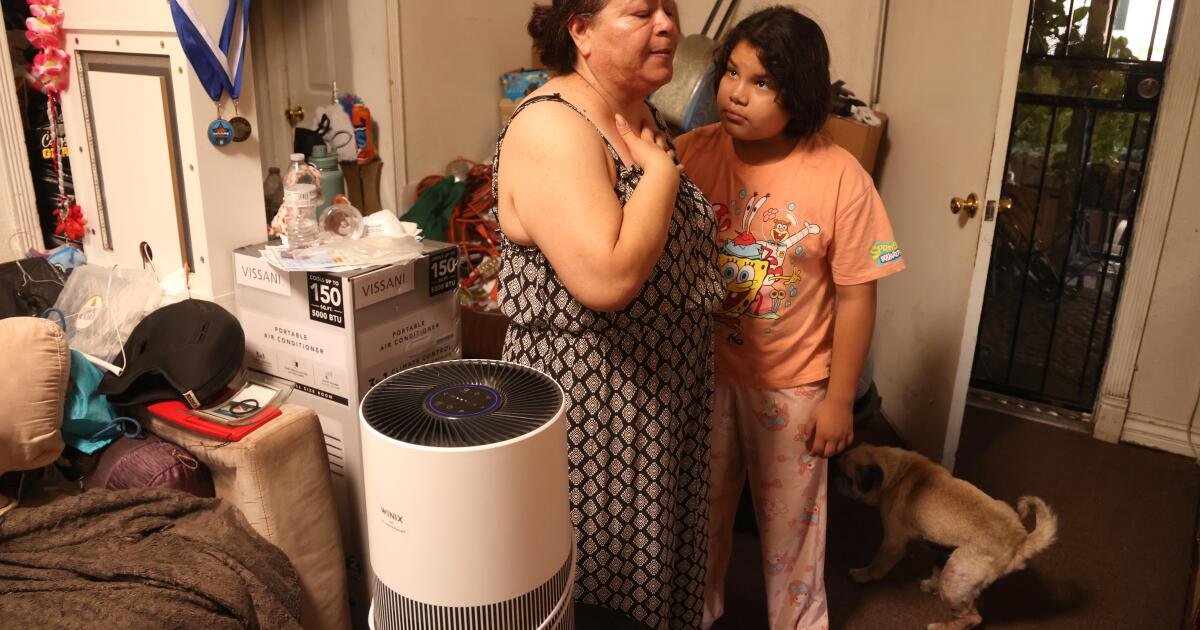
With two weeks before school starts, families in Boyle Heights are gripped with concern about the conditions and safety at eight campuses within a one-mile radius of the Lineage warehouse fire, schools located in and near neighborhoods beset with the stench of rotting food, fly swarms and rats. Parent Myrna Silva, who lives a block away from the Lineage site, is among the scores of parents worried about how their children — who attend three early education and care centers, four elementary schools and a middle school near the burned hulk of the warehouse — will cope with the odor and vermin infestations that have kept them indoors since the June 17 fire erupted and upended their lives.Her main concern is about the noxious stench of rotting food. Will that prevent her children from concentrating on schoolwork or having a full school experience that includes outdoor recreation?“It is a priority that my kids be able to play outside at school,” she said. “It is what they are used to and they need to de-stress. This is not healthy for their mental health.”LAUSD responds with tests, cleaning and air filters An outdoor flytrap hangs on a pole across the street from the Lineage Warehouse in the Boyle Heights. (Genaro Molina/Los Angeles Times) There are no plans to delay the Aug. 12 opening of nearby campuses, transfer students to other schools or switch to online learning. All schools will open as normal — although operations will be tightly monitored and affected campuses are being scrubbed clean inside and out. When the blaze erupted during summer school session, L.A. Unified moved students to other locations. But the change drove down attendance at summer school, which is optional for students. Officials with Los Angeles Unified, which is conducting a series of online meetings for parents, say that schools in the area are clean and safe, that the indoor air quality will meet high standards and students will be kept inside if odors wafting from the warehouse are strong. Principals will decide whether to keep students inside if the odor is too bad to play outside.“We have replaced the air filters at the schools that are impacted,” Supt. Andrés E. Chait said in a recent response to a Times query. “Plant managers have been on all summer, so we absolutely have been working with all those schools, and we’ll continue to all the way through leading up to August 12th.”Extra safety measures have included dust and air sampling that is ongoing at ten campuses in the Boyle Heights area, said Carlos Torres, director of the school district’s Office of Environmental Health and Safety. “We have enough information to show that our schools are safe,” Torres told parents during a Thursday evening webinar. “The agencies have said that the areas are safe to reoccupy.” He said the testing reports will be posted on the district website. Region East Supt. Lourdes Ramirez-Ortiz said district officials will be knocking on doors to ask how they can help make families feel safer.“Our mission is to make families feel safe, healthy, and learning,” Ramirez-Ortiz said. “The school site is the safest place for our students to be.”Gilberto Martinez, who is in charge of regional operations, told parents that “during times of trauma, we want to ensure that these regularly scheduled days, times, activities remain as normal as possible. So we want students to be able to go outside and play.” Health concerns mount for parents near Lineage fire schools Myrna Silva walks through the front yard of her family’s home about a block away from the Lineage Warehouse in Boyle Heights. (Genaro Molina/Los Angeles Times) Silva said the summer has been filled with stress. In the summer heat, the family hasn’t used the air conditioner — at first over fear of bringing in toxic substances from the smoke and then because of the stench from 42,500 tons of rotting food contained within the formerly refrigerated warehouse.Her 15-year-old son will be a sophomore at Garfield High — a little over two miles distant — and seemingly far enough away. The school district held an opening-of-schools event there on July 21 and, on that day at least, there was no lingering odor. But her 10-year-old daughter is entering 6th grade at Stevenson Middle School, about six blocks from their home and within a mile of the fire and, frequently, directly downwind.Her persistent concern is about the near-omnipresent odor and whether it will disrupt learning. For now, she doesn’t allow her kids to play outside and they also did not attend summer after-school programs once the fire erupted. They are stressed and frustrated, Silva said. The odor is too intense even to sit on their patio.Teachers inspect schoolsOn Tuesday a delegation from the teachers union toured Eastman Elementary and Stevenson. Much of what union Vice President Jessica Rodarte saw was reassuring — with school managers and officials at pains to explain cleaning and testing efforts. She learned that although there has been no soil sampling so far, the district has selectively tested dust because the more recent dust would provide a reading on what was deposited as a result of the fire.All classrooms have air conditioners and she was reassured that all filters had been replaced and that the new ones had a high-grade MERV 13 rating. In addition, air purifiers — with carbon filters to control odor — would be in every classroom. “There are contingency plans to keep the kids inside,” she reported. “They are planning for an indoor-activity schedule.”“We are still concerned about whether or not there is enough staffing to keep up with pest control,” the rats and flies, Rodarte said. “Air quality and pests are an issue that could require closure,” Rodarte said. “Some of the schools are fairly large and where do we relocate?”Sixth-grade teacher Rafael Rodriguez took a walk-through of Eastman Elementary.“It’s not what I saw, it’s what I smelled,” said Rodriguez, who teaches at a school outside the odor zone. “When I was nearby … the smell was horrible. It was something that we don’t feel that anybody should have to put up with. … We want to make sure that students are able to come back to a safe and healthy environment, and we feel that there are still many concerns that need to be addressed.”Demand for action A worker walks past the clean up site at the Lineage Warehouse in Boyle Heights. (Genaro Molina/Los Angeles Times) In Boyle Heights, community members are demanding quicker cleanup action and more health and home safety assistance for the largely lower-income neighborhoods.“The Lineage fire exposed long-standing environmental injustices impacting Boyle Heights in East L.A. and other areas,” said school board member Rocío Rivas, who represents the area. “Our schools, our students and families experience real disruptions, including concerns about air quality, health impacts, child care and lost learning opportunities.”She called for the facility to be permanently closed. “Corporate operations should never come at the expense of children’s health and safety,” Rivas said.At the current pace, it appears extremely unlikely that the rotting food will be removed by Aug. 12. The removal could continue for several months.“Low-income communities of color should not be forced to suffer longer than needed simply because of their class status,” said Elmer Roldan, executive director of Communities in Schools of Los Angeles. “Our elected and business leaders are responsible for caring for our communities, and we are counting on them to move faster.”He believes that schools should temporarily relocate if issues are not resolved by the start of the school year. Other community leaders spoke in similar terms.“Until we get soil samples and inspect the schools and classrooms to determine that our children will not be exposed to toxic chemicals or particulates, we should not send our kids to nearby schools,” said Henry Perez, the head of the community group InnerCity Struggle.But moving a school population to another location is no panacea.Silva worries, for example, about getting to a campus that is farther away. The family feels safe at Stevenson; transportation would be complicated. And on top of worrying about the start of school, Silva said her family is still suffering from headaches, nausea, sore throats, eye irritation, stomach pain, diarrhea and persistent coughing. She also fears for the health of her asthmatic daughter.“I did not sleep. I had to keep checking that my children were breathing,” Silva said.