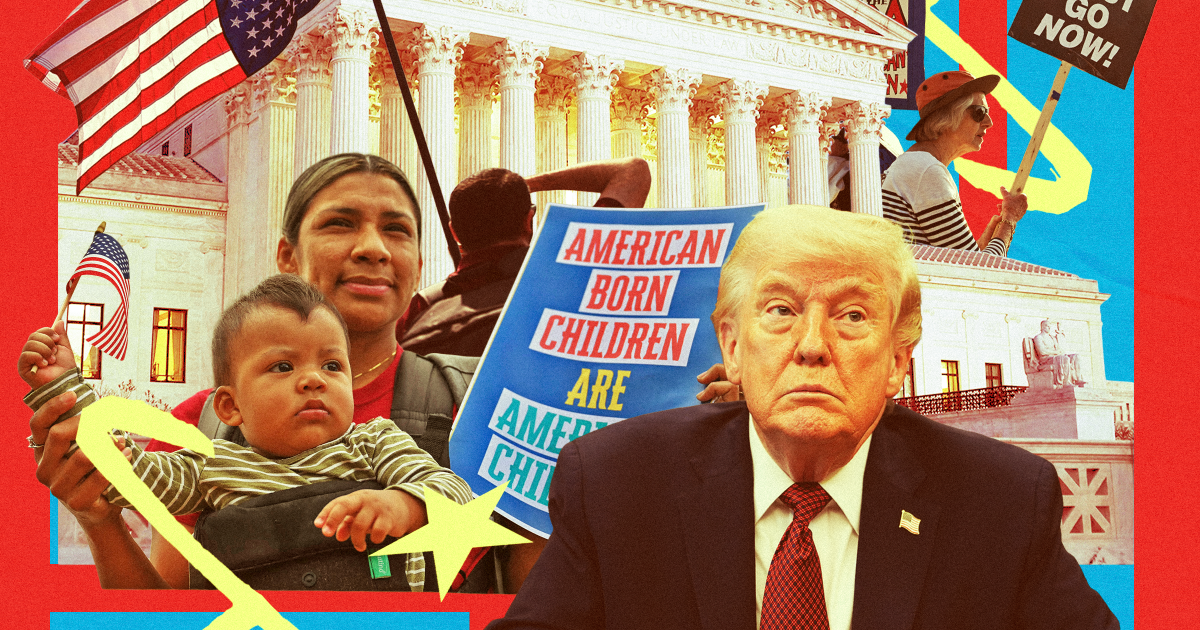
On Tuesday, the Supreme Court reaffirmed the 14th Amendment’s Citizenship Clause, which states that all those born in the U.S. are citizens, regardless of the status of their parents.In a 6-3 decision, the justices rejected President Trump’s plan to revise the Constitution by executive order and to end citizenship at birth for newborns whose parents were in the country illegally or temporarily. The order would’ve been enacted retroactively to all children born under such circumstances beginning Feb. 19, 2025.The ruling came as a rare loss for Trump from a majority-conservative court — underscoring the absurdity of the framing from which the Trump legal team was operating.In the majority opinion, Chief Justice John Roberts explained the constitutional rationale behind the decision.“Citizenship, then and now, was the right to have rights — to freely participate in our political community,” he said. “The framers of the 14th Amendment extended that promise to ‘every free-born person in this land.’ We keep that promise today.”Cecillia Wang, the legal director of the American Civil Liberties Union, who argued the case at the Supreme Court, said the decision was a substantial victory because it affirmed that the “president cannot change the Constitution by executive fiat.”Ever a gracious loser, Trump signaled that he’s not done pursuing this topic, writing on Truth Social that his political allies could “easily make it up in Congress through Legislation, with the support of the President.”The ruling lands as a big win for U.S. Latinos as the demographic would be the most affected if the conditions surrounding birthright citizenship changed. According to a UCLA analysis of 2022 data from the Urban Institute’s count of children of immigrants, 75% of all children in the U.S. — totaling 4 million people — with noncitizen parents were Latino. UCLA researchers estimated that approximately half of Latino children born to noncitizen parents would be affected if the Supreme Court had ruled Trump’s executive orders constitutional.“The decision really affirms that Latino kids, regardless of who their parents are … are members of our country,” Amada Armenta, the director of UCLA’s Latino Policy & Politics Institute, told The Times.Armenta said she was glad about the ruling but found it “alarming” that the issue of birthright citizenship was up for debate in the first place. She was also upset by how the court was split on the conclusion.“The decision to provide birthright citizenship in 1898 [in United States vs. Wong Kim Ark] was a 6-2 decision and 1898 was the height of American immigration racism with the Chinese Exclusion Act [and] all of these obviously racist laws on the books as a nation,” Armenta said. “When the Supreme Court had to decide that case, they decided it more decisively than this one.”She said the level of xenophobia behind the dissenting judges’ opinions and the segment of the U.S. population that rallied around an end to birthright citizenship were concerning.“There’s something deeply painful about being part of a group where you know that there are people in the country, including the government, who wish that you weren’t a member,” Armenta said.The overriding emotion the UCLA educator felt was relief upon hearing the news because it signaled one fewer roadblock for Latino families in this country.“I think there’s just so much political uncertainty about a lot of other social issues that harm our ability to thrive,” she said. “There’s still all of these exclusionary measures that exist. We only have to think of last summer, what it felt like to live in L.A. and to have that tangible experience that the government thinks it’s OK to question Latinos based on what they look like.”Juan Proaño, chief executive of the League of United Latin American Citizens, encouraged Latinos to take a “victory lap” but, just like Armenta, expressed a bit of cynicism about the ruling.“There’s a lot to be proud of. … This will benefit a lot of immigrant families,” Proaño told The Times. “I feel it sort of falls flat because technically speaking, nothing changes, right? It’s like we were going upstream on something that shouldn’t have really ever been an issue.”The fact that the ruling was not unanimously in favor of preserving the current interpretation of the Citizenship Clause was unsurprising but deeply disturbing to Proaño. He hoped that the decision animates Latinos to mobilize.“We have to be ever vigilant, we’ll take the win, but we have to be very thoughtful about this,” Proaño said. “What we can do is educate our community, make sure that they’re informed, make sure that they’re registered to vote and they can participate in the upcoming election cycle, because that’s the only thing that’s going to stem the attack on immigrants in this country.”Personally, I’m underwhelmed and frustrated by the ruling.I’m mad that this whole farce of a Supreme Court case was even heard in the first place. It was truly a waste of time and resources and only further caused fear to millions of already vulnerable Americans. It all just felt like one big vibe check for the right-wing nativist movement on where all the Supreme Court justices stood so they could find another avenue to revisit this issue with a more specific attack.Despite all that, I’m glad that the parameters of birthright citizenship remained intact and I think it’s fittingly beautiful that so close to Independence Day, many Latinos will be able to feel a real sense of freedom and security thanks to this Supreme Court decision. It also notably comes at a time when the U.S. Men’s National Team leading scorer in the World Cup, Folarin Balogun, is someone who is allowed to represent the U.S. thanks to birthright citizenship. But I don’t love that the potential for so many Latinos to become second-class citizens by law rested in the hands of Justices Amy Coney Barrett and Brett Kavanaugh. That doesn’t exactly inspire confidence.It’s also worth noting that while Kavanaugh sided with the majority in affirming that Trump’s orders violated a federal statute, he aligned himself with dissenters on saying that the mandates didn’t violate the Citizenship Clause of the 14th Amendment. What’s even crazier to think is that Coney Barrett and Kavanaugh will now be perceived as some of the more level-headed justices — they are not! Our society’s perception of what a moderate looks like has simply skewed so rightward. Maybe I’m a cynic and I should just enjoy the win, but that feels impossible when basic human rights are challenged yearly in the Supreme Court and Latinos continue to face an onslaught of attacks from the Trump administration. But there should be no shame in celebrating a win, no matter how ridiculous a circumstance it comes by. Lord knows we could use it.An ode to the fermented drink of Colima, Mexico (Daniel Hernandez / Los Angeles Times) On a recent trip to Colima, the least-populated Mexican state, Times food editor Daniel Hernandez indulged in the traditional fermented drink known as tuba. Made from the sap of the coconut palm tree, the regional delight is cultivated by artisans and has roots in the Philippines that trace back to 1565. The beverage is often served as tuba compuesta, which features muddled red berries and diced apples — giving it a bright pink coloring — and is topped with peanuts. Tuba is currently having a resurgence in Colima, with the drink being sold by industrious street vendors and swanky mixologists alike. It is such a delicacy that some visitors freeze it and travel with it back to the U.S., one street vendor told Hernandez. For Angelenos interested in trying tuba, they can sip the beverage at Raspados Nayarit in Lincoln Heights. The store’s offering is a rarity in L.A., and according to its owners, 80% to 90% of the clientele is people originally from Colima who are seeking a taste of home. Outside of his tuba experience, Hernandez ate at renowned chef Nico Mejía’s restaurants in Colima’s port city of Manzanillo, sampled regional beers, partook in the state’s cafe culture, enjoyed the region’s popular pozole seco dish and explored the ancient history of the area. You can read more about Hernandez’s experiences and insights on the often-overlooked Mexican state here. Comic: How to help in Venezuela Andrea Cáceres is a Venezuelan-born illustrator, author and art director based in NYC. As an immigrant, she draws from her own journey to create work that celebrates identity, belonging and the bond between pets and people.Stories we read this week that we think you should readUnless otherwise noted, stories below were published by the Los Angeles Times.Politics and immigrationArts & EntertainmentVenezuela earthquake coverage