San Diego City crews will continue clearing homeless encampments along a 5-mile stretch of freeways near downtown, but now they’ll also remove graffiti, clear weeds and debris, and trim trees.This week, the city and the California Department of Transportation (Caltrans) renewed an agreement allowing city crews to clear encampments on state land. The new contract replaces an expired one signed last year.Franklin Coopersmith, Deputy Director of the City’s Environmental Services Department, said the new plan expands on what the abatement teams are there to do.“There are bad places and then there are way worse places that the homeless can be,” he said. “The freeways are by far the worst place that you can be.”Since the first agreement took effect last year, Coopersmith said some 115 people exited homelessness into housing, including 19 who secured permanent housing. And, he said, the city has removed more than 413 tons of trash.”We think it was successful in that not only did we get over 100 people out, but we have people in permanent housing which, that was not possible before with the same approach,” Coopersmith said. “So, not only are we cleaning but we’re getting people out of here”Before crews clean an area, the city posts signs at least 48 hours in advance, telling people who camp there to clear out. If campers are still present when crews arrive for abatement, an officer with the neighborhood policing department will direct them to social services before enforcing their removal.
A sign posted by the city of San Diego before an encampment sweep on July 30, 2026.
Coopersmith said abatement efforts are completely separate from the work that social service providers do. The city will let outreach workers know when and where encampments will be cleared so they don’t overlap.Critics say the approach falls shortSome homeless advocates, including the Western Center on Law and Poverty, say that clearing encampments isn’t a solution. It’s a non-profit that supports low-income Californians in securing housing, benefits and healthcare.“On its face it might seem like you see an encampment today, you don’t see an encampment tomorrow and that has solved some sort of issue,” said Brandon Greene, the center’s director of policy advocacy. “But in fact, what it actually does is further destabilize folks.”Moving people out of encampments can make it harder for service providers to find them, he said, and puts people experiencing homelessness at a greater risk of losing important personal items.
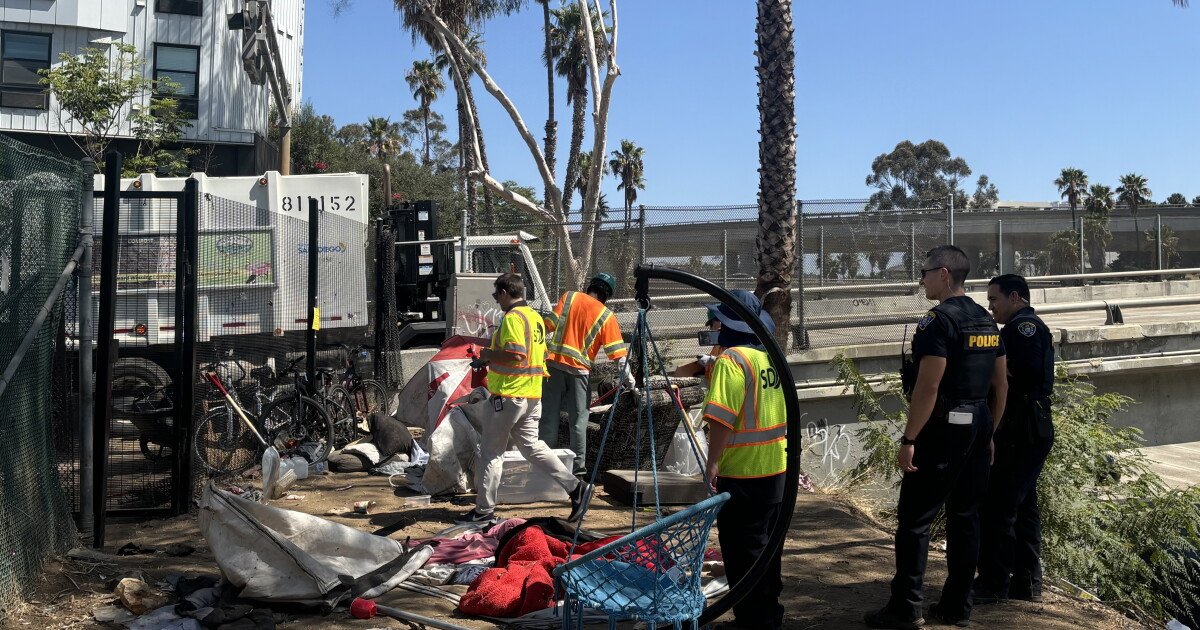
San Diego City crews clear trash during an abatement on July 30, 2026.
When a homeless encampment is cleared, Greene said people will often return after the abatement because they’ve established a community there and it’s what they’re comfortable with. What ultimately helps people experiencing housing instability, he said, is to get them housed and connect them with resources.“There are a lot of people who are one paycheck away, one medical emergency away, one missed bill away from finding themselves in a similar position,” Greene said. “And so I think approaching these things from a place of grace and understanding with an eye towards how to make it so that people can be stable economically and have stable housing is really where all of our intervention should be coming from.”How city abatements workThe abatement crew members are contracted by the city through Urban Corps of San Diego County, a nonprofit for underprivileged youth.They clear everything that’s left from an encampment, which could include handling hazardous materials and impounding bicycles.Crews leave signs with a number to contact for retrieving an impounded bike, Coopersmith said. The city has a system in place to send found IDs to its homeless outreach teams, he added, which will try to locate the individual.Since the agreement started, Coopersmith said fewer fires have occurred along the 5-mile stretch of freeways.“Not only is it a distraction when you know you’re driving by on the freeway, maybe you see a fire up on the other side, and you’re traveling 65 mph,” he said. “You have people that are crossing four, five lanes of traffic, people are trying to merge. They’re not thinking that someone might be on their bicycle, walking their dog across the freeway.”
Police observe an abatement on July 30, 2026.
And now, under the renewed agreement, he said the overall landscape will improve.“Rather than just coming in, removing the trash from the encampment, we can do other things like, if there’s graffiti on the side over there, get rid of that as we do and try to make the whole area look better,” Coopersmith said.The specific areas of freeway that crews attend to under the agreement are 3.5 miles of Interstate 5, four-tenths of a mile of state Route 163 and 1.1 miles of SR-94, all near downtown.Under the new agreement, the city will continue to clear encampments along this stretch of Caltrans property five days a week.Coopersmith said the city has applied for Encampment Resolution Funding from the state and hopes to use that grant money to cover more land.