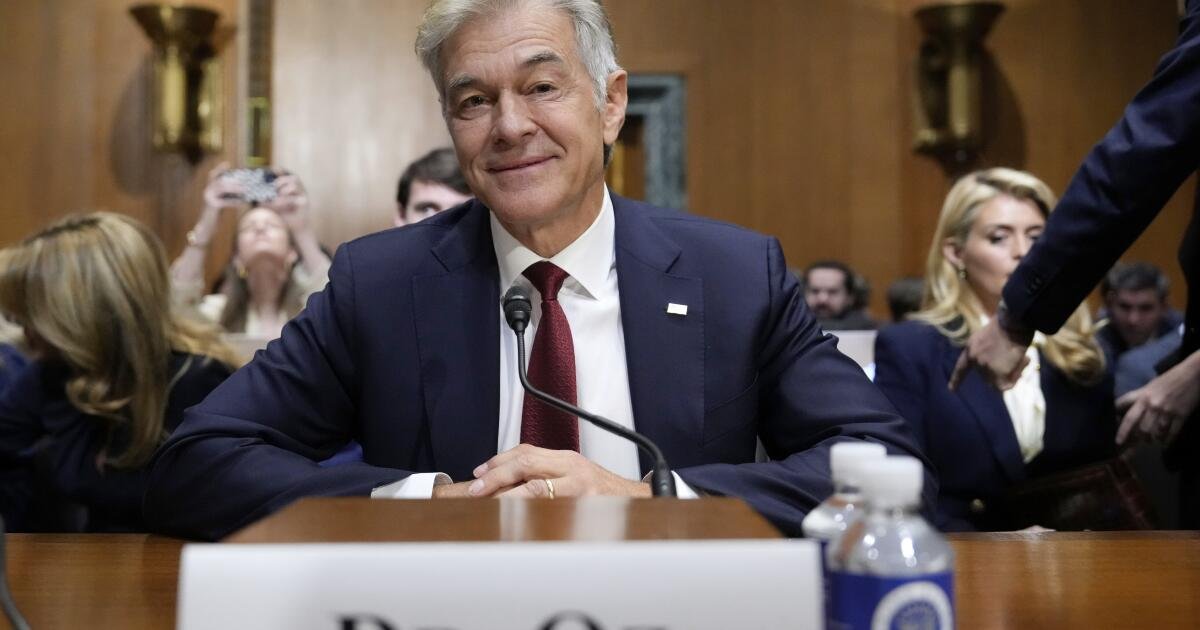
All policy wonks worth their salt know there are a few ways to kill a government program. One is for Congress to abolish it. If the lawmakers aren’t so inclined, a hostile administration can get its way by starving the program of resources or making it harder for people to sign up or stay enrolled.That’s been the Trump White House’s approach to Social Security, Medicaid and Medicare — make them more expensive to use and saddle the beneficiaries with more paperwork and administrative obstacles. The administration has just piled another lead weight on Americans already struggling to manage their increased expenses because of Trump’s Iran war and tariffs: On July 29, Medicare chief Mehmet Oz announced that the government is canceling a subsidy program that kept premiums for the Medicare prescription drug benefit — known as Part D — under control. These are significant cost-shifting burdens for seniors. It’s unfortunate that Dr. Oz and his colleagues can’t appreciate what it means for someone living mostly on Social Security. — Max Richtman, National Committee to Preserve Social Security and Medicare The subsidies were due to continue at least through the end of next year; instead, they will end Dec. 31.This could increase Part D premiums substantially for many of the 23 million Americans enrolled in Part D — even doubling the monthly cost for 11 million or more. Get the latest from Michael Hiltzik Commentary on economics and more from a Pulitzer Prize winner. By continuing, you agree to our Terms of Service, which include arbitration and a class action waiver. You agree that we and our third-party vendors may collect and use your information, including through cookies, pixels and similar technologies, for the purposes set forth in our Privacy Policy such as personalizing your experience and ads. “It’s pretty clear that it’s going to hurt the people who need this protection the most — not Dr. Oz, but the average Social Security and Medicare beneficiary,” says Max Richtman, president of the National Committee to Preserve Social Security and Medicare.Oz said in announcing the change that “premiums will go up by less than $10 for most Medicare recipients, with many even seeing lower premiums.” I’ll unpack those claims in a moment.There isn’t much new about this action. Trump has systematically starved Social Security of funds for customer service, a cynical effort to make this all-important program seem more burdensome to the seniors who rely on it. And with the connivance of Republicans in Congress, Trump has cut the funding for Medicare and Medicaid and — with work requirements and other rules — raised the barriers for enrollment in Medicaid.Here’s the background, starting with how Part D works. Enacted in 2003 and launched in 2006, Part D was conceived as insurance for prescription drugs, including brand names and generics. Like other parts of Medicare, it’s available to those 65 and older.Enrollees can choose from a multitude of plans sponsored by insurance carriers, varying somewhat by the drugs covered and the premiums. The standard benefit encompasses an annual deductible ($590 this year). After the consumer meets the deductible, the insurer covers 75% of the cost of the drugs until the consumer reaches a cap on out-of-pocket spending ($2,000 this year). At that point, the coverage moves into its “catastrophic” stage and the consumer won’t pay anything more for the rest of the year.The subsidies — formally the Part D Premium Stabilization Demonstration — were enacted in 2024 to stabilize premiums in the wake of the Biden administration’s Inflation Reduction Act, which shifted some Part D costs to the insurers. The idea was to give insurers a way to get their arms around their increased costs without passing them back to enrollees. It was legislated to continue for at least three years, through 2027.As Juliette Cubanski of KFF explained, the demonstration worked by reducing the base beneficiary premium for Part D and capping the yearly increase. Last year, when the program began, she wrote, “the base beneficiary premium was reduced by $15, and the monthly premium increase was limited to $35. For 2026, these parameters were scaled back, with a base premium reduction of $10 and a maximum allowable premium increase of $50.” The program, according to the Government Accountability Office, hardly has been a serious drain on the federal coffers. During its two years of operation, it has cost about $9.8 billion — $6.2 billion last year and $3.6 billion this year. As a yearly average, that’s about seven-hundredths of 1 percent of the federal budget. To put it another way, Trump’s $200-billion request for additional funds for his Iran war would cover the subsidy for 40 years. Oz, a millionaire physician and former host of a TV healthcare talk show, explained the early cancellation by asserting that the program already succeeded in stabilizing Part D premiums, and that the subsidies were effectively a “bailout” for big insurers. The administration further claimed that next year, more than half of the subsidy would go to UnitedHealth Group.A couple of points about that. It’s unclear what Oz means in claiming the subsidies have stabilized premiums, since, as Cubanski pointed out, we won’t know the full range of new premiums until the fall. That’s when insurance carriers offering Part D coverage start announcing their rates for next year, ahead of the open enrollment window to sign up for coverage. I asked the Centers for Medicare and Medicaid Services, the agency Oz leads, to explain its reasoning, but didn’t receive a reply. It’s worth keeping in mind, however, that the cost pressures facing prescription drug insurers won’t be ebbing in the near future — the take-up of diet drugs such as Ozempic, which carry price tags of hundreds of dollars a month, is only intensifying, while pharmaceutical companies continue to develop new specialty drugs for cancer and other diseases that can cost hundreds of thousands of dollars a year. Furthermore, calling the subsidy a “bailout” for insurers glosses over the fact that the insurers are almost certain to get their money from somewhere. If they don’t get it from the government, they will from enrollees paying higher premiums out of their own pockets. This amounts to the government getting off the backs of the people so big business can saddle up. As for the flow of money going to UnitedHealth, that’s hardly surprising: UnitedHealth is the nation’s biggest health insurer, and a major participant in Medicare. Buried in Oz’s announcement were the real impacts on enrollees. Given that the average monthly premium for Medicare Part D this year is $36, the premium increase of up to $10 that Oz cited would amount to a hike of nearly 30%. While he said “most” enrollees would be in that cohort, he didn’t define “most”—90%? Or 60%? Or 50.5%? Who knows?What we do know is what the premium increases might have looked like without the subsidies. For last year, the GAO reported, the subsidies reduced premiums by up to $19 a month for more than a third of enrollees, by $20 to $39 for 1 in 5, and $40 to $59 for 12%. In other words, 57% of enrollees — that’s “most” of them — would have paid anywhere from 50% more to twice as much per month if not for the subsidies.Those figures conform to those generated this year by the Medicare Payment Advisory Commission (MedPAC), an advisory panel for Congress, which found that the subsidies reduced average Part D premiums by $26 a month last year and $16 this year. Something like that could be lurking for enrollees next year.What really makes Oz’s claims deceptive is that terminating the subsidies will drive many more Medicare beneficiaries to Medicare Advantage plans, for which the government pays a higher rate than it does for traditional Medicare, fattening insurers’ pockets. Medicare Advantage bundles many services that aren’t covered by the traditional program, such as dental care and health clubs, and its stated prescription premiums are as little as one-fourth of the Part D charges. But Medicare Advantage isn’t for everyone — its beneficiaries give up some flexibility and face tougher approvals for services. It’s popular among insurers, which record higher profit margins for Advantage plans than for traditional Medicare. Indeed, official estimates are that the government pays about $80 billion more annually for Advantage plans than it would if the enrollees received the same services via traditional Medicare. Keep that in mind when Oz grouses about the money the government is funneling to UnitedHealth and other big insurers. He must know that the money paid to them for the Part D subsidies is a pittance compared with what it’s shoveling out for Medicare Advantage.That leaves us with the question of why the Trump administration is bothering to cut the subsidies off. “These are significant cost-shifting burdens for seniors,” Richtman told me. “It’s unfortunate that Dr. Oz and his colleagues can’t appreciate what that means for someone living mostly on Social Security. It’s baffling, coming when the midterms are around the corner. It’s not clear to me how this makes any sense, politically.”