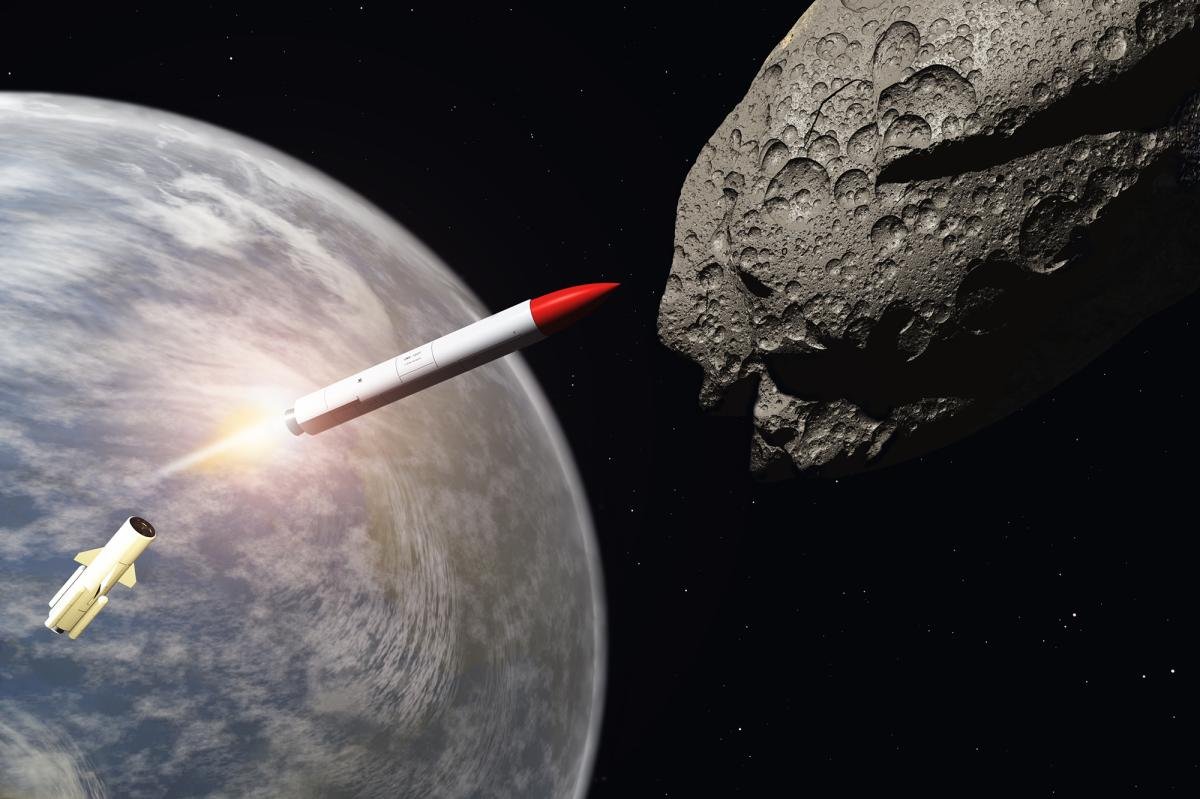
That’s one way to stop the a-rock-alypse.
Chinese scientists have devised an unorthodox solution to stop a potential Doomsday asteroid from destroying Earth — by nuking the space-rock with a force equivalent to multiple Hiroshima bombs.
Seemingly taking a leaf from “Armageddon,” the researchers proposed first drilling deep inside the intergalactic gravelstone and then implanting the nuclear bomb inside this blast crater for detonation.
A television at NASA’s Kennedy Space Center in Cape Canaveral, Florida, captures the final images from the Double Asteroid Redirection Test (DART) just before it smashes into the asteroid Dimorphos on Sept. 26, 2022. AFP via Getty Images
“This study can provide references for the engineering design of defense against large near-Earth asteroids,” wrote the researchers, who hailed from the China Academy of Launch Vehicle Technology in Beijing, The Independent reported.
The somewhat unconventional solution comes amid a rash of near-misses involving asteroids, including a bus-sized space rock that came within 56,000 miles of Earth in May, Vice reported.
NASA scientists have warned that there are as many as 15,000 several hundred-foot -wide asteroids that are small enough to avoid detection but large enough to destroy a city.
With warning times ranging from days to weeks, there’s not enough time for planetary defense systems to deploy proposed countermeasures such as DART — in which NASA used a spacecraft to knock the asteroid Dimorphos off course in 2022.
A mushroom cloud reaches high into the sky during atomic testing in Nevada, circa 1940. (Hulton Archive) Getty Images
Per the latest study published in the journal Space: Science & Technology, the only viable way to nip a Doomsday asteroid in the bud would be via impregnating it with a nuclear device.
To test this atomic solution, the researchers conducted a computer simulation involving hypothetical asteroids approaching Earth at a speed of 6 miles per second.
They then tested how effective different defense measures would be against asteroids of varying sizes, speeds and trajectories.
According to the simulations, a 164-foot asteroid could be obliterated with a 300-kiloton nuclear explosion — the same as around 20 Hiroshima bombs — while a 3-megaton blast could destroy a nearly 1,000-meter one, the South China Morning Post reported.
“This study can provide references for the engineering design of defense against large near-Earth asteroids,” wrote the researchers. dottedyeti – stock.adobe.com
The depth of detonation also played a factor with the researchers finding that installing the nuclear payload around 100 meters deep tripled the change in the rock’s velocity compared to a shallower version.
However, the mission’s success would require the researchers to detect the threat early enough to launch and execute this mission before impact, and also design a vehicle capable of carrying a drilling device and nuclear device into deep space.
Nonetheless, the researchers felt that the study “holds profound strategic significance for enhancing humanity’s capability to respond to asteroid impact threats.”
This wouldn’t be the first time that scientists have proposed nuking an asteroid to Kingdom Come.
This past fall, scientists floated going “Armageddon” on 2024 YR4, a space rock that sparked worldwide concern that it could strike our planet on December 23, 2032, potentially generating enough power to destroy an entire city.
NASA’s Center for Near Earth Objects has since downgraded the likelihood of the space rock striking home to a negligible 0.00081% chance, but upped the chances of it hitting the moon on that date to over 4%.
If this were to happen, the cosmic collision could cause a cloud of shrapnel to impact Earth-orbiting satellites and spacecraft, while displaced matter could fall back to the moon, impeding rovers and even jeopardizing astronauts with the Artemis program.