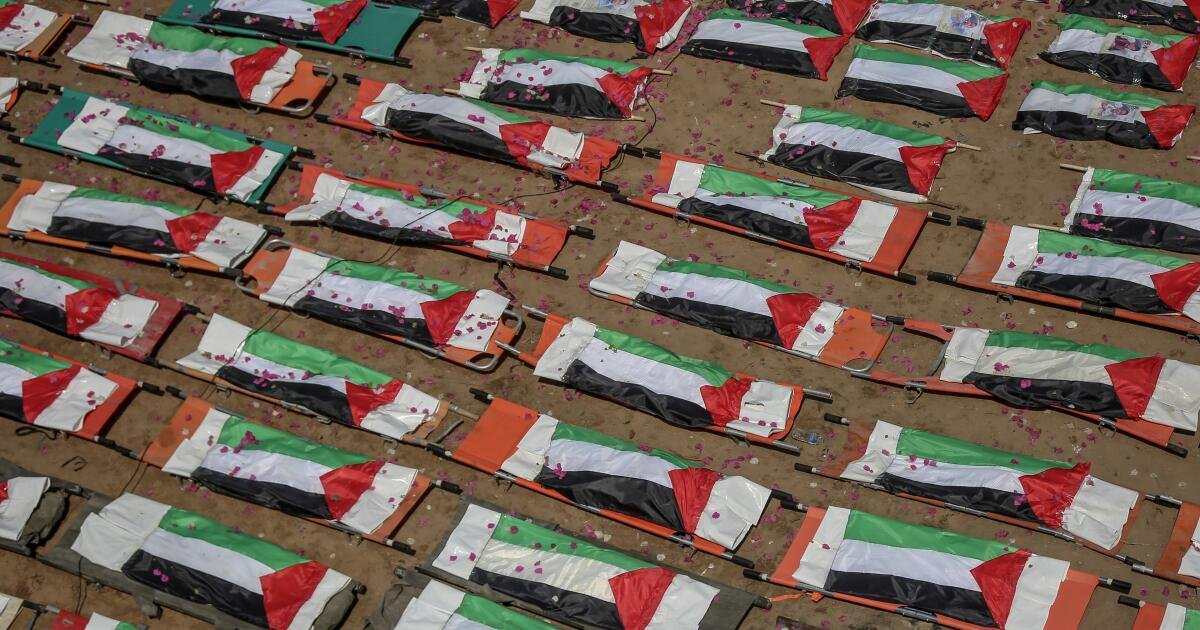
GAZA CITY — For 18 days last month, Palestinian Civil Defense crews searched for the bodies of people killed almost three years ago in the opening weeks of the Hamas-Israel war. This week the remains the crews recovered were finally laid to rest.In Gaza City, community elders, mokhtars, local dignitaries and civil defense crews gathered Tuesday for a mass funeral after the recovery effort that was accomplished with a single excavator and simple hand tools. Before them stood 112 coffins containing bones and fragments of victims from the Abu Sharia and al-Hasayna families, two branches of the same Bedouin clan.Following brief remarks, the funeral procession made its way through the Sabra neighborhood in southern Gaza City. Daily life briefly gave way to the procession. Street vendors paused their work to watch in silence. Women leaned from apartment windows, filming the march on their phones, while others scattered rice and rose petals over the men carrying the coffins. Armed relatives fired repeated volleys into the air, a customary gesture of mourning in many Arab communities.Draped in Palestinian flags, the coffins were carried through streets filled with nationalist songs and chants. Loudspeakers urged the crowd to keep the march peaceful while calling on the international community to deliver justice for Palestinians. The people buried Tuesday died during an Israeli airstrike on Nov. 22, 2023. Israel struck the Gaza Strip after Hamas militants attacked southern Israel on Oct. 7, 2023, killing 1,200 people and taking 251 hostage. The bodies of 112 people were draped in Palestinian flags during the funeral procession through the Sabra neighborhood of Gaza City. As the procession advanced, grieving relatives repeatedly cried, “Allahu Akbar” (“God is Greatest”), their voices rising above the crowd.Those buried Tuesday, including 40 children, died during an Israeli strike on Nov. 22, 2023. It came just weeks after the Oct. 7, 2023, Hamas attack on Israel, which left 1,200 and 251 taken hostage. Ibrahim Abdul Aziz Abu Sharia, 52, said those killed on Nov. 22 included his two brothers, his two sons, two nephews and three grandchildren from the extended family. He said that strikes targeting the Abu Sharia and Al-Hassayneh families have claimed the lives of 308 family members since the beginning of the war.He said no warning was issued by the Israeli military before the Nov. 22 attack. The families believed the location was safe and had therefore gathered in the buildings that were later struck.He also said that Israeli forces prevented residents from reaching the site after the bombing., “Anyone who tried to approach to rescue survivors or recover the bodies came under shelling or gunfire, making rescue efforts impossible,” he said. Palestinian Civil Defense teams search for the bodies of members of the Daghmash family beneath the rubble of their destroyed home on July 9 in the Sabra neighborhood. Yousef Bassam Abu Sharia, 23, attempts to guide Palestinian Civil Defense teams on July 19 as they search for remains of his family in a destroyed building in the Tal Al-Hawa neighborhood of Gaza City. He was not home with his family at the time of the 2023 attack. 1 2 1. A member of the Palestinian Civil Defense recovery team holds a copy of the Koran found beneath the rubble of the Daghmash family home. 2. White sheets cover the bodies of people recovered on July 19 from ruined buildings in the Tal Al-Hawa neighborhood. The bodies were buried after Tuesday’s mass funeral. Tayseer Al-Hassan, 54, a lecturer at Erada International Academy, also recalled Nov. 22. “The first missile hit the home of the family mukhtar, Faraj Abu Sharia. Everyone believed it was an isolated strike, so they fled to another nearby house for safety,” he said. “That house was also bombed.” He said the survivors then moved to the home of former Minister of Public Works and Housing Dr. Mufeed Al-Hassayneh, believing it would be safe because its owner was a U.S. citizen.“People thought the house would somehow be protected. Around 300 people gathered there. Moments after they entered, the house was struck by about nine missiles. Within seconds, the entire residential block disappeared,” Al-Hassan said.He said that anyone who attempted to approach the site to rescue survivors or recover bodies came under renewed attack. “No one was able to get close, and the massacre unfolded before the eyes of the world,” he said. Member of Al-Hassan’s family also died. “I lost my two brothers, my sister, my father, and their families in that place,” he said. One of his brothers left behind a family of seven, the other a family of five, while his sister had four family members with her. 1 2 3 1. Palestinian Civil Defense teams work with basic and limited equipment to search beneath for bodies in the rubble of bombed out buildings. 2. A Palestinian Civil Defense worker climbs onto a piece of heavy machinery to assist the operator in directing the recovery effort in the Tal Al-Hawa neighborhood on July 19. 3. Issam Hassan Daghmash stands on the rubble of his destroyed home on July 9. Issam was inside the house when it was struck, but Civil Defense crews rescued him and his wife from beneath the debris. Thirteen of his relatives were killed in the strike. He added that during the efforts to recover remains in July, some victims’ remains could not be fully identified. “In some cases, we could not even find bones or skulls. The force of the explosions was so great that there was almost nothing left of some bodies,” he said. Among those buried Tuesday were 38 women and 40 children, according to the Gaza Health Ministry. Describing the recovery of the remains, he said: “Our feelings were a mixture of grief and relief. Relief because we were finally able to recover our loved ones and bury them with dignity, giving them a grave where we can visit them and recite Al-Fatiha [the first chapter of the Quran]. But the pain and heartbreak remain overwhelming.” He added that his family’s experience is not unique. “We are not an exception. Families throughout Gaza have endured similar massacres and tragedies.” 1 2 3 1. After the funeral ceremony, the 112 bodies were taken to a nearby cemetery for burial. 2. During the funeral procession, some mourners shoulted, “Allahu Akbar!” or “God is great.” 3. Relatives of the victims scatter flower petals from a damaged building as the procession passes below. Asked about the most painful scene he witnessed during the recovery operation, he recalled the discovery of a mother and an infant, a scene that left everyone in tears. “When volunteers recovered her body,” he said, “she was still holding her baby, Jana, in her arms.” Shbeir is a special correspondent. The funeral procession and burial for the 112 killed drew hundreds to the Sabra neighborhood in Gaza City.