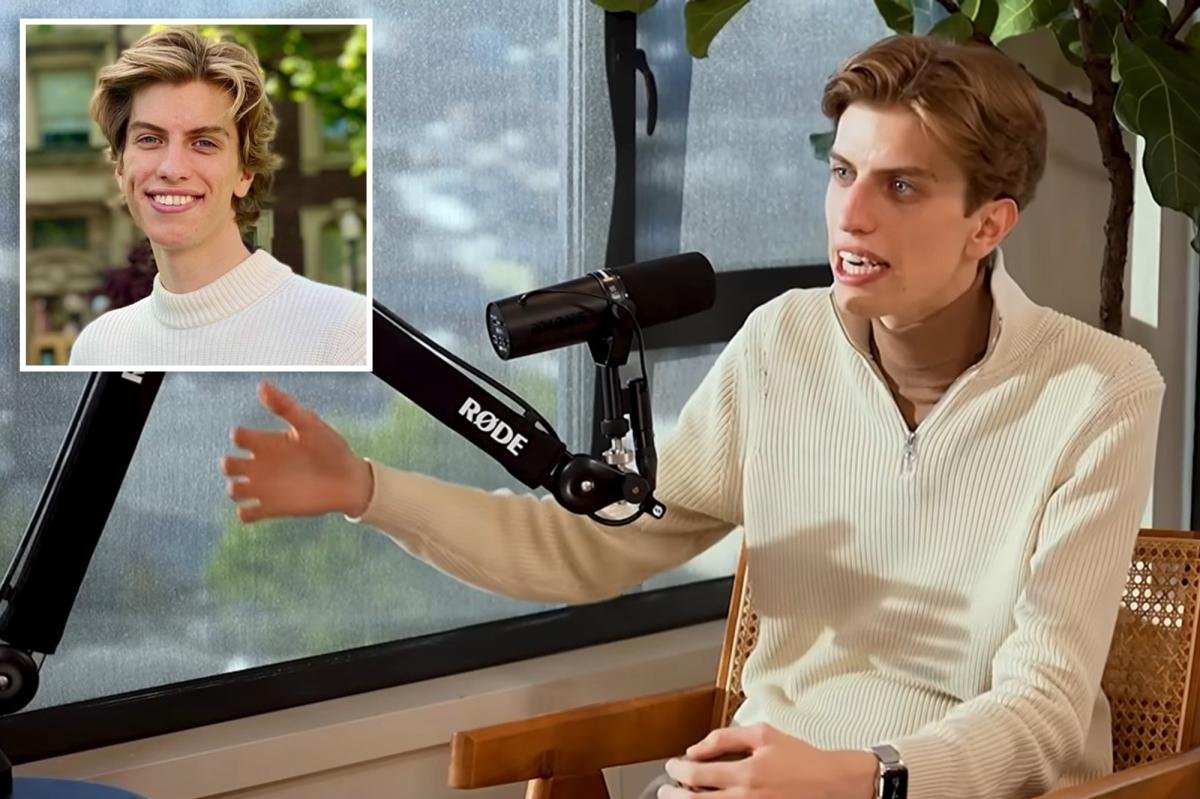
AI investing wunderkind Leopold Aschenbrenner is already placing big bets again, less than a week after his much-watched hedge fund Situational Awareness saw a spectacular blow-up.
For those who have followed the “Nostradamus of AI’s” career, that comes as no surprise.
The 24-year-old former OpenAI researcher recently made a $400 million investment in a privately held company, Bloomberg reported Thursday. The business was not named.
The move came just days after Aschenbrenner was forced to unload most of the public-stock portfolio at his AI-focused hedge fund, Situational Awareness, after a brutal selloff in semiconductor and infrastructure stocks triggered crushing margin calls.
Leopold Aschenbrenner, 24, is seen in an undated LinkedIn photograph. Linkedin/Leopold Aschenbrenner
But the fund is still in business, has eliminated its leverage and maintains control of an estimated $10 billion in assets, including a multibillion-dollar stake in AI giant Anthropic, according to reports and regulatory filings.
And, despite losing about 67% of its portfolio value in July, Situational Awareness remains sharply ahead for the year because of its extraordinary first-half gains.
Aschenbrenner’s new bet shows he has no intention of slowing down.
Meanwhile, Wall Street has been asking whether Aschenbrenner’s biggest mistake was his bullish bet on artificial intelligence — or simply borrowing too much money to make it.
“The scissors of leverage cuts both ways,” Derek Reisfield, co-founder and former chairman of MarketWatch, told The Post.
“It’s great while things are going up, as it magnified returns, but it kills you if things go down, especially if you then get margin calls you cannot cover.”
Young prodigy
Just weeks ago, the young “Nostradamus” — who got the nickname from podcaster Tim Ferriss — looked unstoppable.
The brainy German native known for enjoying Rubik’s cubes had graduated from Columbia University at just 19. An early adherent to Sam Bankman-Fried-style “effective altruism,” Aschenbrenner went on to work briefly for SBF’s FTX Future Fund. The wunderkind also did a stint at OpenAI, where he was part of the wonky “superalignment” safety team but reportedly got fired for leaking info the firm considered sensitive to the spouse of an exec at rival Anthropic.
Aschenbrenner recent wed Avital Balwit. X/@AvitalBalwit
After leaving OpenAI in 2024, he launched Situational Awareness in San Francisco with a few hundred million dollars and no prior investing experience.
The firm was named after his 165-page June 2024 manifesto in which he argued that artificial general intelligence would arrive far sooner than most people expected and trigger an unprecedented boom in semiconductors, data centers, memory chips and power infrastructure.
“Before long, the world will wake up. But right now, there are perhaps a few hundred people, most of them in San Francisco and the AI labs, that have situational awareness,” Aschenbrenner wrote.
“Perhaps they will be an odd footnote in history, or perhaps they will go down in history like Szilard and Oppenheimer and Teller. If they are seeing the future even close to correctly, we are in for a wild ride.”
That thesis drew Aschenbrenner a cult following — and jaw-dropping returns.
Leopold Aschenbrenner speaks with Dwarkesh Patel on his podcast in a video posted to YouTube on Tuesday, June 4, 2024. YouTube/Dwarkesh Patel
The fund reportedly returned 439% in the first half of this year, helping attract billions of dollars in investor capital and swelling to more than $20 billion in investor assets before last month’s selloff.
Regulatory filings show the portfolio became heavily concentrated in companies tied to the AI buildout, including semiconductor firms, cloud infrastructure providers and energy companies.
Aschenbrenner appeared to enjoy the fruits of his labor, moving to a mansion in San Francisco’s upscale Nob Hill neighborhood, according to the Wall Street Journal. He and his friend Dwarkesh Patel, a podcaster, hosted happy hours at Situational Awareness HQ.
‘Playing with dynamite’
However, when AI infrastructure stocks tumbled in July, the same concentration and borrowed money that had powered the fund’s earnings magnified its losses.
As collateral values fell, Goldman Sachs demanded Situational Awareness pay back some of its loans, the New York Times reported, citing two bankers who were involved.
To come up with the cash, Aschenbrenner scrambled to dump much of its public-equity portfolio.
Citadel ultimately acquired most of those holdings in a distressed transaction, allowing the fund to extinguish its leverage and stabilize what remained.
Balwit is an AI researcher, writer, and executive best known as chief of staff to Anthropic CEO Dario Amodei. Instagram/@avital.balwit
Reisfield likened the situation to Long-Term Capital Management, the legendary hedge fund whose Nobel Prize-winning founders were ultimately undone by excessive leverage after markets moved against them.
“The kids were playing with dynamite,” he said of Aschenbrenner. “They just didn’t know it.”
Aschenbrenner struck a regretful note while vowing to “fight another day.”
“We let you down this month,” Aschenbrenner wrote investors Friday after the selloff. “While we ultimately found a solution that protected the fund and you as investors, our intention in running the fund is to never find ourselves in such a position in the first place.
“Volatility is the price of long-term investment returns.”
Aschenbrenner seemed to show a certain sangfroid over the weekend — getting married to Anthropic CEO Dario Amodei’s chief of staff Avital Balwit in the thick of his firm’s near-implosion. Dozens of Silicon Valley bigshots, many of them Situational investors, came to the party at a Tuscan-style villa in the seaside town of Carmel, Calif.
They quaffed Napa Valley wine while a DJ spun a set reminiscent of notorious Berlin club Berghain, a nod to Aschenbrenner’s roots.
Comeback kid?
On the finance front, rather than liquidating everything, Situational Awareness retained its private investments, including a reported $5 billion stake in Anthropic.
That may have been possible because of the way the fund was structured, according to Fabio Savoldelli, a former head of Merrill Lynch’s alternative investments group and an adjunct prof at Columbia Business School.
Savoldelli told The Post that Situational Awareness’s investor lockups meant clients generally could not immediately withdraw their money, giving Aschenbrenner room to sell liquid public stocks while hanging on to illiquid private holdings like Anthropic instead of dumping them in a fire sale.
Leopold Aschenbrenner’s AI-focused hedge fund, Situational Awareness, lost about 67% in July after a leveraged bet on AI infrastructure unraveled, but the firm remains in business with billions in remaining assets. Columbia College
“He’s basically traded his liquid assets in return for being able to hang on to his illiquid assets,” Savoldelli said, adding that the fund’s lengthy redemption restrictions made a broader run on the portfolio far less likely.
“He doesn’t have to give you back anything until 2028.”
Holding on to Anthropic is key to any comeback.
The fund reportedly explored selling part of its position in the OpenAI rival during the liquidity crunch, but ultimately held on to it.
Remarkably, Situational Awareness is still well in the black for the year in spite of its sharp losses in July.
Leon Metzger, a hedge fund industry expert witness who reviewed Aschenbrenner’s investor letter, said that distinction matters.
“From a strict operational standpoint, if a fund has not been liquidated, it has not collapsed,” Metzger told The Post, while acknowledging that others may reasonably view such severe financial distress differently.
Ken Griffin, chief executive officer of Citadel Advisors in Oslo, Norway, on April 28. (Bloomberg) Bloomberg via Getty Images
“Notwithstanding the July losses, a year-to-date net gain of 80% is very, very impressive,” he added.
Whether Aschenbrenner himself remains a billionaire is less clear.
His personal ownership stake, accumulated performance fees and investment in the fund have never been publicly disclosed, making it difficult to determine the true size of his fortune.
“Ultimately, the core valuation comes down to two questions: What is the current market value of his holdings, and what liabilities are tied to financing those positions?” Metzger said.
For now, Aschenbrenner’s reputation as one of AI’s boldest believers has survived much the same way his fund has: battered and dramatically smaller, but far from gone.
Aschenbrenner and Goldman Sachs did not return requests for comment.