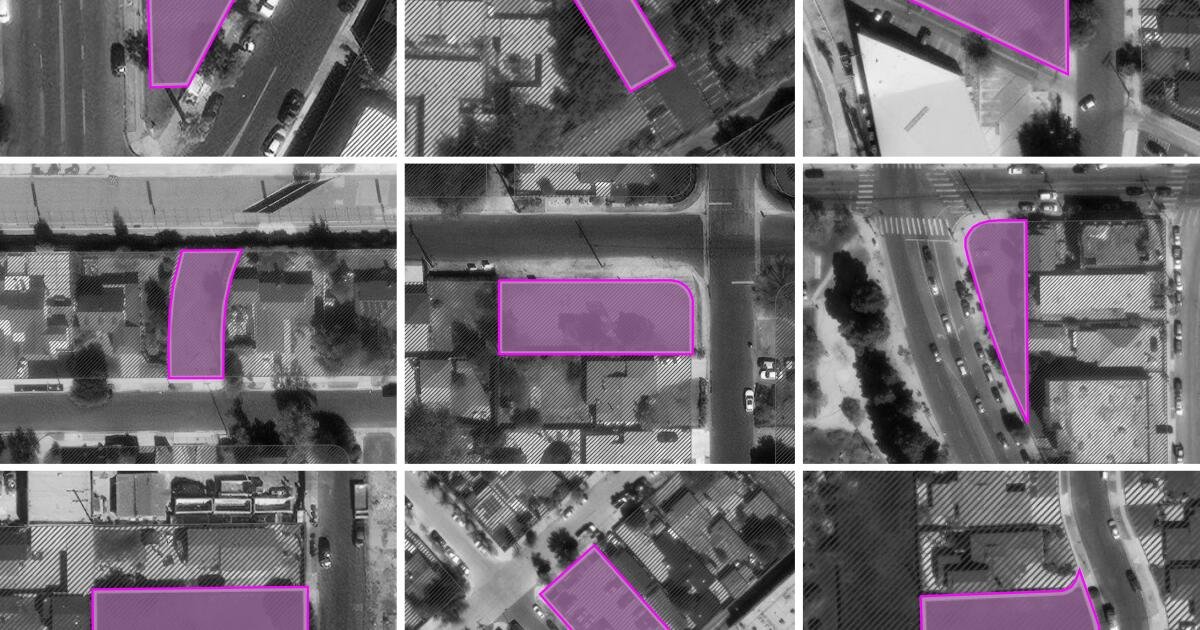
It is perhaps one of the biggest contradictions of Los Angeles’ housing crisis.How can a city where homes are in such short supply and financially out of reach for so many have more than 20,000 lots that are zoned for housing but remain vacant?It’s been a long-missed opportunity, but one that some housing experts hope could now create a fresh wave of attainable homeownership.A newly launched novel experiment aims to demonstrate how these vacant lots, while small, can be transformed into thoughtfully designed “gentle density” housing — such as duplexes, fourplexes and townhome communities — to be sold at more reasonable prices than L.A.’s long-venerated single-family home. “There hasn’t been a new generation of starter homes since post WWII. How do we get back to that?” said Dana Cuff, director of UCLA’s cityLAB, which is spearheading this phase of the “Small Lots, Big Impacts” initiative, focused on turning vacant, privately owned parcels into affordable homeownership opportunities.Small-scale, multiunit housing has been a mainstay of L.A. architecture for more than a century — from grand Spanish Colonial duplexes in places like Carthay Circle to tidy courtyard apartments and boxy mid-century “dingbat” complexes across Hollywood and the Fairfax District. Courtyard apartments are among the many small-scale multiunit formats found in the L.A. area. (Carolina A. Miranda / Los Angeles Times) But such small-scale housing options have typically been offered as rentals, or sometimes as high-end listings in some of the city’s most desirable neighborhoods. In recent years, L.A. has held some of the lowest rates of homeownership in the state, which already falls well below the national average. Until recently, almost three-quarters of the city’s residential areas were zoned only for single-family homes. But with recent legislation that upended zoning laws across the state, many more lots — including vacant ones — are now open for development of small-scale complexes, each of which can be sold individually. This, proponents say, presents an opportunity to develop reasonably priced homes for sale, particularly in communities that may not have many mid-density buildings. Affordable homeownership is “a big hole in the market,” said Emmanuel Proussaloglou, co-director of cityLAB. “If we do this right, hopefully this is going to be the first step in making that available.”Los Angeles has famously struggled to build enough housing to keep up with demand. While some areas like downtown have seen a surge of new units over the last decade — mostly large-scale, high-rise apartments — many other neighborhoods haven’t kept up. Often, proposals for new developments have faced pushback from resident groups.But backers of this initiative believe they can find success by focusing on smaller lots that can take on slightly more density than a single-family home, or even one with an accessory dwelling unit, without changing the fabric of a neighborhood. A rendering shows one of the winning teams’ designs for middle-density residences, which they plan to build on one of the thousands of vacant lots in L.A. (West of West) “If we can figure out a way, through this project, to build five, six, 12 units [on lots] that could otherwise hold one or two … that seems to be a really sustainable way to build housing in L.A.,” Proussaloglou said. CityLAB’s analysis found more than 20,000 privately-owned vacant lots primed for such projects. Its search included parcels already zoned for residences that are a quarter-acre or smaller and don’t have any existing structures, he said. “It’s a pretty incredible number,” Proussaloglou said. He pointed out that these lots account for only about 2% of all privately owned parcels in L.A., but still, they “can have a big impact.” This week, the “Small Lots, Big Impacts” initiative announced the three designer-developer teams that will bring to life pilot versions of these “multifamily, attainable homeownership projects … to lead the missing middle revolution in Los Angeles,” according to a news release. The teams are expected to build their unique housing complexes — each with at least five separate units — on a small, privately owned, empty lot within the city. Small-scale, multiunit housing has been a mainstay of L.A.-area architecture for more than a century, including “dingbat” apartment buildings like this one in Inglewood. (Los Angeles Times) The program will provide some financial and regulatory support, including a low-interest loan to fund each project from community development group Genesis L.A. The teams are all required to list the homes for sale, with a percentage reserved below market rate for low- or middle-income buyers. The effort is also receiving support from private-public alliance group LA4LA, the city of L.A. and BMO bank.The goal is to model — both to developers and potential buyers — how these lots can provide the space to bring the now-defunct starter home into the 21st century. “We’ll demonstrate that it is feasible at lower entry prices,” Cuff said. “This system both creates more potential housing units and provides a type of flexibility in the housing stock that’s incredibly attractive,” such as access to outdoor space, a built-in community and some individuality. This cityLAB initiative started last year with looking at city-owned, small, empty lots, with a similar mission of building multiunit starter homes. That effort is ongoing, Cuff said, but it’s taken longer than expected to get off the ground, which prompted the team to shift attention to privately owned lots. A small, empty lot in Los Angeles that housing experts would like to see transformed into mid-density housing that can be sold as a new generation of starter homes. (Robert Gauthier / Los Angeles Times) Christian Stayner, founder and principal at Stayner Architects, is helping lead one of the three teams selected for the initial pilot projects. For years, Stayner and his colleagues have thought about developing an almost 6,000-square-foot lot they own on L.A.’s Eastside that’s currently used for storage. But the large financial risk, on top of regulatory hurdles, kept them from making the jump.Now, with support from cityLAB and Genesis L.A., and with legislative changes that eased the construction of such mid-density projects, he feels they finally have the right footing — and space creatively — to move ahead. He hopes it could inspire other similar projects.Their design, if all goes according to plan, will include one building with six separate units, all individually owned. The two other teams supported by the program, which both need to acquire a vacant lot for their projects, offer slightly different visions for their complexes. One plans to use an alternative homeownership model, such as a shared cooperative structure, and the other wants to expedite building by utilizing prefabricated construction materials. A rendering of one of the winning teams’ designs for middle-density residences. (Frolic Corvidae Co-Op) That variety is the goal of this pilot project, Cuff said. “It’s kind of a Noah’s Ark for the next generation of L.A.,” she said. “As other developers and designers try to lay out their own versions, they’ll be able to see three different ideas about how to move forward.”Program officials expect the three teams to break ground before next summer.