The Jarvis children “used to be strong, but then she had to push them up the steps,” according to building superintendent Dennis Rivera. “They couldn’t climb.” It’s been more than a week since Geneva Jarvis, 36, and her mother, Denise Jarvis, were charged with the murder of Geneva’s 16-year-old son Adonis. The nonverbal autistic teen weighed only 59 pounds when he was brought to The Bronx’s Lincoln Hospital in March, according to authorities. His twin brother, who suffered from the same disabilities, was only 60 pounds, but managed to survive.
With the sadly unsurprising reports that the family has been on the radar of the Administration for Children’s Services since at least 2014 (when cops say ACS investigated an allegation that their mother was failing to give the boys seizure medication to treat their epilepsy), it is time for the public to demand transparency from the agency responsible for protecting abused and neglected children.
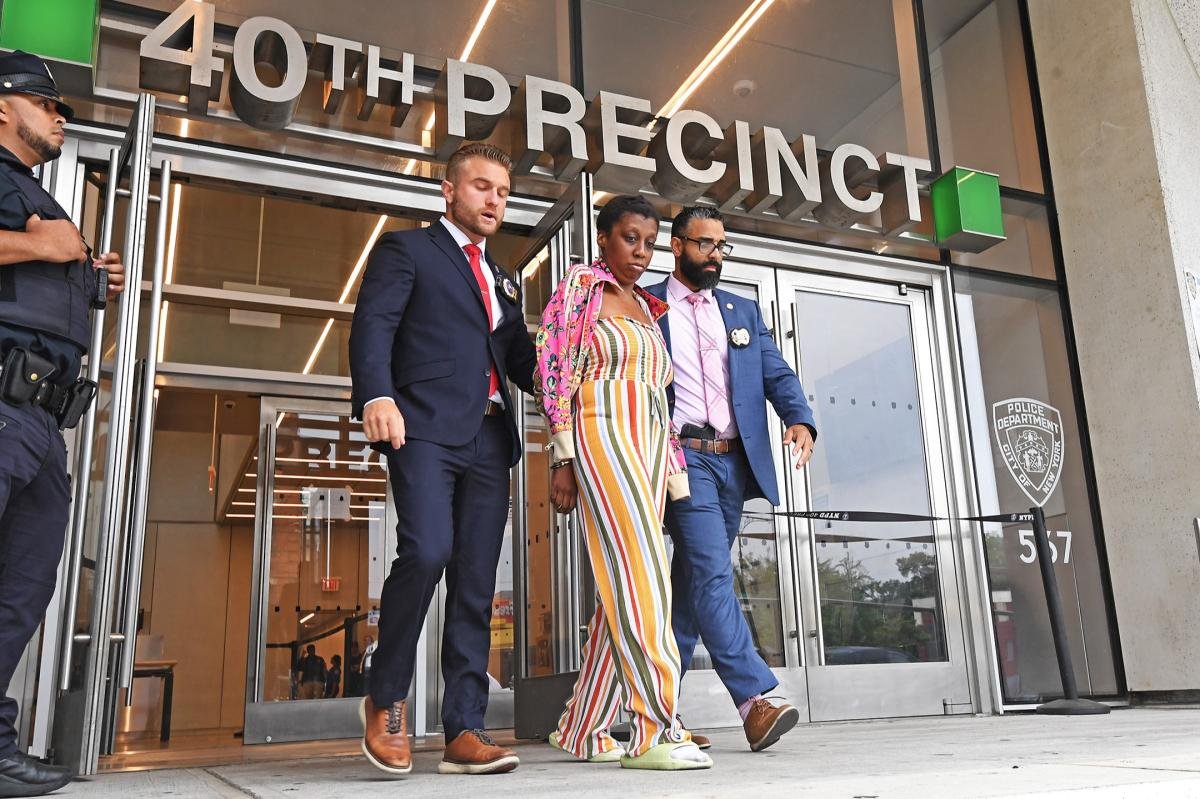
Geneva Jarvis is walked out of the 40th Precinct by NYPD detectives after she and her mother, Denise Jarvis, were arrested for child abuse on Thursday, July 30, 2026, in the Bronx. Matthew McDermott for NY Post
Governor Hochul has astonishingly failed to sign legislation that would allow the Department of Investigation to get more access to ACS records in cases where there has been a fatality or where workers have been accused of sexual abuse.
But the time has come for bolder action. The state should consider a tool that has been used to shed light on the actions of other government agencies — body-worn cameras.
The demand for bodycams on police officers began in earnest in 2014 after the shooting of Michael Brown in Ferguson, Mo., and has steadily increased since then. As of 2023, 82% of police departments used them. In recent months, there has been a growing call for bodycams on ICE agents as well. Front-line workers in Child Protective Services are performing a law-enforcement function and they too should be added to this list.
More From Naomi Schaefer Riley
Inside apartment #6 at 527 E. 127th St., the home of mother Geneva Jarvis and grandmother Denise Jarvis, on Thursday, July 30, 2026. The two women were arrested by NYPD detectives for neglect and child abuse of their son and grandson. Matthew McDermott for NY Post
Just as with police officers, there are always conflicts when child-protective services show up to investigate a report of child abuse or neglect. Were the workers respectful? Did they follow proper procedure. A lawsuit against ACS filed in 2024 charged that its workers were routinely performing unnecessary strip searches on children.
As much as I think child-protective service workers are undertrained or just incompetent, I am skeptical of such sweeping claims. But by all means, let’s look at the video.
Bodycams for police have not revealed much in the way of system-wide bias or corruption, but they have shed light on individual incidents and ensured that officers are held accountable or exonerated in accordance with the evidence.
There is also potential for bodycams to improve practices throughout the child-protection system. Agencies throughout the country are understaffed — some report a 40% turnover rate. Training includes too much on reducing racial disparities in child welfare and not enough on how to actually conduct a real investigation.
New York State Governor Kathy Hochul speaks at a press conference in the Bronx, New York, on Tuesday, August 4, 2026. Hochul, New York City Mayor Zohran Mamdani and New York City Schools Chancellor Kamar Samuels announced that more than 2,000 children had received offers to join the city’s inaugural 2-K class. (Copyright Notice: Copyright (c) 2026 Splash News. No use without permission.) Andrew Schwartz / SplashNews.com
One state child-welfare leader recently told me that she asked a worker why she didn’t ask more questions of a family later found to be engaged in severe maltreatment. “That seemed nosy,” the worker told her. Can you imagine a police detective giving a similar response?
Being a frontline worker for a child welfare agency is a hard job — going into potentially dangerous environments, asking hard questions, gathering relevant evidence. Bodycams would show that we are not equipping workers with the right skills.
They would also show the public some of the disturbing circumstances that CPS workers regularly encounter. We have now seen the pictures of the Jarvis home piled high with debris. Authorities say Adonis was found covered in flies and feces. The superintendent says that hundreds of pounds of clothing have been removed from the apartment.
But what did this apartment look like 12 years ago when investigators first came by? Or during another visit seven years later? How did Geneva and Denise Jarvis act then? Did they ask for help or did they behave as if they were suffering from mental illness or engaged in substance abuse (as the vast majority of the parents in these cases are)?
The inside of apartment #6 at 527 E. 127 St., the home of mother Geneva Jarvis and grandmother Denise Jarvis, is seen on Thursday, July 30, 2026. Both women were arrested by NYPD detectives for neglect and child abuse of their son and grandson. (Matthew McDermott) Matthew McDermott for NY Post
It is not uncommon these days to hear that the children investigated by ACS are simply suffering from poverty, not neglect. Indeed, educators in New York City schools have actually been discouraged from reporting families to ACS, and should instead offer to “support” them. (Which apparently is what happened in the case of the Jarvis family.) But if these teachers and administrators could see what was going on in many of these homes, they would report families to the state’s child abuse hotline immediately.
Bodycams would show the public what neglect really looks like. One child welfare leader recently told me that her investigators actually have a separate pair of shoes for work because they so often encounter human and animal feces on the floor of homes they visit. People who are just poor may not have all the resources we would like them to, but the idea that any sane, sober person would have a home littered with excrement simply beggars belief.
Bodycams would allow New Yorkers to see that there are parents of young children behind closed doors behaving in the same unpredictable, crazy and violent ways as the city’s homeless population on the streets. And they would see ACS workers pretending everything is just fine.
Naomi Schaefer Riley is a senior fellow at the American Enterprise Institute.