It’s a viral theory made true.
A DNA analysis of mummies in Chile has confirmed the longstanding theory that European colonists brought smallpox to the Americas, unleashing a plague that decimated native populations, per a study in the journal Science.
“We interpreted this as the first direct molecular evidence of smallpox introduction into the Americas through European colonization,” said study author Shigeki Nakagome at Trinity College Dublin, Ireland, New Scientist reported.
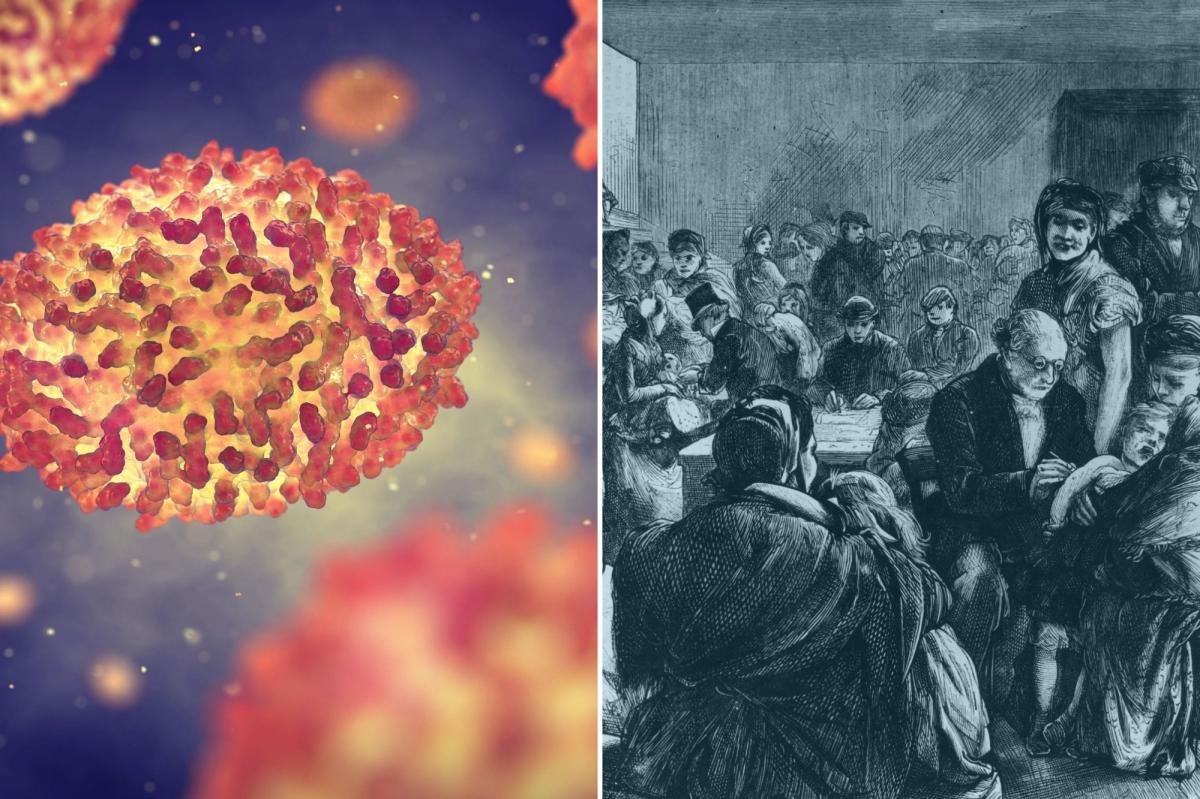
Smallpox, also known as Variola, was an infectious disease caused by the Variola virus. nobeastsofierce – stock.adobe.com
Defined by scarring pustules that break out over the skin, the virus was one of the deadliest diseases in history before being eradicated in 1980 with the advent of vaccination.
Historians credited the infection with killing 95% of the Americas’ indigenous inhabitants, paving the way for their conquest at the hands of Europeans, according to historian Matthew Ward of the University of Dundee, Smithsonian Magazine reported.
Now, Nakagome and his team have found evidence of this inadvertent bioweapons campaign after revisiting bone samples collected from a repository at Camarones in northern Chile.
Gene analysis of the mummified skeletons of two people — a 30- to 35-year-old woman and an 18- to 20-year-old man interred at the site during the Spanish colonial period — revealed traces of ancient smallpox that were similar to the European strains.
This marked the first evidence of the disease in that region.
Pontiac, of the Ottawa tribe, confronts Colonel Henry Bouquet in 1764. Bouquet authorized his officers to spread smallpox among Native Americans by deliberately infecting blankets after peace talks. Getty Images
A 16th-century Aztec drawing of smallpox victims. Wikimedia Commons
It would also help explain the lesions found on the mummies, which had previously been attributed to arsenic exposure.
By dating the remains, the researchers deduced that the pair died from the disease between 1492 and 1631, bolstering theories that the disease originated with the Spanish, who killed the Inca emperor in what is now Peru in the early 1530s.
“Nobody would ever question that smallpox came to this hemisphere from colonization, but this proves it,” Patricia Foster, a biologist at Indiana University who was not involved in the research, told the Associated Press.
The exact source of the epidemic is yet unclear, as European settlers arrived in waves, with Christopher Columbus sailing the Caribbean in 1492 while Amerigo Vespucci explored the South American coast 10 years later.
Also unclear is whether these diseases, which the natives had no defense against due to their lack of exposure, were spread deliberately or accidentally like a historical bioterror campaign.
Either way, “without these epidemics, colonization of the Americas would have been very different,” said Ward.