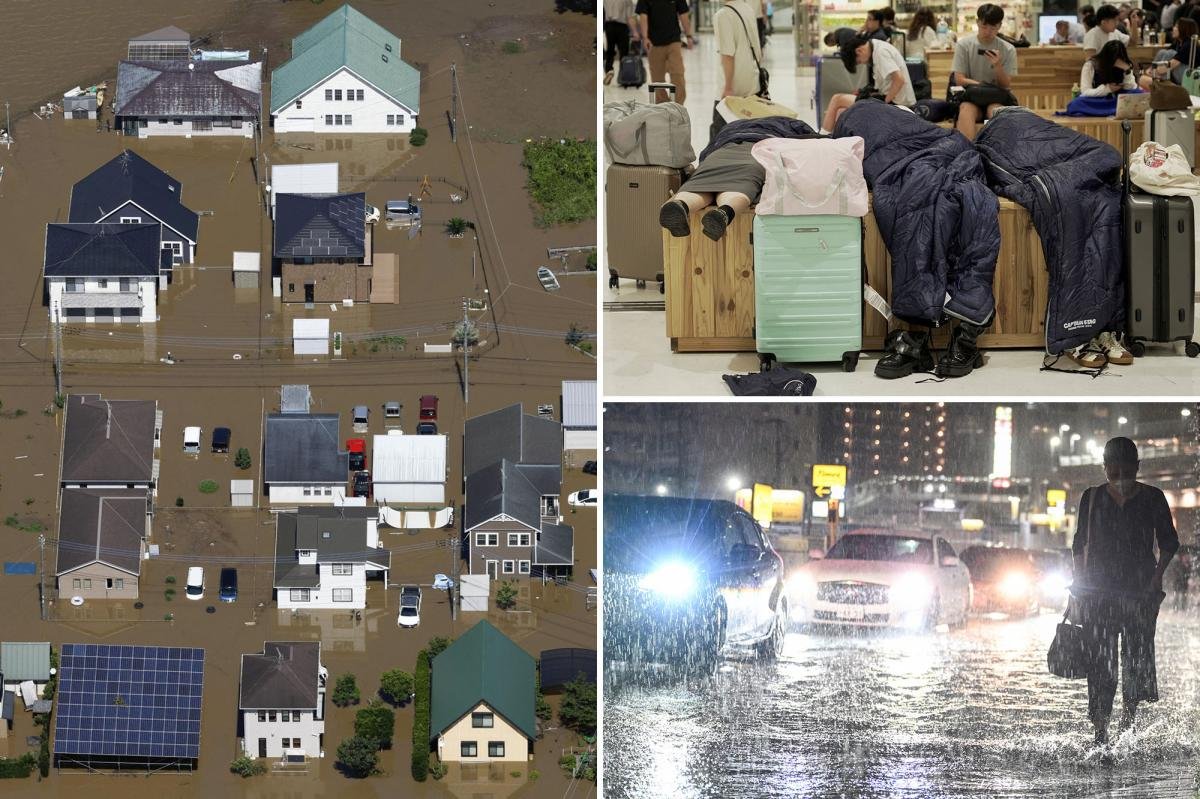
A wall of record-breaking rain has turned roads into rivers east of Tokyo, killing at least eight people and leaving more than 10,000 travelers and commuters stranded across Japan’s Chiba prefecture.
Around 7,000 people were forced to sleep inside terminals at Tokyo’s Narita International Airport after floodwaters severed rail and road connections during one of Japan’s busiest holiday travel periods.
Emergency workers could be seen handing out sleeping bags, water and food as families bedded down across crowded departure halls on Thursday night.
Among the eight people who have died in the flooding was a man believed to be in his 60s or 70s who was found floating on a flooded road in Ichikawa.
An aerial view of a flooded area after heavy rain is seen on Friday, August 14, 2026, in Oamishirasato, Chiba Prefecture, Japan. via REUTERS
A 66-year-old woman also died after becoming trapped inside her submerged car in Sakura, while other victims were found in flooded vehicles or collapsed on streets across the prefecture.
The scale of the downpour was extraordinary even by the standards of disaster-prone Japan, with over 14 inches of rain falling within 24 hours in parts of Chiba.
Chiba city recorded 4.5 inches in a single hour on Thursday evening, followed by more than 7 inches over three hours and 11.5 inches in six hours.
All three totals smashed local records dating back to 1966.
Local residents walk in a flooded area after heavy rain on Friday, August 14, 2026, in Oamishirasato, Chiba Prefecture, Japan. REUTERS
“This case was an extremely unusual situation, even by Japan’s historical weather standards,” Chiba Governor Toshihito Kumagai said.
“I have responded to many disasters in the past, but I have never experienced a case like this.”
Almost 230,000 residents were urged to seek safer ground as floodwaters poured through streets, swallowed cars and entered homes.
Abandoned cars are seen partially submerged on a flooded road in Sakura, Chiba prefecture, on Friday, Aug. 14, 2026. AFP via Getty Images
A man cleans up a restaurant flooded by heavy rain a day earlier in Chiba near Tokyo, Japan. JIJI PRESS/EPA/Shutterstock
An early damage count found more than 80 homes had been flooded, but authorities warned the true figure was likely to rise as emergency crews reached more of the affected areas.
The rain knocked out power to about 68,000 households at its peak.
Roughly 23,000 remained without electricity on Friday morning.
Japan’s Meteorological Agency issued its highest Level 5 heavy rain warning across 22 Chiba municipalities as the deluge intensified, along with its most severe landslide warning in six areas.
Passengers queue to enter the train information centre station after train lines and public transportation services were suspended due to heavy rain at Narita International Airport in Narita, Japan, on Friday, August 14, 2026. REUTERS
People stranded by heavy rain rest at Narita International Airport in Narita, Japan, Friday, August 14, 2026. REUTERS
Those warnings were downgraded to Level 4 shortly after 5 a.m. on Friday as the worst of the rain eased.
However, forecasters warned that the atmosphere remained highly unstable and further intense thunderstorms were possible later in the day.
Waterlogged ground and swollen waterways also meant even comparatively modest rainfall could trigger fresh flooding or landslides.
Start your day with all you need to know
Morning Report delivers the latest news, videos, photos and more.
Thanks for signing up!
At Narita, the airport company said approximately 7,000 people remained inside the terminals at 4 a.m. after buses and trains linking the airport with central Tokyo were suspended.
“I never thought I’d spend the night at the airport, but it is what it is and we are learning,” one stranded traveller told Japanese broadcaster NHK.
People sit on the floor at Chiba station as some railway lines are still suspended on Friday, August 14, 2026, in Chiba, Japan. FRANCK ROBICHON/EPA/Shutterstock
“We’re never going to forget this trip.”
Rail links began reopening in stages on Friday morning, although delays, cancellations and long queues continued.
Flights were operating broadly as scheduled, with Japan Airlines warning that some services could be delayed but saying no widespread cancellations were expected.
A signboard announcing suspended train services caused by heavy rain is seen at the Narita International Airport in Narita. REUTERS
The chaos extended far beyond the airport.
More than 4,000 people spent the night inside JR Soga station after surrounding streets were submerged by water that reached as high as an adult’s waist.
As many as 1,700 other people took shelter inside the Chiba prefectural government building and a neighbouring government facility, while 11 temporary accommodation sites were opened across Chiba city.
Among the eight people who have died in the flooding was a man believed to be in his 60s or 70s who was found floating on a flooded road in Ichikawa. via REUTERS
Weather experts said the disaster was caused by a rare combination of cold air high in the atmosphere, an enormous supply of warm, moist air and converging winds over Chiba. AFP via Getty Images
Dozens of abandoned vehicles remained scattered across flooded roads on Friday morning.
On one stretch of road in central Chiba, more than 20 vehicles blocked traffic across approximately 492 feet.
Major highways linking Narita Airport with Tokyo were also closed or heavily congested, forcing motorists onto alternative routes.
Weather experts said the disaster was caused by a rare combination of cold air high in the atmosphere, an enormous supply of warm, moist air and converging winds over Chiba.