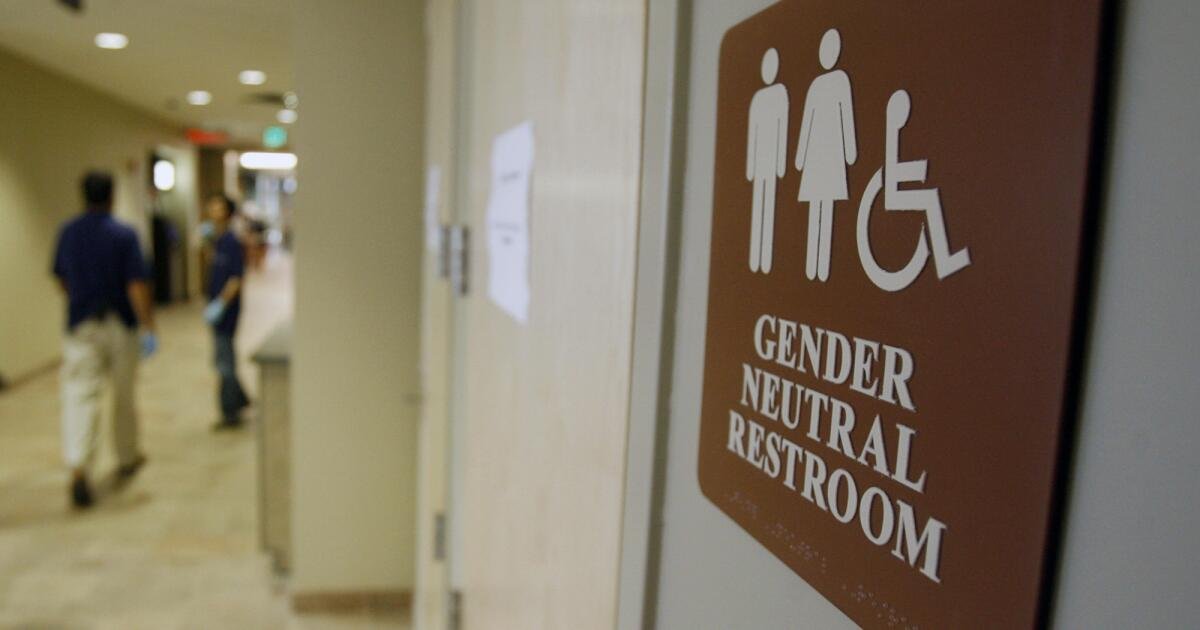
Every protest movement or significant historical undertaking had a moment that started at a public bathroom door.That’s the claim made by Temple University professor Bryant Simon, who spoke with Essential California this week about his latest book, “For Customers Only: Public Bathrooms and the Making of American Inequality.”Simon, a onetime postdoctoral fellow at Caltech, pointed to connections between public restrooms and civil rights, the farm labor movement — then and now — and trans debates.One such local front was the war the city of Long Beach waged against homosexuality more than a hundred years ago and, in particular, sex in public bathrooms.Let’s dive into some excerpts from his book, which is available for preorder. You’re reading the Essential California newsletter Sign up to start every day with California’s most important stories. By continuing, you agree to our Terms of Service, which include arbitration and a class action waiver. You agree that we and our third-party vendors may collect and use your information, including through cookies, pixels and similar technologies, for the purposes set forth in our Privacy Policy such as personalizing your experience and ads. Behaving in societySimon’s chapter entitled “Misbehaving” spoke of “scripts,” or behaviors the general public developed coming out of the Gilded Age. One routine that created apprehension among the general public was visiting public restrooms, Simon wrote.“Once bodies were sorted at the bathroom door, they were expected to move through the space quickly and anonymously,” Simon wrote.Bathrooms offered gay men a public space to meet and have anonymous sexual contact, Simon wrote.More than a century ago, public bathrooms initially were welcomed in Long Beach. The “bright white sinks and fancy flush toilets” showcased the International City as “more settled, civilized and appealing to others with money to invest,” Simon wrote.That image took a hit in the spring of 1914 when an undercover sting netted 31 men on suspicion of social vagrancy, L.A. Times clippings from the era read.“A few dressed in silk kimonos and one with no clothes on at all,” Simon wrote, and the arrests led to “a tsunami of homophobia” in Long Beach.Enter Long Beach’s vice patrolThe sting operation involved two handsome failed actors, B.C. Brown and H.W. Warren, who were hired as vice officers to spearhead the “purity campaign.” Public restrooms served as the battle’s “ground zero,” Simon wrote.The men lingered outside restrooms, “[spicing] up their outfits with a lapel flower and pastel shirt” with the goal of entrapping public fornicators.The undercover officers followed men who dressed similarly to them, or “walked with a swish in their step.”The officers would strike up a conversation with a potential suspect, perhaps pass a note or even make “explicit” comments. They then would attempt to lead the suspect into a bathroom stall and await a suggestive act. If the suspect showed the officers his genitals, they would stamp them with “an indelible marker” that led to instant arrests.Vice arrests led to big finesThe vice business boomed as Brown and Warren were paid $10 per arrest, with the officers racking up as much as $150 a day, according to Simon.In 2026 dollars, that’s about $334 per arrest with a peak of $5,000 per day.That original 1914 undercover sting resulted in combined fines totaling $5,275 in that day’s money from the 31 men. Those accused became social outcasts, leading to eviction notices from landlords, pink slips, club membership revocation and divorces.Scottish immigrant Josh Lamb even committed suicide, ingesting cyanide, after seeing his name in the newspaper.Gay rights activists provide a twistWhen the gay rights movement reached Long Beach in the late 1960s, activists “called for equal rights, an end to discrimination, and the opening of the closet door,” Simon wrote.They also pushed back at the police department’s long-running bathroom entrapment efforts. In a twist, though, activists self-policed the bathrooms and called for a “strategic end to public sex.”One gay rights group implored the city to close the public bathrooms at night, even offering to send gay community members to “shoo sex seekers from public bathrooms,” Simon wrote.Bathrooms became forgottenIn the end, neither the police nor gay activists completely ended public sex in restrooms.Police raids eventually moved to bars with rainbow flags and drag shows, taking the focus off bathrooms and eventually relegating them to a forgotten state.The week’s biggest stories ( Friends of Big Bear Valley) Animal and pet sagasState of the economyHealth and healthcareTrump administrationMore newsEditor’s pickMore picksThings to doToday’s recipe (Flavio Morais / For The Times) Chef Michael Roberts wrote of his version of birria, the Mexican goat stew. “If you’ve never tasted goat before, this is the perfect introduction to this full-flavored meat. The best way to eat the goat is wrapped in a tortilla with salsa, beans and rice. You can buy one can or jar of chipotle chiles in adobo sauce to get the sauce and the chiles you need for the dish.”Have a great day, from the Essential California teamJack Dolan, investigative reporterHugo Martín, assistant editor, fast break deskKevinisha Walker, multiplatform editorAndrew J. Campa, weekend writerKarim Doumar, head of newslettersShi Bradley, audience internHow can we make this newsletter more useful? Send comments to essentialcalifornia@latimes.com. Check our top stories, topics and the latest articles on latimes.com.