Voter ID is a common-sense proposal — and this November, voters in California have the opportunity to pass it.
Specifically, Proposition 39 says that election officials must verify the ID of whoever is voting, including whether registered voters are US citizens.
But California officials have tried to scare voters away.
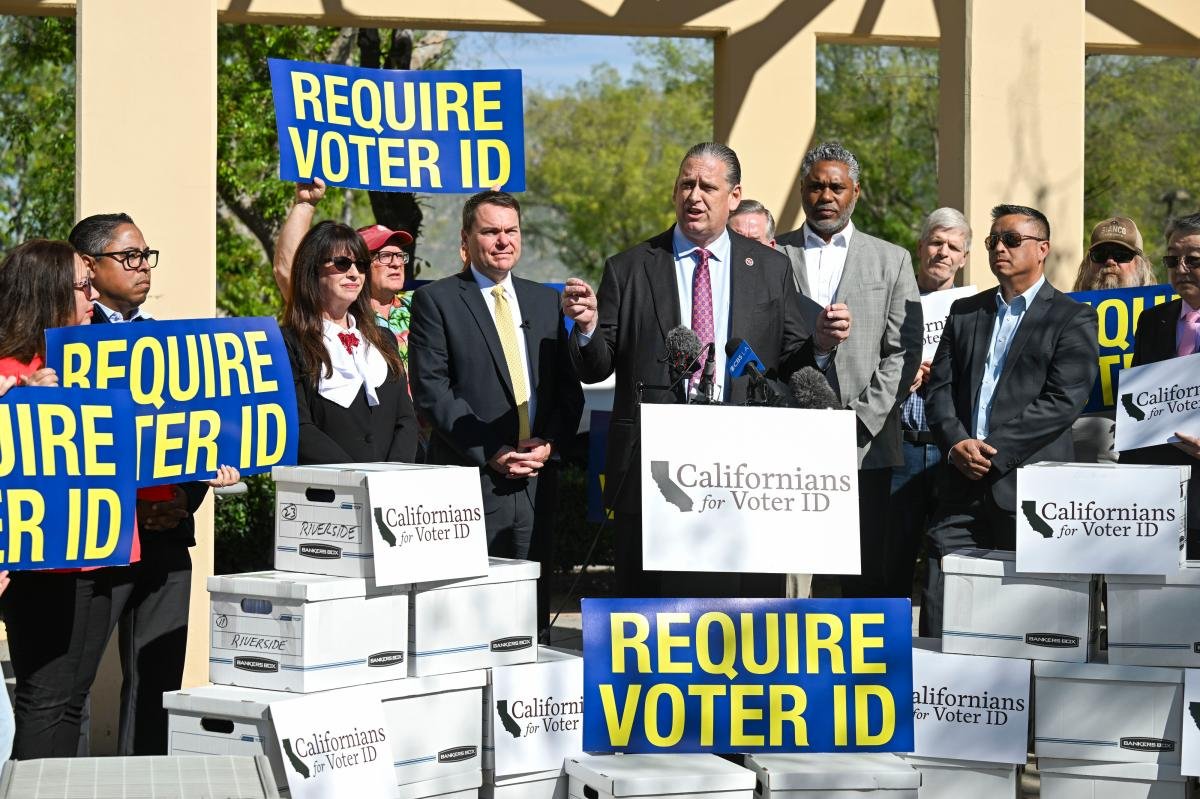
Sen. Tony Strickland speaks at the Riverside County Registrar of Voter. MediaNews Group via Getty Images
At first, California Attorney General Rob Bonta’s office described the initiative in neutral terms, saying it “Establishes Additional Voter Identification and Citizenship Verification Requirements.”
But Bonta turned that into something entirely negative: “Prohibits Citizens From Voting Unless They Present Government-Issued Identification.”
Prop. 39 supporters challenged the new language in court, but a Sacramento judge allowed it to stand.
It’s already illegal under current California law for noncitizens to register to vote. But as a practical matter, it is very hard to prosecute violations.
Prop. 39 would shift the burden to state and local election officials to verify the citizenship of voters on the rolls, and then to report, county by county, what percentage of registered voters have actually been verified as citizens.
Attendees hold “Voter ID” signs during a news conference with Steve Hilton, Republican gubernatorial candidate for California, right, at the Los Angeles County Registrar of Voters in Norwalk. Bloomberg via Getty Images
It applies the same principle to voter ID.
For in-person voting, voters would need to present government-issued identification. For mail voting, which accounted for roughly 13 million of California’s 16 million votes in the 2024 presidential election, a voter would provide the last four digits of a government-issued identification number of the voter’s choice.
Such a requirement already exists in 19 other states, covering almost half of the US population.
And for eligible voters who need identification, the state would provide a voter ID card upon request at no charge.
Prop. 39 is hardly a radical proposal. In 2024, a Gallup poll found that 84% of Americans support requiring photo ID to vote, while 83% support requiring people registering to vote for the first time to provide proof of citizenship.
Sign up for the California Morning Report newsletter
California’s top news, sports and entertainment delivered to your inbox every day.
Thanks for signing up!
It is difficult to find anything that 84% of Americans agree on anymore, but Prop. 39 has it!
Opponents continue to argue, falsely, that voter ID creates barriers to voting and disproportionately harms minorities.
The truth is the opposite.
A randomized field experiment by the Abdul Latif Jameel Poverty Action Lab conducted in partnership with the League of Women Voters found that voter ID notifications did not reduce turnout, and may actually have increased participation among minority and low-propensity voters.
Research supported by the Carnegie Corporation of New York also concluded that “in aggregate, the [voter ID] laws have no significant effect on turnout.”
The evidence shows that voter ID can strengthen public confidence without reducing participation among eligible voters.
Reasonable people can debate how voter ID should be implemented. But the “voter suppression” mantra does not change the evidence, as much as state officials wish it did.
California’s government hates voter ID so much that it has actively worked to prevent local communities from enacting it.
In 2024, Huntington Beach voters approved Measure A, authorizing voter ID requirements in municipal elections. Sacramento responded by passing legislation prohibiting local governments from imposing their own voter ID requirements.
This time, voters statewide have a chance to make their voices heard with Prop. 39.
They are being asked a fundamental question: Should California’s election system verify both identity and eligibility instead of relying primarily on signatures and attestations?
The initiative still leaves the details to the Legislature, including which forms of government-issued ID will qualify.
Those details matter, and legislators will have their opportunity to work everything out fairly.
In the meantime, California’s political class is doing everything it can to stop common-sense election integrity measures.
But thanks to Prop. 39, on Nov. 3, the voters of California will have the last word.
Ken Cuccinelli is chairman of Heritage Action’s Election Transparency Initiative, former acting deputy secretary of Homeland Security and former Virginia attorney general.