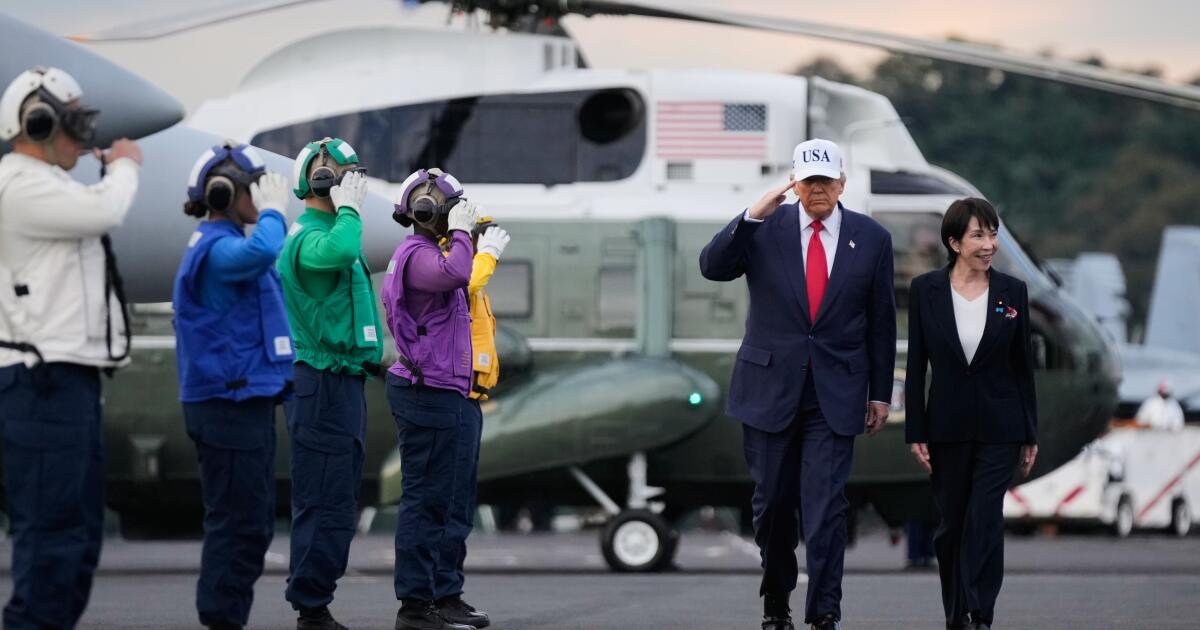
WASHINGTON — The only remaining U.S. aircraft carrier patrolling the Pacific departed Asia through Singapore last week en route to the Middle East, marking the latest step in a steady drawdown of American military assets across the region.An armada of naval forces, alongside a constellation of air-defense and missile capabilities, has been removed from a theater the Trump administration said just last year would be the battleground of the coming century.And now, President Trump’s surprise decision this week to curtail military exercises with South Korea has further fueled anxiety across Asia, where Washington’s closest allies fear violent consequences from a vacuum of American power.Trump said his decision to withdraw U.S. participation from the annual military drills was de-escalatory, claiming they would needlessly provoke North Korea’s dictator, Kim Jong Un, with whom he has recently been in touch.But he also blamed Seoul for its decision to not take part in his war with Iran.“I said, ‘Would you like to give us a little hand?’ ” Trump told reporters. “He said, ‘No thanks,’ and I said, ‘Wait a minute — we have 39,000 soldiers over there, guarding you from Kim Jong Un, your next-door neighbor, and you’re not going to help us.’ ”“That’s strange,” Trump added. “We can’t go around and protect all of these countries, especially when they’re not there to help us.”South Korea’s president, Lee Jae Myung, responded to Trump’s last-minute decision to pull back from the drills with a degree of alarm.“From now on, we must prepare measures with even the worst-case scenario in mind,” Lee said, “on the premise that the Middle East situation may be prolonged.”It was the latest jolt to South Korea’s confidence in an alliance that has formed a cornerstone of Washington’s defense strategy in Asia since the end of World War II.The Pentagon has kept its THAAD missile-defense batteries on the Korean peninsula. But in March, it moved some of the system’s radars and forward-positioned interceptors toward the Middle East, as the Iran war strained U.S. missile-defense stocks. Analysts estimate the conflict has consumed more than 40% of the Pentagon’s THAAD interceptor inventory.The diversion was accompanied by the redeployment of dozens of combat and dry-cargo ships, mine countermeasure vessels, and guided-missile destroyers out of the region, ahead of the departure of the strike group centered on the nuclear-powered USS George Washington, which is now on its way to the Middle East.Other U.S. allies in the region reacted swiftly to Trump’s pullback from the Korean exercises.The Australian government said it remained “deeply concerned” with North Korea’s nuclear weapons and ballistic missile programs, while Japan’s defense minister, Shinjiro Koizumi, warned of historic stakes.“As Japan faces the most severe and complicated security environment in the post-war era, the cooperation among Japan, the United States and South Korea is critical to the peace and stability of the region,” Koizumi said in a statement.And Beijing has been quick to capitalize on the vacuum. China’s Foreign Ministry mocked that the United States “has become addicted to quitting groups and scrapping treaties,” while its military began installing permanent infrastructure in Taiwan’s exclusive economic zone within days of the George Washington’s departure.“The current international landscape has once again proven that only by ensuring the effective operation of the multilateral system can we prevent the spread of the law of the jungle,” said Mao Ning, a spokesman for the Chinese Foreign Ministry, “and keep the international order from being dominated by the logic that ‘might makes right and force represents justice.’”Speaking with journalists in the Oval Office on Monday, Trump said that his communication with Kim was “making things safer” in the region.He did not offer details on their conversations.“Kim Jong Un has always treated me with great respect,” Trump said, confirming that the North Korean leader had replied to his overtures. “I understand him,” Trump added. “He understands me.”