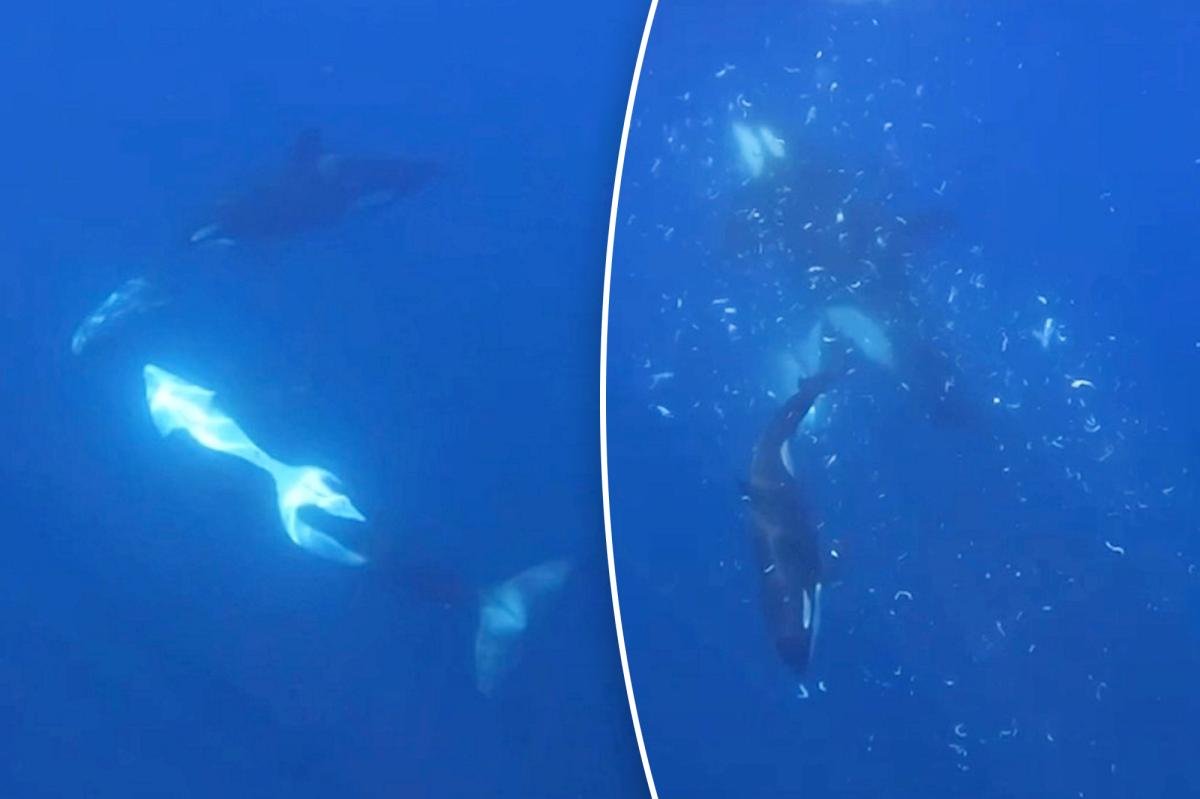
An iconic marine predator has been caught on camera demonstrating a curious way to play with their prey.
Scientists have captured orcas, fittingly known as killer whales, engaging in some macabre behavior.
Researchers filmed an orca slamming into a fish with such force that the creature was confetti-ed into thousands of tiny pieces.
The victim was no dainty underwater creature but a 2-tonne sunfish, among the largest and heaviest fish in the sea.
In the footage, a female orca ‘tees up’ a dead sunfish for a male to eviscerate. Kathryn Ayres / SWNS
In the footage, marine biologist Dr Kathryn Ayres, a scientist at Beneath The Waves, in the Gulf of California, watches as a female orca holds onto the tail fin of a recently killed sunfish.
The female holds the fish steady, kind of teeing it up if you will, then a male orca speeds up and smashes the fish to bits.
Ayres can be heard shouting “oh, my god” and a string of expletives as she floats among the fish debris.
Orcas have been spotted pulverizing sunfish in the Gulf of California on two occasions: in 2024 and 2025.
In both instances, the fish was dead before impact, suggesting the move is less of a death blow and more of a final processing technique.
Ayres observed that post-explosion, the adult orcas focused on what was left of the body while the juveniles in the group started snacking on the death debris.
The victim was no dainty underwater creature but a two-ton sunfish, among the largest and heaviest fish in the sea. Kathryn Ayres / SWNS
‘”Orcas often tear apart prey and share it with other members of the group, including calves and juveniles,” said Ayres, suggesting the blown-to-bits technique is akin to a human cutting their kids’ chicken into bite-sized pieces.
Pulverization could also help tenderize the meat and make nutrients more accessible. Sunfish are covered with a capsule, a thick, rubbery layer with a unique microbiome. Scientists speculate that smashing the fish could disperse microbiome nutrients into the water, making them more absorbable for orcas.
There’s also a third, more sinister explanation: the behavior, according to Ayres, could ‘just be for fun.’
She notes that orcas are known for playing with their prey, be it ganging up to drown juvenile blue whales, punting seals into the air, wearing salmon carcasses as hats or smashing sunfish to pieces.
Orcas are known for playing with their prey, be it ganging up to drown juvenile blue whales, punting dead seals into the air or smashing sunfish to pieces. AP
While some believe these dark pursuits could be a way for orcas to teach their offspring hunting techniques, others maintain that killer whales get their kicks from battering their lessers.
Orcas are also known to find fun in ramming and sinking boats, making out with each other and offering animal sacrifices to humans.
Ayres is interested in collecting more high-quality footage that would allow individual orcas to be identified and their behaviors tracked.
“Collecting good identification photographs whenever possible is key: we are still seeing new techniques of how orcas hunt and process their prey,” she said.
Earlier this week, a massive and potentially legendary orca was spotted cruising off the coast of Montauk in what could be the first sighting off Long Island in decades.
The beast — possibly the famous Old Thom whale known for patrolling the waters off Cape Cod — shocked sailors by sticking its 7-foot dorsal fin above the surface and shooting a spout of seawater from its blowhole.
One of the last known sightings of an orca off Long Island was in 1986, and a killer whale reportedly sank a fishing boat off the coast in 1958 after the fisherman struck it with a harpoon.