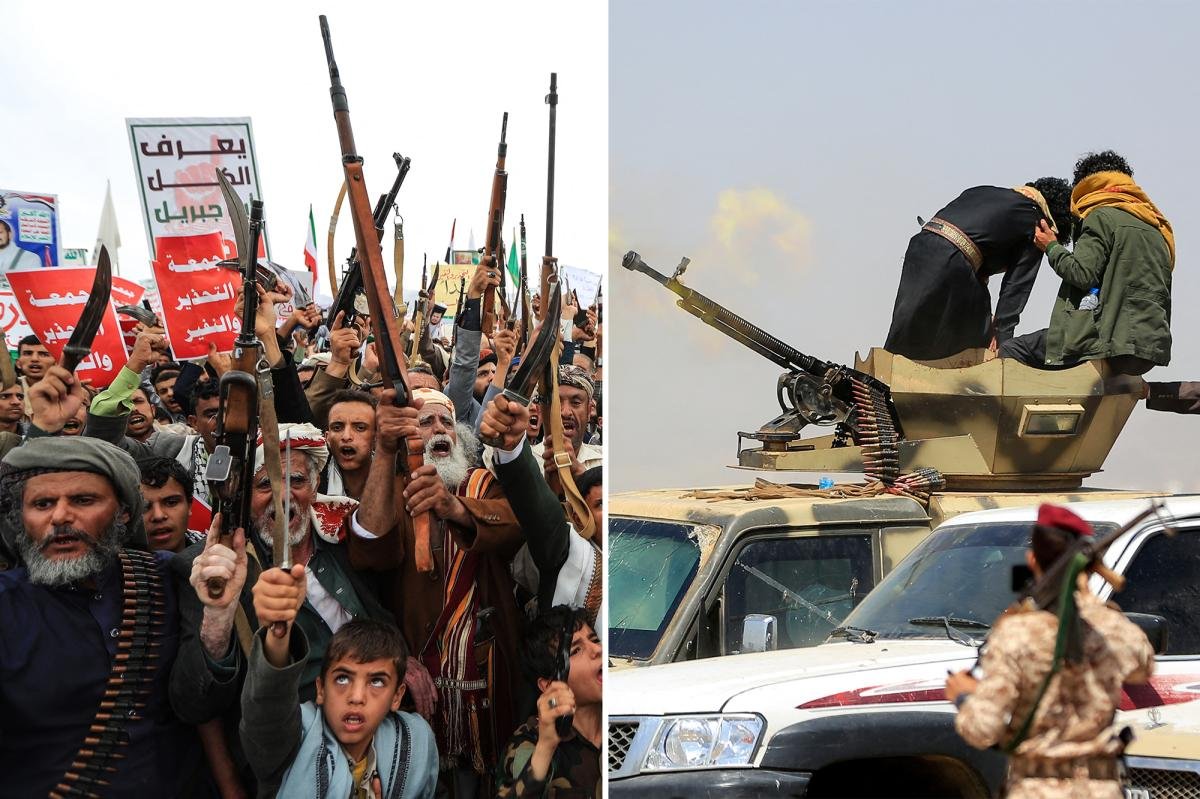
Iran sent men and military hardware to its Houthi terrorist proxies before the group began attacking oil tankers in the Red Sea — partially closing the “Gate of Tears” strait and opening a second front in the battle to keep crucial Middle East shipping lanes open.
Iran flew Islamic Revolutionary Guard Corps (IRGC) commanders, military advisers and missile and drone gear into Yemen ahead of the overnight strikes on two ships in the Red Sea, sources told Reuters on Wednesday.
The Houthis’ attacks — and previous warnings issued by the group — have already caused several ships to turn back along the critical trade route through the Bab-el-Mandeb strait, which connects the Red Sea to the wider ocean.
Iran allegedly sent senior military commanders and equipment to bolster the Houthi rebel group in Yemen. AFP via Getty Images
The Iranian team and gear were allegedly on the plane that Yemen’s Saudi-backed government tried to stop from landing last week. AP
Iran has also crippled passage through the Strait of Hormuz, which lies on the other side of the Arabian Peninsula and allows passage out of the Persian Gulf. It previously carried 20% of the world’s oil.
The Houthis’ attacks on two Saudi oil tankers on Wednesday sent Brent crude oil surging past $100 a barrel for the first time since May.
President Trump vowed to hold Iran accountable for any more attacks by the Houthis in the Red Sea.
“Please let this TRUTH serve to represent that if they do this again, the U.S. will hold Iran responsible, in that the Houthis are a Surrogate and/or Proxy of Iran, and major military punishment will be inflicted upon Iran and, of course, the Houthis, themselves, who I am very disappointed with,” Trump wrote on Truth Social.Brent crude rose by some 7% to $100.74 a barrel by Thursday morning marking a dramatic 40% gain in the key benchmark this month.
The Houthis are currently threatening Saudi tankers in the Red Sea, putting more of the world’s oil supply in jeopardy. AFP via Getty Images
Wednesday’s attack raised fears that the Houthis could attempt to shut down the Bab-el-Mandeb — aka “Gate of Tears” — strait entirely. The waterway carries roughly 5% of the world’s oil and also connects to the Mediterranean via the Suez Canal in the north of the Red Sea.
Going the long way around costs ships bound for India and China an extra 10 to 15 days journey.
Iran and its proxies have attacked 13 commercial ships since the war flared up again.
Trump warned that he would hold Iran responsible for any Houthi attacks in the Red Sea. AP Photo/Julia Demaree Nikhinson
Iran’s move to put the Houthis in play involved sending between 10 and 21 IRGC personnel, including senior commanders, from Tehran to Yemen on July 13, Reuters said.
“The IRGC commanders travelled there to support Houthi operations and provide training on new missile systems,” one of the sources said, adding that Iran also sent gold on the aircraft to fund Houthi activities.
The Houthis claimed to have attacked the Saudi tankers ENCELIA and LAYLA with missiles and drones on Wednesday “for their violation of the blockade decision,” Houthi spokesman Yahya Saree posted to X.
Until the attack, the Houthis had largely stayed out of the conflict. The incident also marked the first oil disruption incident in the critical Red Sea trade route after the terror group declared the naval blockade against Saudi Arabia.