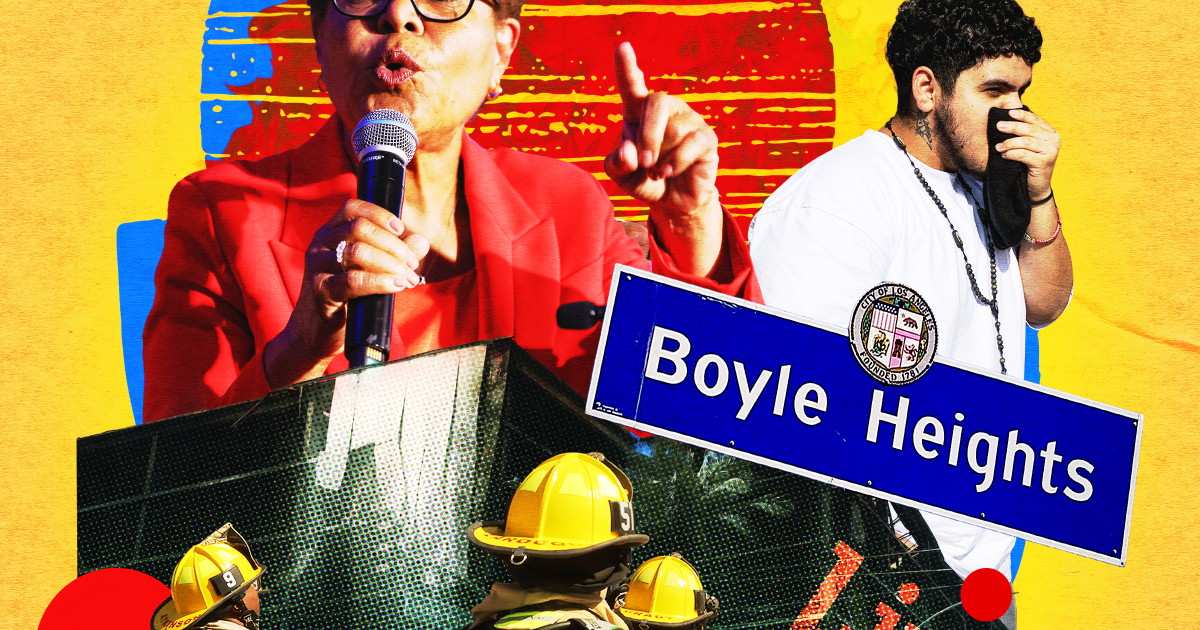
After burning for more than a week, the industrial fire in Boyle Heights was finally extinguished Wednesday evening.On June 17, a warehouse operated by Lineage, a global temperature-controlled storage facility company, caught fire reportedly during work on solar panels on the building’s roof. The flames got inside, which is insulated, and slowly burned through 85 million pounds of food and goods inside for eight days.Smoke filled with toxic substances billowed over large portions of L.A. County, most strongly affecting heavily Latino areas such as Boyle Heights, East L.A., the San Gabriel Valley and several other unincorporated municipalities east of the blaze.Several experts told The Times that the chemicals emitted from the fire can have immediate effects on people’s health regardless of age or health status, and that they can “cause long-term lung damage, and sometimes they can even cause cancer.” Of particular alarm was how they could affect children, pregnant women and the elderly. Despite what air and health professionals warned, fire officials said “there is nothing in the air that is so dangerous that we have to do evacuations or even shelter in place.” When asked at a recent news conference whether the air was dangerous, Mayor Karen Bass said, “not to the extent that required a mandatory evacuation.”And so it goes yet again for those living in “sacrifice zones” — neighborhoods or stretches of land that have been environmentally despoiled in the name of corporate profits. Environmental disasters disproportionately affecting Latino households is unfortunately not a recent phenomenon in L.A. County. A 2022 study by UC Berkeley and Columbia University found that the 1930s practice of redlining of Black and Latino residents in L.A. often forced the communities to live in neighborhoods with oil wells because of racially restrictive covenants. The construction of several majors freeways during the 1950s in the Eastside essentially created a pollution bubble for many Latino residents. Warehouses soon moved in to the area and have been spewing gases into the adjacent neighborhoods ever since. “It’s a combination of intentional neglect and deliberately deciding to put these kinds of industrial facilities in neighborhoods that are already burdened with too many of these kinds of facilities,” Rebecca Overmyer-Velazquez, coordinator for the Clean Air Coalition of North Whittier and Avocado Heights, told The Times.“Warehouses like the one that [was] burning in Boyle Heights seem innocuous because nothing seems to be coming out of them, but the problem with [them] is the truck traffic and so it adds to what we understand is the cumulative impacts of pollution,” she said.Overmyer-Velazquez pointed out that these warehouses and industrial plants often provide great benefits to the larger society, yet their effects only burden a select few. “We have a zoning problem, a segregation problem and a regulatory agency problem that allows for these kinds of places in these communities to operate virtually without much oversight,” she said. “As a result, they literally poison us because no one is taking seriously the impacts of these places.”One of the frustrating elements of what’s going on with the fire at the Lineage warehouse has been the lack of clear communication coming from local politicians. Messaging about what’s in the air has been confusing. Shelter-in-place orders have been lifted and reimposed back and forth. Friends and family members of mine who live in the San Gabriel Valley — where the toxic smoke from the warehouse blaze has blanketed cities — have told me that they never received direct alerts to their phones from county or local agencies regarding the levels of toxicity wafting their way. Overmyer-Velazquez said that mixed messaging and obfuscation often go hand in hand with the proliferation of industrial-linked environmental disasters. “I can speak from experience of trying to alert neighbors about the Quemetco [battery recycling plant], now called Ecobat facility, for many, many years,” she said. “So many times people are surprised to know that they live right next door to a place that’s so toxic.”In 2016, air quality officials told Ecobat to cut its arsenic emissions after an assessment found they posed an increased cancer risk to 12,000 people. The company invested tens of millions of dollars to reduce its exhaust in the mid-2000s, but air district records showed it still violated emissions standards for benzene, a carcinogen, and once for releasing too much arsenic.The slow response by local leaders have forced on-the-ground organizations and residents to take care of their own neighbors.One such group is the Regenerative Collective, an “autonomous, anti-colonial collective network” that focuses on hyperlocal community initiatives. Yesenia Pum, an organizer with Regenerative Collective, said she knew from the onset that the fire was going to last for a while and be a problem. Within 24 hours, Pum had a constant headache and felt itchiness in her throat while sheltering at home with several family members with no air conditioning.“This is not living, these are not living conditions, we’re in saunas … even if the windows are closed, the air is still going to seep in, right?” Pum said. That want for breathable air was palpable when Pum and other organizers went around the area distributing masks to adults and children. “Kids ran up to me like I’m the ice cream man passing out masks because no one has come for them. No one,” Pum said. “We’re talking about pregnant mothers, we’re talking about senior citizens. And so, luckily, I came prepared. I had the kid’s mask, because a lot of times there’s not a lot of kid’s mask.” Pum noted that people erroneously assumed that she and other organizers were with working city or county officials.“I know that no one is coming for us, no one’s gonna save us but us … as neighbors, we know people’s stories,” she said.“What we’re responding to is not something novel, this is not a one-off issue, this isn’t something that we should expect will go away,” said Mapi Castillo, another Regenerative Collective organizer. “We understand that, as colonized people, we’re captives to capitalism. This what we’re angry about. We’re not quietly and peacefully managing a crisis, we’re front liners resisting what is essentially corporate-sponsored death. … This is what a bomb in the hood looks like.”Castillo added that they were glad that people were embracing a sense of “righteous anger” in the aftermath of the fire.“The fact that air purifiers were trickling in is such a slap in the face of everything that we stand for as people,” Castillo said. “It’s a moment for folks to come to understand that we really only have each other. I think more and more people are recognizing that we are just here to be disposed of.”The Times reached out to City Councilmember Ysabel Jurado — who represents Boyle Heights — for comment. Jurado did not respond to the request.When Bass was reached for comment, a member of her communications team referred The Times to a Thursday press conference in which she addressed some of the systemic issues revolving the fire and the sense of confusion with messaging. “Air conditions and advisories have gone back and forth and have changed, and I certainly hope that any statements that I’ve made along the way have not contributed to any confusion, because I’m very clear that all smoke is a problem, and it is a stronger problem depending on your age and your health condition,” Bass said in the press conference. “People who are familiar with Boyle Heights know that this fire did not happen in a vacuum. Environmental hazards have too often fallen on communities like this one. This moment must be a turning point. We will hold those responsible fully accountable, and we will fight to change the longstanding, systemic failures that have left Boyle Heights disproportionately impacted by industrial accidents,” Bass added.A representative for Los Angeles County Supervisor Hilda Solis highlighted how her office was helping her constituents as the fire burned.“Since the start of the incident, Los Angeles County and First District Supervisor Hilda L. Solis’ office have prioritized outreach and support for residents in unincorporated East Los Angeles, which falls under County jurisdiction,” Solis’ spokesperson Kimberly Ortega told The Times in an email.The statement also pointed to Solis’ declaration of a local emergency on Saturday, which will provide funds for aid and help in the fire’s investigation. At the end of my conversation with Pum, the 31-year-old organizer talked about the pain of caring and wondered aloud how many more battles she’s going to have to fight just to survive. Much like Pum and Castillo, I too am tired of Latinos being sacrificed in favor of corporations that extract and poison. It hurts to see Latino culture performatively touted around L.A. — especially right now, during the World Cup and election season — on ads and by politicians while Latino families are left to fend for themselves while being choked out by a fire. I hope the mess of this blaze and the long recovery process gets people angry and that they force their will onto politicians. Politeness isn’t going to get these super-polluter facilities out of our neighbors. Giving grace to those who govern isn’t going to pay for people’s medical bills that arise from this environmental disaster. The loud and insistent residents of Monterey Park showed that shaming and pressuring politicians can work. Earlier this month, 86% of voters approved a measure to ban the construction of data centers, the first city in the country to do so by public vote.So let’s stay mad as hell and fight for our neighbors and ourselves. The Venezuela earthquakes and how to help (Adrian Naranjo / Associated Press ) On Wednesday, two massive earthquakes struck Venezuela, causing catastrophic destruction, particularly in urban areas in the northern part of the country near Caracas.At least 188 people have been confirmed dead and nearly 1,500 have been injured, with both figures expected to climb, the Associated Press reported early Thursday. The region was especially susceptible to this level of devastation, in part because of the ubiquity of “non-ductile concrete buildings,” which tend to crumble more easily when met with tectonic activity.The earthquakes have now further exacerbated the ongoing the humanitarian crisis in the South American country.How can you help with recovery efforts in Venezuela?The International Rescue Committee is scaling up its support services to Venezuela to provide emergency services to survivors. The organization has been in the country since 2021 and will provide food, healthcare, shelter and education with any funds sent its way. People can donate here. UNICEF is on the ground in Venezuela delivering physical and mental health support to children and families affected by the quake. Donations can be made here. The International Federation of the Red Cross said in a statement Thursday that it was deploying medical professional to earthquake sites. The organization said it will mostly be helping with “search and rescue, emergency shelter for families whose homes have been damaged or destroyed, and emergency health care, including trauma care and psychosocial support. Safe water and sanitation and essential household items are also expected to be priorities in the hours and days ahead.”People can donate to the IFRC here. Join De Los at Grand Performance this Saturday (Diana Ramirez Santacruz / De Los) This Saturday, June 27, at California Plaza in downtown L.A, De Los will be co-presenting a night of music and comedy as part of the storied Grand Performances free summer concert series. The Chicano troupe Culture Clash will take the stage to perform its show, “American Payasos! Culture Clash’s End Times Cabaret.” The trio — which includes Richard Montoya, Ric Salinas and Herbert Sigüenza — formed in 1984 in the San Francisco Mission District. Through its avant-garde live skits, the group has weighed in on topics like race, immigration and politics, including the 2016 election race between Hillary Clinton and Donald Trump.“We are highly pissed off about a lot of stuff right now,” Montoya recently told The Times. “This is a very strange moment for satirists … We have a responsibility to use those tools to say what’s going on in our city and country and provide these moments where we can do a little bit closer examination because the people in power aren’t telling us what’s going on.”Also performing at Saturday’s event are retro cumbia-quebradita musician É Arenas (bassist of Chicano Batman) and the cumbia-fusion, luchador-masked cumbia group La Nueva Ola de Cumbia, as well as DJ Dali.Stories we read this week that we think you should readUnless otherwise noted, stories below were published by the Los Angeles Times.Lineage Fire storiesPolitics and immigrationArts & Entertainment