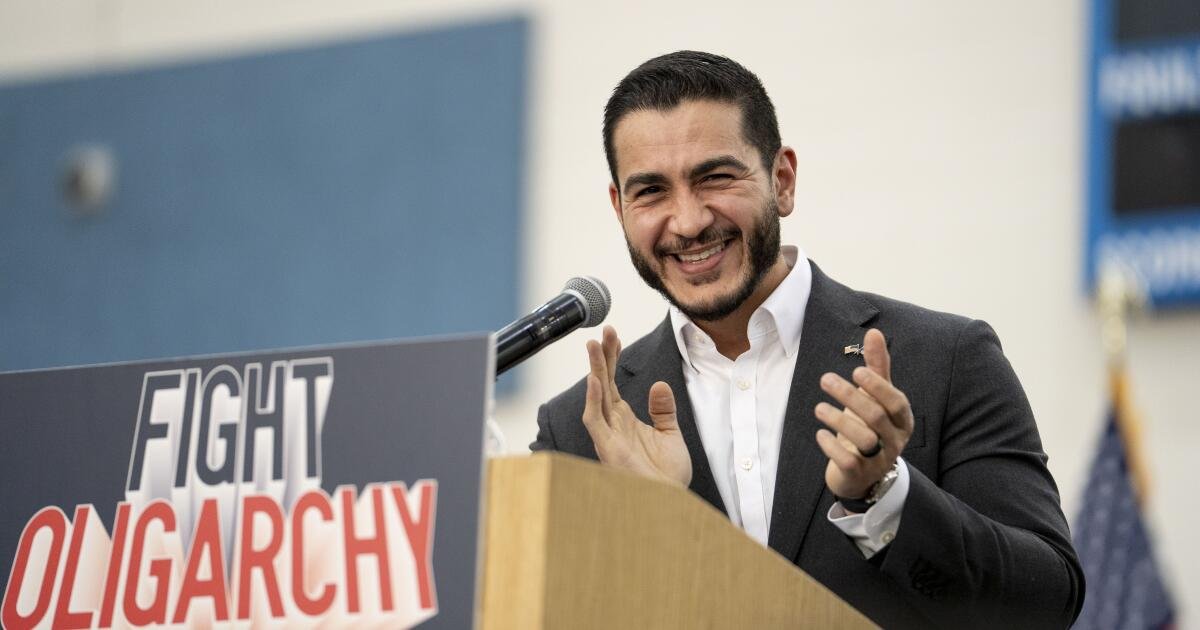
Warren, Mich. — It was 94 degrees outside, the heat index was over 100, and smoke from the Canadian wildfires triggered air quality alerts here in the Detroit suburbs … and yet a hodgepodge of about 20 curious voters continued to stand outside and wait. Senate Democratic primary candidate Abdul El-Sayed, the former public health official turned progressive lightning rod, officially wrapped up this campaign stop more than 30 minutes ago.I am not sure whether it is excitement for El-Sayed or desperation for economic relief that is fueling the energy behind his candidacy.What I do know is his name is the one I see more often on signs in lawns across the state.“I don’t really believe in ideology. I have faith and everybody else brings evidence,” El-Sayed said when I asked him about the rise in democratic socialist candidates in these midterms. (For the record, his beliefs are also fact-based; he’s a Rhodes scholar and endorsed by Sen. Bernie Sanders.)The emergence of the party’s left has caused some soul-searching, which El-Sayed considers overdue. The new Democrats are “calling the Democratic Party out on its hypocrisy,” he says, particularly elites who are “taking money from corporations and then come through and tell working people that they should support you because you’re less bad than the other guys. That’s uncomfortable to be called out on.”And why are voters lining up behind these critical candidates in Democratic primaries? Because “they’re frustrated that this party takes money from the very same people that Republicans take money from to do a lot of the same things,” El-Sayed says. “When you have a bipartisan consensus that the best use of our foreign policy is to backstop the military of a foreign government, when you have bipartisan consensus that we cannot have guaranteed healthcare, at some point, part of me says, ‘Well, what are you actually about?’”What progressives in Washington have struggled to grasp — particularly those long-term entrenched ones who are powerful fundraisers for the party — is that the people have moved on. Americans are not just fed up with pandering to Israel by politicians beholden to funding from the American Israel Public Affairs Committee. The people have moved on from this notion that things need to move slowly or worse yet, nothing can be done at all. The current fear-mongering about democratic socialists overshadows the fact it started in the early 1980s, a time when Americans struggled to make ends meet. And the current scare framing is no different from what conservatives said when President Lyndon B. Johnson began a war on poverty in the 1960s, when President Franklin D. Roosevelt launched the New Deal in the 1930s to lift Americans out of poverty from the Great Depression or when President Cleveland tried to derail the populist movement in the 1880s or demonize the formation of the People’s Party in 1892.Austerity is a tough message to receive in a state that has been hemorrhaging good-paying jobs since the 1980s. Meanwhile, Michiganders see the money being spent on wars in Ukraine and Iran; they see the billions the president has made since returning to the White House; they watched Elon Musk invest nearly $300 million to fund that return to office and in less than two years become the world’s first trillionaire.This is what the voters in Michigan have been telling me for months. They bring up facts like these and they’re asking themselves: Why am I struggling? They’re wondering why the young people in their families can’t find a decent-paying job. And instead of looking at the same cast of characters in Washington to fix their problems, they are going to the ballot box with the hope of creating a brand new show. One where a medical emergency doesn’t send a family into bankruptcy.That is what the 2025 election of Zohran Mamdani in New York City truly represents. It was never a threat to democracy; it was a challenge to the system that has enabled the top 0.00001% of the wealthy in the U.S. — around 35 households — to hold more wealth than the bottom 50% of Americans — roughly 65 million families.Why hasn’t the Democratic Party stood against that all along?“I think too often what happens is people get comfortable in these positions,” El-Sayed said. “They get pulled away from everyday people and they don’t remember what it’s like. This job is about humbling yourself to their experience and asking yourself: ‘How do I always remember that the whole point of any of this is to make your life better?’”YouTube: @LZGrandersonShow Insights L.A. Times Insights delivers AI-generated analysis on Voices content to offer all points of view. Insights does not appear on any news articles. Viewpoint This article generally aligns with a Left point of view. Learn more about this AI-generated analysis Perspectives The following AI-generated content is powered by Perplexity. The Los Angeles Times editorial staff does not create or edit the content. Ideas expressed in the pieceThe column contends that the surge of progressive and democratic socialist candidates such as Abdul El-Sayed reflects deep grassroots frustration with both parties over economic hardship, corporate influence and the lack of universal health care, aligning with Michigan polls showing Democrats favor fighters, single-payer care and candidates who shun corporate money.[1][4][5][14][15]It argues that voters have “moved on” from incrementalism and are seeking bolder structural change, especially younger and working-class Democrats drawn to a populist left agenda; progressive primary victories nationwide, including Zohran Mamdani and other democratic socialists, are presented as evidence that these ideas are now mainstream within the party’s base.[4][5][7][18]The piece suggests that El-Sayed and similar candidates are calling out what it describes as Democratic Party “hypocrisy”—accepting corporate and AIPAC-aligned funding while asking working people for support—thereby forcing overdue soul-searching among party elites who have long depended on big donors to remain competitive.[3][13][14][15]It portrays bipartisan consensus on issues such as military aid abroad and opposition to guaranteed health care as proof that both major parties prioritize foreign militaries and wealthy interests over ordinary Americans, leading many voters to question what Democrats “are actually about” and to look for candidates who break with that consensus.[13][19][20]By linking contemporary scare rhetoric about “democratic socialism” to earlier backlash against Franklin D. Roosevelt’s New Deal, Lyndon Johnson’s War on Poverty and 19th-century populism, the column argues that today’s left is part of a long American tradition of movements challenging concentrated wealth and demanding social protections, rather than a novel threat to democracy.The article frames Mamdani’s election and the broader progressive wave as a direct challenge to an economic system that allows a tiny fraction of ultra‑rich households to hold more wealth than tens of millions of families, and asks why the Democratic Party has not consistently opposed such inequality despite its stated commitment to working people.[4][5][7][18]It emphasizes that the appeal of candidates like El-Sayed lies less in ideological labels than in their focus on concrete material issues—jobs, health care costs, debt—and their willingness to “humble” themselves to voters’ lived experiences, echoing progressive strategists and candidates elsewhere who describe their message as centering economic pain and affordability.[7][15][20]Overall, the column argues that Democratic voters, particularly in states like Michigan that have lost good-paying jobs for decades, increasingly want the left wing’s program on health care, economic populism and foreign policy, and are using primaries to demand a “brand new show” in Washington rather than a continuation of centrist, donor-driven politics.[1][2][5][13][14][18]Different views on the topicEstablishment Democrats and centrist strategists counter that, despite progressive energy, swing-state electorates like Michigan remain wary of far-left platforms, warning that nominating candidates such as El-Sayed—who backs Medicare for All, abolishing ICE and sharp criticism of Israel—could jeopardize the party’s chances of winning statewide and holding the Senate majority.[13][17][20]Recent polling cited by outlets including the Detroit News and Fox News indicates that moderate Rep. Haley Stevens currently leads El-Sayed among likely Democratic primary voters, with particular strength among non‑college‑educated and Black voters; critics say this undercuts the claim that the party’s base uniformly wants a democratic socialist agenda.[8][10][11][13]Commentaries in conservative and centrist media argue that left-wing rhetoric on Israel and Gaza, including descriptions of Israeli actions as “genocide” and calls to halt or condition U.S. military aid, risks alienating Jewish voters, pro‑Israel Democrats and swing voters, and can be portrayed by opponents as extreme or irresponsible on national security.[6][10][13][17][20]Some political analysts caution that progressive primary wins do not automatically translate into general-election success, noting that earlier cycles saw left-wing challengers lose in purple districts and that many competitive 2026 Democratic nominees in Republican-held seats are still backed by centrist groups such as the DCCC, the New Democrat Coalition and the Blue Dog Coalition.[13][16][18]Critics of the party’s left flank contend that an aggressively anti‑billionaire, anti‑Washington populism may energize activists but can oversimplify complex economic problems, downplay the role of private investment and entrepreneurship, and make it more difficult to build broad coalitions that include moderate suburban voters and business interests.[17][18]Opposing columns also warn that embracing the democratic socialist label and policies like wealth taxes, major new social spending and expansive government programs could reinforce Republican messaging about “socialism,” potentially driving swing voters toward the GOP and undermining Democrats’ efforts to present themselves as fiscally responsible stewards of the economy.[4][9][12][17][18]Within the party, skeptics argue that focusing on internal purity tests—refusing corporate PAC money, centering divisive foreign-policy debates and targeting incumbent Democrats—may distract from the shared goal of defeating Trump and Republicans, pointing to data showing that many high-profile 2026 primaries are still being won by candidates aligned with the establishment.[1][13][18]Additionally, some observers note that many voters express complex, non‑ideological mixes of views—such as being “very pro closed borders” but also “very pro Medicare for all”—and suggest that rigid left-right narratives may misread an electorate whose frustrations do not automatically translate into support for the democratic socialist program highlighted in the column.[1][16][19]