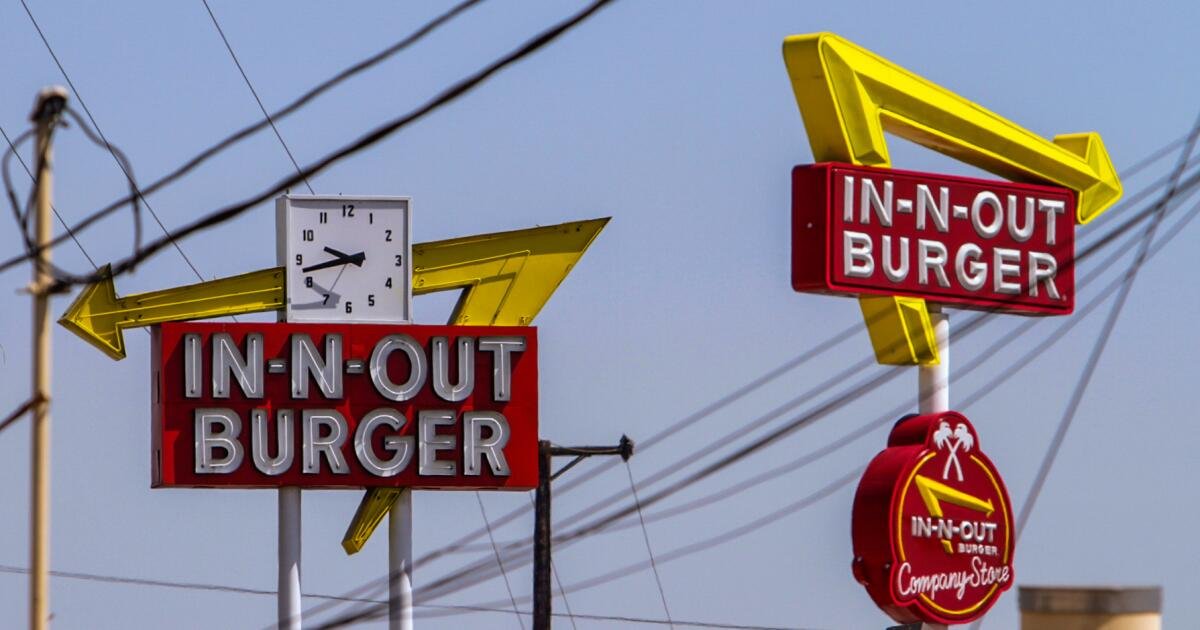
Many cities — not to mention their hungry residents — are eager for burger icon In-N-Out to open an outpost.The chain has been expanding rapidly, finding there are plenty of customers for each new location.But there is one Southern California city that is pushing back.When In-N-Out recently approached Culver City with interest in opening one of its drive-through restaurants in the Westside community, it sparked a backlash. Some residents expressed concerns about pollution, the traffic congestion, the dangers of errant drivers around kids and the lingering aroma of frying food. The City Council listened, imposing a moratorium on new drive-throughs. A drive-thru worker works the long lines at the In-N-Out Burger in the 9000 block of Venice Blvd. in Los Angeles. (Jason Armond / Los Angeles Times) The battle in Culver City has gained national attention because it highlights larger concerns about the proliferation of drive-through restaurants. The car-friendly layout has been booming for decades, with many retail businesses seeing the car lanes as essential to making the restaurants work financially.The pandemic boosted the concept even more, offering a low-risk, low-contact way to get food.California’s first drive-through was an In-N-Out in Baldwin Park in 1948, and by the 1960s, the new approach to dining had begun to reshape the American landscape.But Culver City is part of a small but notable rebellion.At a recent City Council meeting, residents took the mic one by one to speak passionately on an issue that has grown dear to them in recent months: drive-throughs and how much they hate them. It began in January when news traveled of the In-N-Out with a mega drive-through at the corner of Sepulveda and Sawtelle boulevards. The intersection is already considered one of the worst, most traffic-clogged intersections in the small city. And with an elementary school a stone’s throw away on Overland Avenue, parents worried that the already accident-prone intersection would become more unsafe and polluted.“Drive-throughs are pollution monsters,” resident Leah Pressman told the council at the meeting. “They are obsolete.”Another resident, Theresa Attias, said hungry drivers pose a danger to parents, children and other passersby. And, she noted, “how can the children study when the smell of French fries and onion rings is tickling their noses?”The burst of organizing and outrage among neighbors — including a petition opposing the In-N-Out development that garnered more than 900 signatures — spurred the city council earlier this year to impose an emergency 45-day moratorium on any new drive-through. At a meeting earlier this month, the council voted 4-0 to extend the ban for another 10 months, to give more time to city staff to study the impacts and recommend language for an ordinance potentially banning new drive-throughs permanently.Bubba Fish, the Culver City council member and vice mayor who worked closely with local residents to push for the moratorium, said the enthusiastic engagement of “people from different walks of life, different ideologies who you might not typically see at City Hall” was a welcome surprise.“The more I listened to these folks, it became very clear that no one in Culver City wanted a drive-through in their neighborhood,” Fish said. “Drive-throughs are great if you’re a multi-national fast food chain, but they aren’t great if you have to live in their vicinity.”Vanessa Martin, who has helped lead the burst of organizing, said boosting walkability when deciding what development will occupy the currently empty lot could encourage people to spend more time in the neighborhood and patronize mom-and-pop shops. It would make the area more accessible for people such as her brother, who has a developmental disability and cannot drive, she said. “When people literally drive in and out, they don’t stop to shop,” Martin said. “We are interested in being much more proactive about what businesses and development to bring that is smart and creative, and addresses the needs of people more vulnerable, like children and older adults.”The idea of a drive-through ban is not new, with several California cities implementing such bans in the 1980s and 1990s, and a smattering of cities examining the issue in recent years.But the fact that there isn’t more information readily available on how drive-throughs impact communities — particularly in car-centric California where green modes of transportation, denser development and prioritizing bike lanes and foot traffic are increasingly in vogue — means both sides of the drive-through debate see an opportunity to make their case to the public. Marcel Moran, an assistant professor studying urban transportation at San José State’s School of Planning, Policy and Environmental Studies, says drive-throughs have been “understudied relative to the degree of which it’s a feature of the American landscape.” In a study he co-wrote that’s undergoing peer review, researchers counted at least 133,000 drive-throughs across the U.S., using satellite imagery, company records and online reviews, and found that drive-throughs are are not clustered just at highway interchanges and rural stretches, as many perceive them to be, but that 83% are in urban and suburban neighborhoods.According to Moran, drive-throughs can be detrimental to the fabric of a community. There’s pollution from the vehicles and they can encourage social isolation, he said.“You’re sitting in your car, you’re not walking and standing in line. In a dining room you might make conversation with the family at the next table,” Moran said. “All these other things that are part of the social fabric of indoor dining, all of that is removed in a drive-through.”Long queues of idling cars certainly have negative effects on the surrounding environment, releasing nitrogen oxides and volatile organic compounds, even with technological advancements in newer cars that increase energy efficiency, said Daniel Mendoza, an assistant professor at the University of Utah, Salt Lake City, who studied the impact of drive-through COVID-19 testing sites on urban air quality. “Every time a car moves one spot forward, that produces a large amount of emissions, creating this pollution hotspot by drive-through facilities,” Mendoza said. How drive-throughs are designed matters, and limiting worker exposure and how much of the line of cars spills over into nearby streets is crucial, he said. A study that examined the emission rates at three fast food restaurants in Houston with different drive-through configurations found that emissions were relatively lower at drive-through facilities with fewer stops and lanes.When atmospheric weather conditions in May drove dangerous pollution levels in Texas, environmental officials urged residents to limit driving and in particular to avoid drive-through lines. They warned the elevated ozone levels, exacerbated by idling cars, could have immediate health effects for older adults, children and those with heart or lung conditions, such as asthma.Drive-throughs took hold in the 1960s, but after just a decade or two, they began to be cast as pariahs of a sort and drew neighbor complaints around traffic, noise and aesthetics, causing several California cities including Santa Barbara, Sierra Madre, San Luis Obispo and Carlsbad to impose sweeping bans, and others such as South Pasadena, Burbank and Newport Beach to pass some restrictions or temporary bans. In the late oughts, a McDonald’s franchise operator in the San Luis Obispo area lobbied the city to lift its ban but was unsuccessful, as the ordinance was upheld in a 3-2 vote. Long Beach — after an influx of new drive-throughs — moved in 2019 to develop restrictions in certain corridors and require traffic studies and considerate design to allow them to be zoned in other areas.But not all bans are permanent. After issuing a citywide ban in the late 1990s, the city of Carlsbad softened its policies last year, allowing new drive-throughs on a case-by-case basis after an economic study found restaurants produced $30,000 a year on average in sales tax revenue with a drive-through and $22,000 without. Bret Schanzenbach, president and chief executive of the Carlsbad Chamber of Commerce, said surrounding areas had taken advantage of the city’s ban on drive-throughs, effectively stealing away business by stationing Starbucks and Dutch Bros businesses just outside the city’s limits to attract coffee drinkers heading in for work each morning. “They are getting as close to the border as they can to capture that convenience,” Schanzenbach said.Many residents weren’t even aware, he said, that the city had what he described as an outdated ban, until a Chick-Fil-A opened and residents were confused that it didn’t have a drive-through.Before doing anything permanent, officials in Culver City should “thoroughly understand the consequences” of their decision, said Jot Condie, president of the California Restaurant Assn.“Drive-throughs ensure accessibility and the public’s health by allowing families with young children, older adults, and those with disabilities, as well as those with autoimmune diseases to enjoy the same experience as others. It’s vital the city considers these community members before making a decision,” Condie said.Under Culver City’s temporary ban, eight existing drive-throughs in the city would not be affected. The proposed In-N-Out, if allowed, would be the first new drive-through in Culver City since 1997, according to a city staff report. The proposal includes 61 parking spaces and a 26-car drive-through with two lanes winding around the outdoor seating area before merging into one lane, according to the development plan. In-N-Out did not respond to a request for comment about community opposition.Despite a relatively long history of drive-through bans, the idea is still novel and perplexing to Californians who love their burgers and love their cars. Councilmember Albert Vera said at the meeting this month that he initially thought, “I like In-N-Out. Do I want one down the street? Yeah, why not,” he said. He is averse to a sweeping ban, and asked city staff to consider flexible alternatives as they research language for an ordinance, but voted in favor of extending the ban after hearing from residents. “The community essentially changed my mind on this,” Vera said.