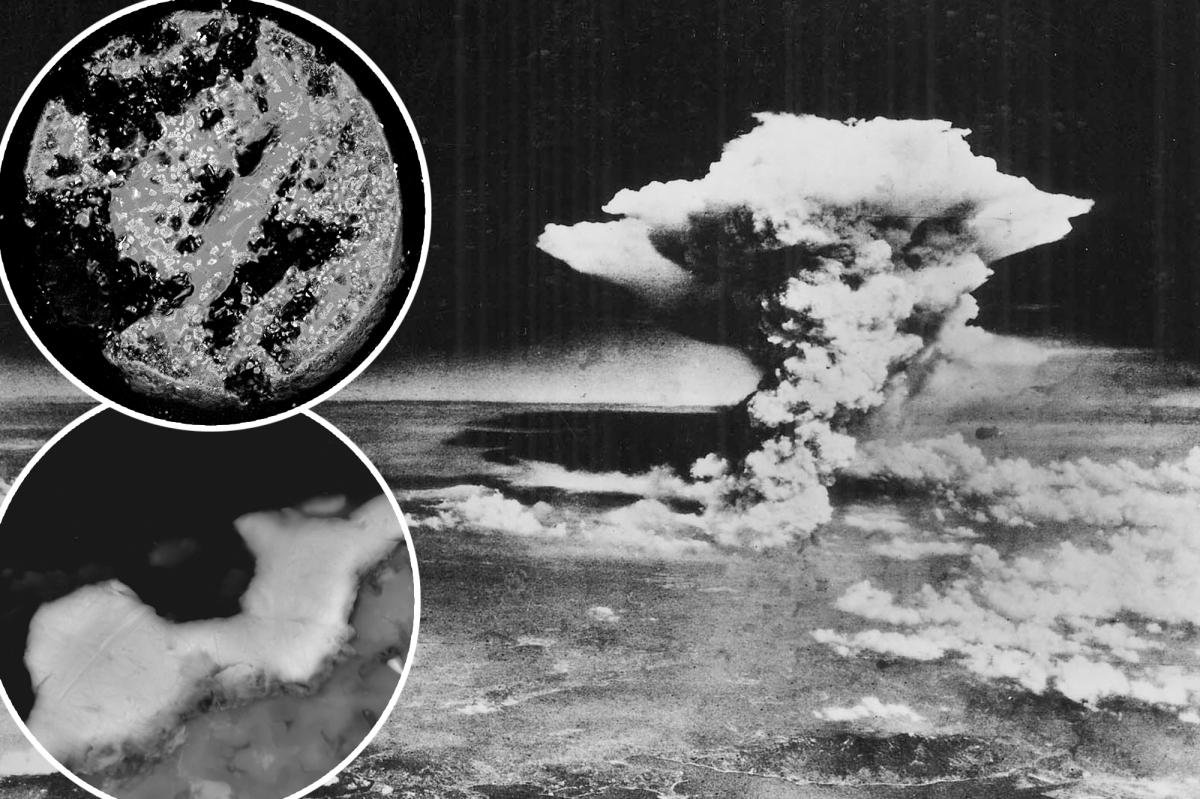
It was a rare Earth metal.
Often cited among the most destructive forces in history, the atomic bomb dropped on Hiroshima, Japan, in 1945 also gave rise to a rare metal never seen on Earth, per a groundbreaking study in Science Advances.
“We report the discovery of a previously unknown multicomponent alloy,” the researchers wrote.
The international research team had discovered this new material while examining 34 fallout samples containing hiroshimaites — tiny droplets that were preserved in sands of Hiroshima Bay, according to Phys.org.
The new alloy (pictured) had an atomic structure never seen before in conventional alloys. Science Advances
The Hiroshimaite sample that yielded the surprising find. Science Advances
These nuclear remnants were reportedly created when temperatures exceeding 12,000 degrees Fahrenheit disintegrated buildings, metal, soil, glass and water.
While examining the droplets with a high-powered electron microscope, scientists discovered tiny metallic particles, which they inspected using X-ray diffraction.
While most were run-of-the-mill iron-chromium alloys, the final grain contained a cocktail of iron, chromium, nickel, manganese, molybdenum, silicon and aluminum that was arranged in an atomic structure never before observed in conventional alloys.
This Aug. 6, 1945, file photo released by US Air Force shows a column of smoke rising 20,000 feet over Hiroshima, Japan, after the first atomic 5-ton “Little Boy” bomb was dropped. AP
This unique configuration formed when the metallic vapor from the blast cooled instantaneously as the fireball expanded, locking the atoms in place.
“This study demonstrates that anthropogenic (man–made) extreme conditions can lead to the formation of previously unknown materials,” the researchers wrote.
Researchers believe that the find could form the basis for creating lighter and more heat-resistant materials in the future.
Along with its industrial implications, the new metal could also shed light on the chemical and physical fallout created in wake of a nuclear blast such as Hiroshima.
Codenamed the “Little Boy,” the 9,000-pound bomb was the first nuclear bomb deployed during war.
When the explosive was dropped on the Western Japanese city on August 6, 1945, it exploded with a force equivalent to 20,000 tons of TNT, killing an estimated 140,000 people total.
Meanwhile, the radiation caused the survivors to suffer a host of side effects ranging from cancer to leukemia.