They weren’t the bird brain they were billed as.
Once seen as synonymous with stupidity, the dodo bird was actually not as dumb as depicted — and could’ve been as smart as a modern pigeon. The flightless bird’s underrated intelligence was detailed in a study published in a zoological journal.
“Our findings challenge the longstanding stereotype of the dodo as a clumsy, foolish daytime forager,” Professor Vera Weisbecker, from Flinders University in Adelaide, Australia, wrote in The Conversation.
They set out to challenge the stigma surrounding the so-called buffoonish featherbag, which went extinct in the late 17th century, just decades after humans arrived on its home island of Mauritius in the Indian Ocean.
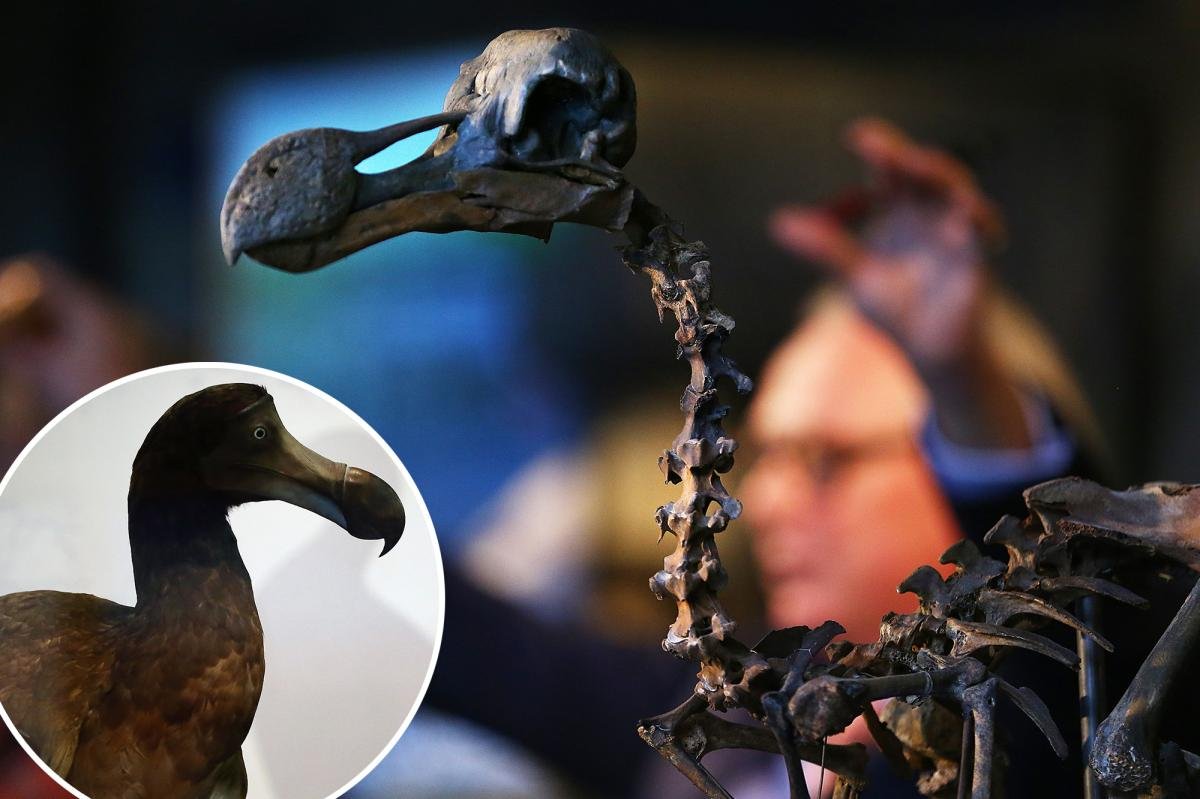
A museum employee looks at a Dodo on display at the ‘Extinction: Not the End of the World?’ exhibition at The Natural History Museum on Tuesday, February 5, 2013, in London, England. Getty Images
This ground-hugging pigeon relative was reportedly wiped out by Dutch sailors — who they were completely unafraid of — via both hunting and predation by the dogs, cats, pigs and rats the interlopers brought with them.
The allegedly dim-witted avian subsequently became shorthand for stupidity, with accounts describing how they’d hold the dodos captive so their distressed squawks would attract their brethren.
Meanwhile, the expression “going the way of the dodo” means to go extinct, or become obsolete.
However, the recent study shows that they didn’t deserve this evolutionary Darwin award.
The Birds exhibition room is seen at the Natural History Museum in London, England, on Tuesday, April 17, 2018. In Pictures via Getty Images
To determine the extinct bird’s cognitive capacity, the team of international researchers conducted high-resolution CT scans of perfectly preserved dodo skulls, of which there are only three in the world.
This allowed them to recreate the noggin’s shape, shedding light on the brain’s size and structure. They were also able to compare the dodo to different members of the pigeon family.
3D models of the dodo skull and its pigeon relatives. Oxford Academic
The team found that the “dodo’s forebrain, linked to cognition and memory, was similar in proportion to other pigeons, when compared to the rest of the brain.”
“In other words, there is no evidence the dodo was less intelligent than any other pigeon,” the researchers wrote. “This is also backed up by previous research suggesting that the overall brain size was similar relative to body mass compared to other pigeons.”
What’s to account for their trusting nature around humans? The researchers wrote that they “simply had nothing to fear until humans arrived, as is common for island species with no predators.”
“Our findings challenge the longstanding stereotype of the dodo as a clumsy, foolish daytime forager,” wrote Professor Vera Weisbecker, from Flinders University, in Adelaide, Australia. Corbis via Getty Images
Their brain did differ from other pigeons in that their optic lobes — the region responsible for initially processing visual data — were smaller than their statuette-sized brethren.
This suggested that they were adapted to low-light conditions at night, dispelling the notion that they were strictly diurnal.
Researchers theorized that this ocular enhancement allowed them to forage in the dark, giving them an advantage over giant tortoises — which used to roam Mauritius — and other competitors for food resources that were only active during the day.
Perhaps one day we’ll be able to gauge the extinct avian’s intelligence for ourselves.
Texas firm Colossal Biosciences hatched live chicken chicks from an artificial egg for the first time this past spring, marking a crucial, “Jurassic Park”-esque step in its mission to bring back the dodo and other extinct avians.
“We didn’t just copy nature,” company CEO and co-founder Ben Lamm previously declared to The Post. “We tried to re-engineer it.”