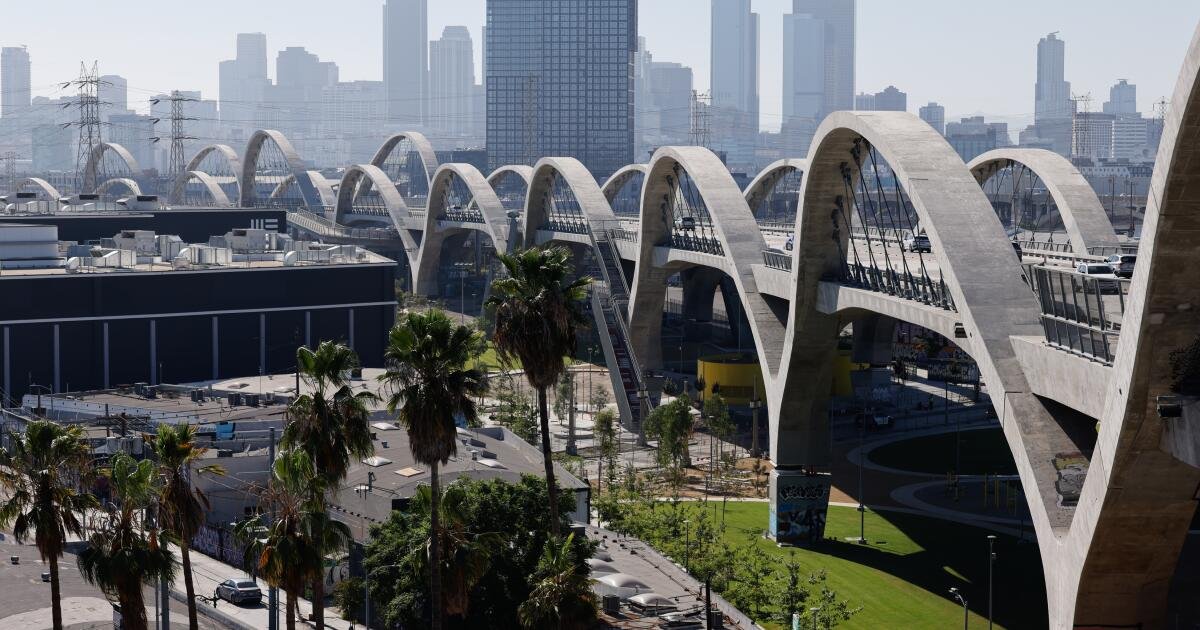
The 6th Street Bridge, one of Los Angeles’ most ambitious public works in a generation, is in a sorry state. The $588-million span, which opened four years ago with a design by Michael Maltzan Architecture and HNTB, has become layered with furious graffiti, particularly its spiraling approaches, which resemble open-air galleries of street art. Copper wiring that once made its stretched arches resemble a rhythmic ribbon of light has been stripped away, leaving the road dark at night. Trash collects and blows along walkways.But beneath the bridge another version of Los Angeles is struggling to emerge. Expected to open later this year, the $62-million Sixth Street PARC — Park, Arts, River and Connectivity — was envisioned as a key civic complement to the bridge, transforming former maintenance yards and neglected industrial spaces into a bustling landscape of recreation and culture while serving as a connective tissue between the Arts District and the working-class Latino neighborhood of Boyle Heights.However, given the condition of the bridge, the park’s future already feels uncertain. It will take more than good intentions for the project to avoid the same outcome. Graffiti covers portions of the 6th Street Bridge, including an access way to Boyle Heights near the new Sixth Street PARC. (Carlin Stiehl / For The Times) “The park was always fundamental to the overall conception of the bridge,” said Michael Maltzan, founder of Michael Maltzan Architecture. “It’s this idea of changing the role of infrastructure from one of dividing communities to one that really weaves them together.”When complete, the park will stretch 12 acres from Mateo Street in the Arts District to the edge of the 101 Freeway in Boyle Heights. Led by the LA Bureau of Engineering and designed by landscape architects Hargreaves Jones and engineers Tetra Tech, the green space was funded by a state grant and an additional $2 million from the city.In Boyle Heights there will be fields, plazas, picnic areas, playgrounds, splash pads, a dog park, sports courts and a skate park. The Arts District side will include seating and fitness areas, a coffee shop, venues for performances and art, and a direct tunnel to the L.A. River. The massive viaduct above will be a constant source of shade — its repeating, dinosaur-like ribs and legs accentuating each successive zone. Michael Maltzan, founder of Michael Maltzan Architecture, which along with HNTB designed the 6th Street Bridge, sits on the Arts District side of Sixth Street PARC. Maltzan hopes that the park can further the original mission of the bridge to create a thriving civic space. (Carlin Stiehl / For The Times) Construction crews now shuffle among just-planted succulents, fresh expanses of lawn, and bright yellow pavilions. Yet troubling red flags are popping up too. Graffiti already plasters shipping containers, bridge columns and even the signs announcing the project itself. Litter catches against freshly installed landscaping. All suggest that the park’s fate could very well mirror that of the bridge above — civic ambition miserably fading after the ribbon cutting.A divided park, a divided cityA portion of the park resides within the Arts District Business Improvement District, which already helps provide neighborhood security, beautification and programming to a thriving downtown community. Arts District BID executive director Miguel Vargas said the organization will support the city in making sure the park is a neighborhood asset — but only within the borders of the Arts District.“We’re funded by local property owners, and we cannot use local property owner funding to service an area that’s outside of our boundaries,” he explained. The Arts District side of the new Sixth Street PARC underneath the 6th Street Bridge. The Arts District has a dedicated Business Improvement District program to help care for the new space. (Carlin Stiehl / For The Times) Unlike the Arts District, the riverside section of Boyle Heights has no business improvement district, and no sure means of maintenance and security beyond the city. The city, however, has lost local trust despite working to finalize an agreement between the Bureau of Engineering and the Department of Recreation and Parks to take on operational responsibilities.A coalition of dozens of local property owners in May applied to the Los Angeles City Council to create what is being called the Boyle Heights Industrial Flats Business Improvement District. If approved, it would tax businesses to pay for private security patrols, street cleaning and landscape improvements. But the proposal has raised concern among some residents who are wary of being left out of the process due to outsized private influence.“The BID doesn’t feel like part of the community because they didn’t reach out,” said Boyle Heights resident Derek Mejia. As for the BID’s security patrols, he said: “I don’t know that it keeps any of the neighborhood safe. We’re already a heavily policed area. Why add more to it?”During the last few years the area has seen creative businesses trickle over the river from the Arts District, even after a spate of galleries were rebuffed by anti-gentrification activists. The land has long been dominated by cold storage warehouses (including the now-infamous Lineage Logistics’ warehouse), rail infrastructure, and food, garment and metal processing. At night, crime has been common. But in the early 2020s, Hollywood, juiced by TV’s streaming wars, started to gravitate to the area’s massive warehouses and easy access to freeways and industrial infrastructure. Shep Wainwright, owner of East End Studios, stands inside a section of the studio, which is adjacent to the new Sixth Street PARC. A variety of film and TV studios have cropped up in Boyle Heights in recent years. (Carlin Stiehl / For The Times) Warehouses-turned-studios include East End Studios Mission Campus and Ace Mission Studios, sited on either side of the Sixth Street PARC, and 7th Street Studios, which hosts production for Apple. Supplemental facilities have surfaced, including wardrobe shops and production storage facilities. Given Hollywood’s recent struggles, some production has pivoted to incorporate alternative programming. Ace Mission Studios has hosted immersive exhibits like the Balloon Museum, the popular art park Luna Luna and the Skyline Festival, an electronic music event that drew tens of thousands. Both the newcomer studios and the longstanding industrial businesses have been eager to improve the area’s prospects via the proposed BID — particularly with the impending arrival of the park.“Without control, I fear that the park probably goes a little bit sideways,” said architect Tima Bell, whose firm Bell Design Group worked on the neighborhood’s major studios. He noted that thieves have twice stolen copper wiring for street lights next to the projects.“The park could be this great asset, or it could very quickly become a problem,” added Shep Wainwright, managing partner of East End Capital, which manages East End Studios Mission Campus. Margarita Amador, secretary of the Boyle Heights Neighborhood Council, stands on the Boyle Heights side of Sixth Street PARC underneath the 6th Street Bridge. (Carlin Stiehl / For The Times) Also supporting the BID is Margarita Amador, a lifelong Boyle Heights resident and secretary of the Boyle Heights Neighborhood Council. She worries about gentrification but also believes Boyle Heights can’t afford to reject every potential investment. She said the area’s newest businesses are now listening to the community after initially ignoring them, and will foster needed jobs and opportunities.“I grew up in that area and nobody would come to that side of town because it was known as violent. Now people feel safe to come,” she said. “They’re willing to invest in our community to improve our quality of life.”The missing piece?Yuval Bar-Zemer, a local developer, activist and former member of the Sixth Street Viaduct Design Advisory Committee, has watched the bridge deteriorate for years.“I don’t understand how someone can invest hundreds of millions of dollars in infrastructure, then it’s like, ‘We finished. Now let it go to hell,’” said Bar-Zemer. He and local nonprofit Los Angeles River Artists & Business Assn. (LARABA) are proposing a nonprofit to oversee management of the park and bridge, on both sides — similar to Friends of the High Line in New York, or L.A.’s Friends of Griffith Park. The organization, Bar-Zemer said, would partner with city agencies, local communities and any BIDs, and its operations would be supported by city funds, internal fundraising and revenues from filming on the bridge. A City Council motion could transfer operational responsibilities from the city to the nonprofit, he noted.“Whatever the city has in the budget for the park, let’s have it,” Bar-Zemer said. “If the responsibilities are not carried out, you can fire us. The risk for the city is nothing.” Yuval Bar-Zemer, a local developer, activist and former member of the Sixth Street Viaduct Design Advisory Committee, is proposing a nonprofit to oversee programming, maintenance and management of 6th Street PARC and bridge, on both sides— Boyle Heights and the Arts District. (Carlin Stiehl / For The Times) Maltzan, who admits to being frustrated by the bridge’s poor upkeep, is supportive. “I don’t know of too many major civic park spaces in North America that now don’t have one of these kinds of organizations,” he said.LARABA, said Bar-Zemer, has presented the concept to local Councilmember Ysabel Jurado’s office, but “it’s not even in the ‘hey, let’s put it on the agenda’ phase.” Jurado’s office said in a statement that any potential park management needed to be vetted by the community: “My priority is ensuring that neighborhood voices remain at the center of those decisions. Any long-term model should reflect the needs of the people who live and work here and strengthen, rather than replace, public accountability.”Making it belong No matter what governance model ultimately emerges, the park’s future could unfold in dramatically different ways. If upkeep fails, it could drag down both of its neighborhoods and create dire health and safety issues. If it’s successful, it could galvanize the areas and become a central gathering place in a city that sorely needs more. A green patch of park land marks Sixth Street PARC on the Boyle Heights side of the 6th Street Bridge. (Carlin Stiehl / For The Times) But even the latter outcome is complicated. Success, some here fear, could increase the already-palpable risks of displacement in Boyle Heights. Verita Topete, a resident and member of Centro CSO, a local grassroots organization focused on social justice and community self-determination, worries about the area turning into another Arts District.“There’s going to be people coming in from the other side of the bridge — wealthier people — from the … downtown area,” she said. “We’re already seeing it now. So people are wondering, ‘Am I gonna be able to afford my rent?’” East End Studios is one of several studios that have emerged in Boyle Heights near Sixth Street PARC, which is slated to open underneath the 6th Street Bridge later this year. (Carlin Stiehl / For The Times) Megan Esopenko, associate principal at Hargreaves Jones, noted that her team held public meetings, convened workshops, distributed surveys and led neighborhood site tours to ensure that public concerns were incorporated into their plans for the PARC. “We met with them. We talked to them. We designed with them. This park is for them,” she said.But that kind of work can’t stop once PARC opens, said neighborhood council secretary Amador. Success will depend on an ongoing dialogue between the city, private organizations and neighborhood residents to address coming challenges, she said. Despite Hollywood’s current problems, the area could become a major production district, noted Bell. And pricey new apartments and coffee shops are already sprouting up nearby, clearly not catering to locals, said Amador. The area, she added, will inevitably change, park or not. Benches being placed and trees are being planted as construction continues on Sixth Street PARC, which is scheduled to open underneath the 6th Street Bridge later this year. (Carlin Stiehl / For The Times) “We have a lot of organizations and citizens that work together. We will fight. We’re not going to get kicked out of our own home,” she said.Maltzan is hopeful about the park’s future if leadership, citizens and businesses on both sides can step up. “If this area is successful in navigating these pressures and inevitable frictions — but also potential — then the bridge and the park will do what we hope we wanted them to do: create a model for the way physical space can help support a better version of a future Los Angeles.”