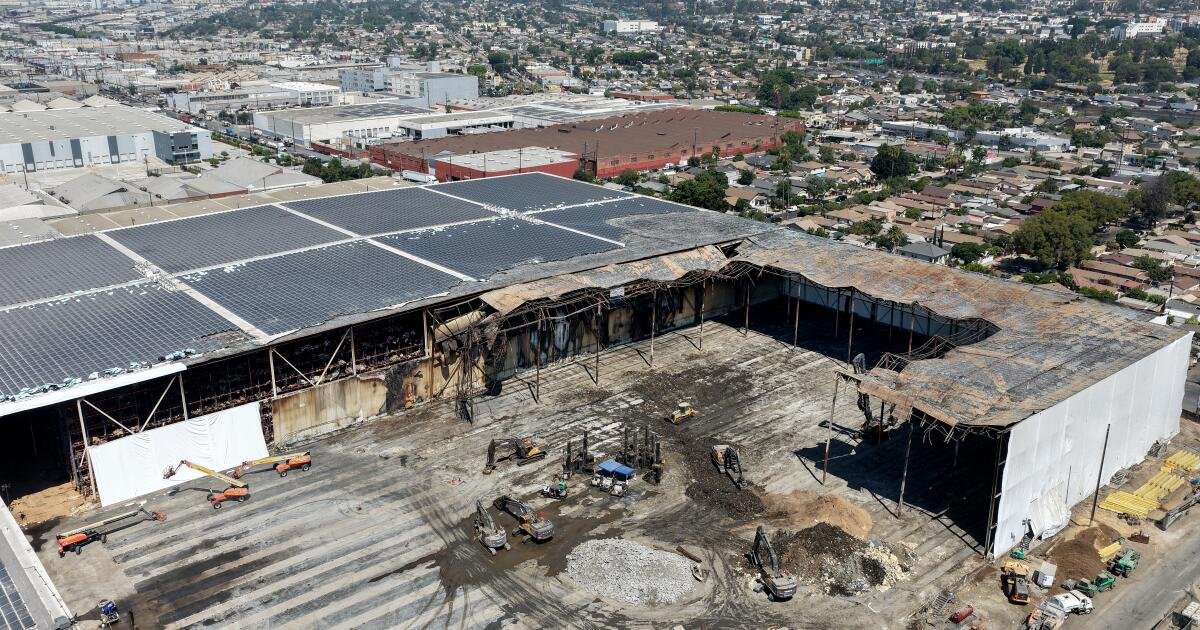
Southern California air regulators Thursday adopted a slate of new requirements aimed at neutralizing the rancid odors from the fire-damaged Lineage warehouse that still contains millions of pounds of rotting food.The South Coast Air Quality Management District’s hearing board, a five-member committee tasked with deciding enforcement matters, voted unanimously to impose more than 90 measures to strengthen odor mitigation efforts and cleanup.South Coast AQMD has been inundated with more than 4,000 odor complaints related to the Lineage cold storage facility in Boyle Heights, prompting the agency to issue the company at least 20 violation notices for public nuisance. The board’s decision provides a legally enforceable baseline for the cleanup and requires the company to remove at least 8.8 million pounds of food waste each week. The pace would put Lineage on track to finish emptying its freezers within two weeks. The company must also sanitize the freezer within seven days of clearing out remaining food waste. “This is a very dynamic situation, it’s not anything any of us have seen before, with the rotting food waste,” said Jason Aspell, deputy executive officer at the AQMD. “The conditions encourage speed. Removing the source of the odors is the primary objective here. However, that speed should not come at the detriment of the emission of odors or public health.”The warehouse has two cavernous freezers on the east and west sides of the building. Workers have cleared out and sanitized the eastern freezer, which was largely destroyed in the fire and filled with spoiled food and charred debris. But millions of pounds unrefrigerated food, mostly meat and seafood, remain in the western freezer, which was unaffected by the blaze.Cleanup workers will be allowed to remove waste and fire debris only through the warehouse’s south loading dock, which is farther from neighbor homes. Lineage must operate an odor-neutralizing misting system around the warehouse and any openings.The air district’s order requires Lineage to establish a public notification system to update residents on the cleanup’s progress and activities that could result in an increase in odors. Lineage representatives said the company has already taken many of the actions required under the air district. So far, 80% of the food waste has been removed from the warehouse, according to the company. “From day one, Lineage has been dedicated to containing the fire, supporting the community and working cooperatively with all the agencies to get done with the cleanup as quickly as possible,” “Lineage understands the community’s concerns and their frustration with the odors. We don’t deny that there are odors coming from this facility.”The vote followed roughly six hours of emotional testimony from dozens of residents from across southeast Los Angeles County who pleaded for the air district to take action to require Lineage to do more to suppress sickening odors. From Boyle Heights to Monterey Park, residents said they were overwhelmed by the smoke from the week-long fire, and then tormented by the horrible stench from decaying meat and seafood. Los Angeles Mayor Karen Bass, City Councilmember Ysabel Jurado and all five Los Angeles County supervisors were among the elected officials who submitted comments and letters in support of the abatement order. Hearing board members echoed fears from the community about the potential release of ammonia, a flammable and highly toxic gas that was used as a refrigerant for Lineage’s freezers. L.A. Fire Department officials have said storage tanks holding about 14,000 pounds of ammonia were removed. Board members asked if residual ammonia could be leaking from the open pipes that weave throughout the building. Aspell, the deputy executive officer, acknowledged that the lung-irritating chemical continues to be a concern. But because decomposing food is a source of ammonia, the source of any emissions remains muddled, regulators said.“It is very apparent that it is coming from the food waste,” Aspell said about lingering ammonia emissions. “We are looking at the odors for the food waste in this order. In terms of concerns in anhydrous ammonia from [Lineage’s] refrigeration system, that continues to be looked at by other agencies as part of this effort.”Lineage contractors installed air filtration systems to reduce the amount of air contaminants seeping out of the warehouse. Thursday’s order requires Lineage to monitor the air these filtration systems discharge into the community. During Thursday’s testimony, Aspell said the highest ammonia level detected was 70 parts per million, which is more than 15 times higher than California’s short-term health-based benchmarks.Dominic DiCarlo, Lineage’s vice president of global safety and compliance, said he was “highly confident that ammonia from the refrigeration system was not compromised.” He said the company was spending $1 million a day to get rid of the food, haul it to landfills and tamp down odors. They said they installed 26 misting stations around the perimeter of the building. Ahead of Thursday’s meeting, the AQMD also added conditions to mandate that Lineage continue tracking ammonia, smog-forming emissions and toxic air contaminants. The air district was questioned by the hearing board on whether it intended to perform its own monitoring. Officials said they have upgraded air monitors at nearby Eastman Avenue Elementary School to screen for hydrogen sulfide, methane and ammonia — all byproducts of rotting food. Ahead of Thursday’s vote, hearing board member Cynthia Verdugo-Peralta expressed her sympathy to the families who were enduring the fallout from the fire. She said the ordeal was the latest incident of “regional poisoning of that whole area.”“This has been a very sad situation for the people there,” she said. “I feel bad that they were not evacuated immediately. I believe that they should have been. I know that the AQMD didn’t have any say-so in that, but … they should have been.”