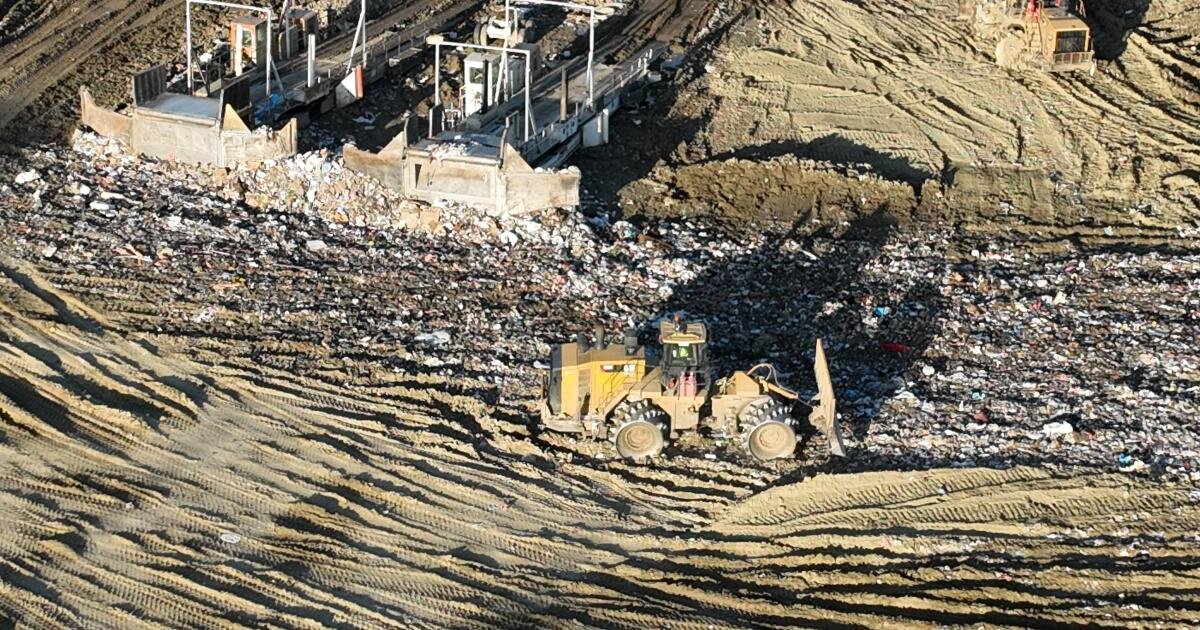
Three years ago, environmental regulators discovered garbage burning deep inside the Chiquita Canyon Landfill in the Santa Clarita Valley. Few imagined the calamity that would follow. Somehow the landfill’s pollution control system introduced oxygen below, causing decades-old waste to rapidly decompose, generating intense heat and eventually widespread smoldering, federal and state environmental agencies say. The broiling temperatures released toxic gases and hazardous liquid waste that bubbled up to the surface. Residents living in the nearby communities of Val Verde and Castaic have phoned in thousands of complaints about stench and lived with nausea, dizziness and trouble breathing. The underground fire has tripled in size since first confirmed in 2023. Recently a towering mound of landfill garbage perched on the hillside has warped and threatens to trigger an avalanche of garbage and chemical-filled liquid, or leachate, according to the California water board. Waste Connections, the landfill’s owner and operator, says it has been working to stabilize that area.“In a worst case scenario, the hillside can liquefy and actually slide into the community,” Assemblymember Pilar Schiavo (D-Santa Clarita) said at a news conference last month. At first, local officials described the problem in Los Angeles County at Chiquita Canyon landfill as a rare, even unprecedented disaster. But since then, California regulators have learned that at least two other landfills are wrestling with high temperatures and similar conditions. Scorching temperatures have overtaken at least 30 acres of El Sobrante landfill near Corona in Riverside County. Excessive heat and emissions have also been detected at Avenal landfill in the San Joaquin Valley.The discoveries raise an unsettling question: How many landfills are dealing with these disasters? Are they a broader problem in California?If you live near a landfill and have experienced an abnormal spike in odors or other issues, we would appreciate the opportunity to hear about your experience.At Chiquita Canyon, conditions have continued to deteriorate. In the years that I’ve covered this issue, I’ve met residents who’ve taken extreme measures to escape the toxic pollution. They’ve worn gas masks and slept overnight in grocery store parking lots. Several families sold their homes. Those who have stayed continue to deal with risks to their health and safety. Schiavo said the stench near Chiquita Canyon has gotten worse in recent days as workers try to stabilize the hillside.In Val Verde, children out of school for the summer have hardly been able to enjoy their time off.“They are already suffering — prisoners in their own homes,” Schiavo said. “They have a great trampoline in front of their house. They can’t jump around on because of this toxic air.” On a recent weekday morning, landfill workers were staged around the damaged, western side of the landfill with heavy machinery. Across the street, dozens Los Angeles County firefighter recruits jogged at the Del Valle Regional Training Center, pushing through the inescapable aroma of trash in the air.Abigail DeSesa, a longtime resident of Val Verde who lives about a mile from Chiquita Canyon, said she regularly wakes up with pounding headaches she believes are related to landfill gases from the fire. She’s gone to a community relief center set up at a local hotel to escape the smell, but has to return home at the end of the day.“The gas is getting into our homes and I am waking up sick every morning,” DeSesa said. “Where is the relief for that? I did not break the landfill, so why am I paying a heavy price with my physical and mental health to fix it?”Chiquita Canyon closed at the end of the 2024 and stopped accepting new garbage. But the fire is expected to last for years as it continues to consume decades-old trash. Underground landfill fires are complex, nearly impossible to extinguish once they break out. As regulators search for a solution, residents are really struggling with the wait.In other air pollution newsWildfires have scorched thousands of acres in Washington state. They’ve destroyed hundreds of homes, prompting tens of thousands of people to evacuate and filling the air with black smoke. For some, the disaster is reminiscent of the 2025 wildfires in Southern California, L.A. Times reporter Clara Harter wrote.Wildfire smoke has overwhelmed large swathes of the Pacific Northwest, reaching hazardous levels in areas closest to active blazes. The National Oceanic and Atmospheric Administration observed a large plume of smoke extending southward over the Pacific Ocean. The pollution is expected to drift into the Bay Area, stealthily diminishing air quality without the signature campfire smell associated with wildfire smoke, according to Anthony Edwards, the San Francisco Chronicle’s newsroom meteorologist. In-N-Out, a the beloved California fast food chain, recently found itself at the center of heated debate in Culver City. Are the restaurant’s popular burgers worth the added traffic and air pollution? L.A. Times business reporter Suhauna Husain writes that some residents are fiercely opposed to a proposed In-N-Out in Culver City, arguing the chain’s notoriously congested drive-throughs — filled with idling cars — could pose a health and safety risk. The Culver City Council responded by extending its moratorium on new drive-through restaurants. Other environmental newsWildfire seasons are becoming alarmingly more destructive in California, and they’re erasing a commodity already in short supply — housing. At the turn of the century, wildfire destroyed about 3% of the California homes they came into contact with, per L.A. Times wildfire reporter Noah Haggarty. The rate rose to 18% by 2020 — despite extensive home-hardening practices.The aviation industry is exploring using a Brazilian palm tree to make jet fuel. Researchers say oil-rich macauba palm seeds can be harvested to make a cleaner and renewable source of aviation fuel, Bloomberg energy correspondent Peter Millard reports. Aviation emissions have been increasing globally, prompting some governments to pursue alternatives to fossil fuels. Although sustainable aviation fuel is very small segment of the market, European mandates may drive airlines to seek out reliable sources in the near future.Small farmers claim they are being harmed by California groundwater regulations, causing some to leave more land fallow, according to L.A. Times water reporter Ian James. The strict fee structure and complex rules were designed to prevent overpumping and aquifer depletion. But these “one-size-fit-all” regulations impose a greater financial burden on small farmers — that generally use less water. This is the latest edition of Boiling Point, a newsletter about climate change and the environment in the American West. Sign up here to get it in your inbox.For more air quality news, follow me at @_TonyBriscoe on X and LinkedIn.