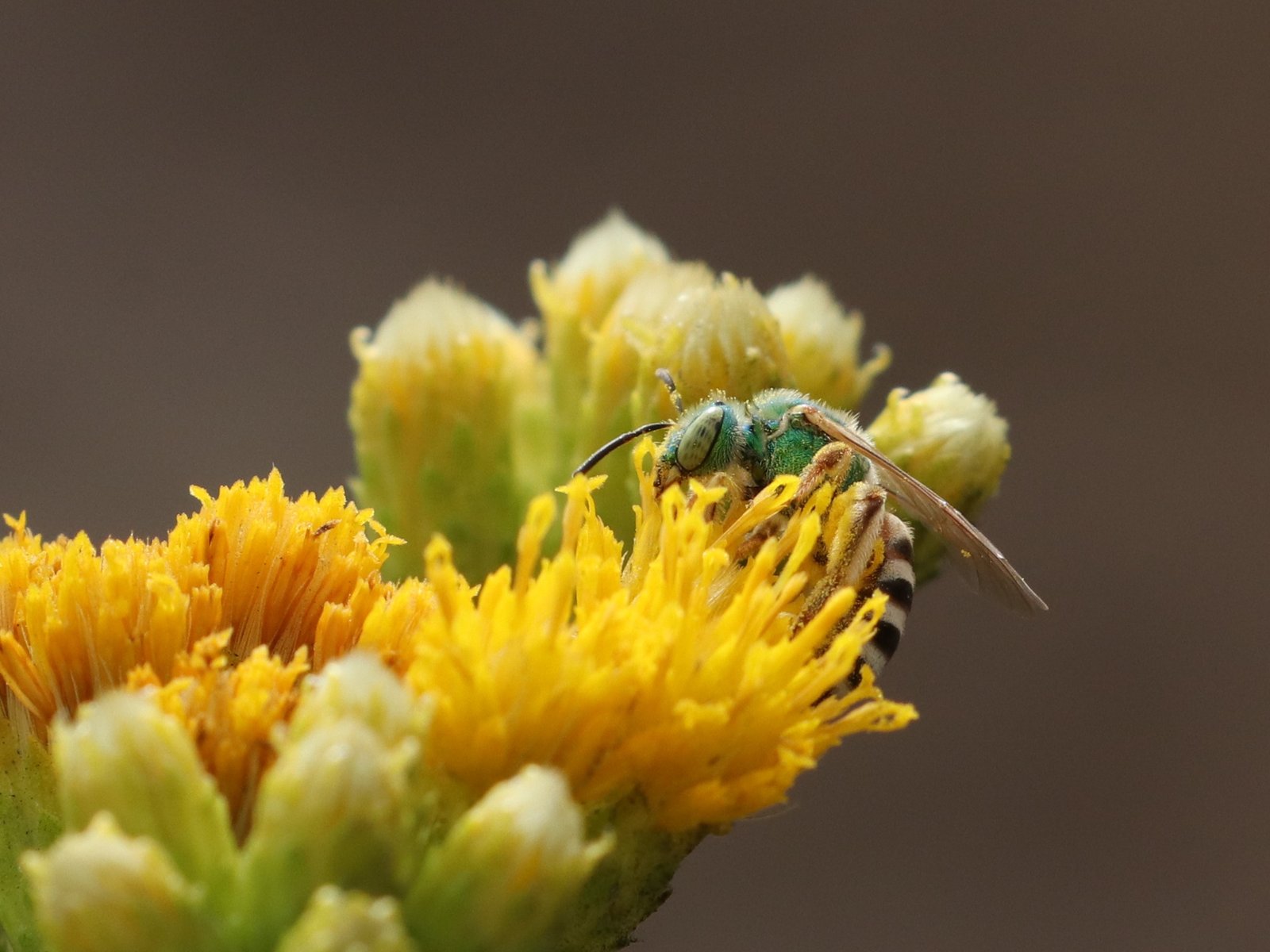
I was today years old when I learned honeybees are colonial invaders, brought over from Europe in the 1600s to use their wax for candles.
And like much about the colonial invasion of North America, honeybees — despite their popularity — create a lot of problems. The state has over 1,600 species of native bees that aren’t the honey-making kind. That’s 40 percent of all the species in the country. San Diego county alone boasts 700 species.
But honeybees might be crowding them out.
Because honeybees live in colonies of ten thousand or more, they’re extremely useful portable pollinators for agriculture. Farmers from Imperial Valley to Central Valley import colonies of honeybees to their fields to produce all kinds of crops from almonds to alfalfa.
A feral honey bee colony. / Photo courtesy of Cindy Pencek of the California Native Bee Society
Yet, especially in wild areas, honeybees hoard all the food. As corbiculate bees – corbicula is basket in Latin – they collect and store pollen in a kind of basket on their legs before returning to the hive. They often take all the pollen off a flower. Multiply that by tens of thousands of honeybees out scoping flowers and that’s a lot of competition for native bees – who often live solitary lives and time their reproduction cycle with the blossoming of a specific plant.
“California Native Bee Society’s position is to uplift native bees, not necessarily put down honeybees,” said Jess Mullins, president of the California Native Bee Society and a PhD in ecology.
That’s partly why the society has launched a public vote and push for California to adopt a state bee. Unsurprisingly, all 19 choices the public can choose from through Sept. 8 are native species.
Take the California Fairy Bee. About the size of a pencil eraser, her life is tied to the blooming of the Mariposa Lily which is her only food source. Like many native bees, she lies dormant underground until the lilies bloom in April.
A female California fairy bee. / Photo courtesy of Cindy Pencek of the California Native Bee Society
Most natives are single ladies who meet up with mates on their flowers of choice. Once the deed is done, the males die and the now single mothers buzz off alone to dig their nest underground.
She builds each egg a chamber, “a little bedroom where she leaves pollen and nectar in a perfectly spherical ball,” Mullins said. “She’ll lay her eggs and close off the chamber with soil or plant resin, and then she builds another.”Some native bees are into interior design, like the silver-tailed petal-cutter bee. She chews perfectly circular pieces out of flower petals and wallpapers the insides of her nest with them, Mullins said.
Photos of the bee on the society’s website show the cute, tiny insect towing a petal larger than her body.
Mullins studied long-term native bee data to understand how climate change impacts their distribution and population size. Some of her research suggests that native bees in wildlands like state reserves are lying dormant longer to wait-out drought, which is positive. But native bees who live in more fragmented, urbanized areas are struggling to survive over their honey-making colleagues.
Humans can help by building habitat.
“If you’re lucky enough to have a yard, plant native plants and leave some soil bare so they can build nests,” Mullins said.
Reporting this story definitely didn’t make me a honeybee hater. But I will pause and look twice now at the buzzing things around me.
In Other News
A plan to restore wetland in Mission Bay got state Coastal Commission approval and one step closer to becoming a reality. (Union-Tribune)
Red diamond rattlesnakes are a species of special concern so San Diego State students are studying how human disturbances like hikers affect the snake’s behavior to help inform conservation strategies. (Union-Tribune)
The city of San Diego-owned Lake Hodges dam is a mess. A growing coalition wants the city to rebuild the dam in order to raise the existing water level, which has been lowered due to safety concerns. (Union-Tribune)
A U.S. District Court ruled Imperial County officials unlawfully approved a lithium development project and asked a lower court to overturn its ruling in favor of the project. (inewsource)
Escondido residents want the City Council to repeal their OK of a housing development over a former oil and solvent recycling and bulk petroleum storage yard. (KPBS)
Three major oil and gas companies have joined forces to build a 1,300-mile pipeline that would bring gasoline and jet fuel to constrained Southern California. (Union-Tribune)
An 18-year-old San Diegan pleaded guilty to kicking a protected sea lion in La Jolla last October. He faces a $100,000 fine and up to one year in prison. (ABC 7)
Related Posts