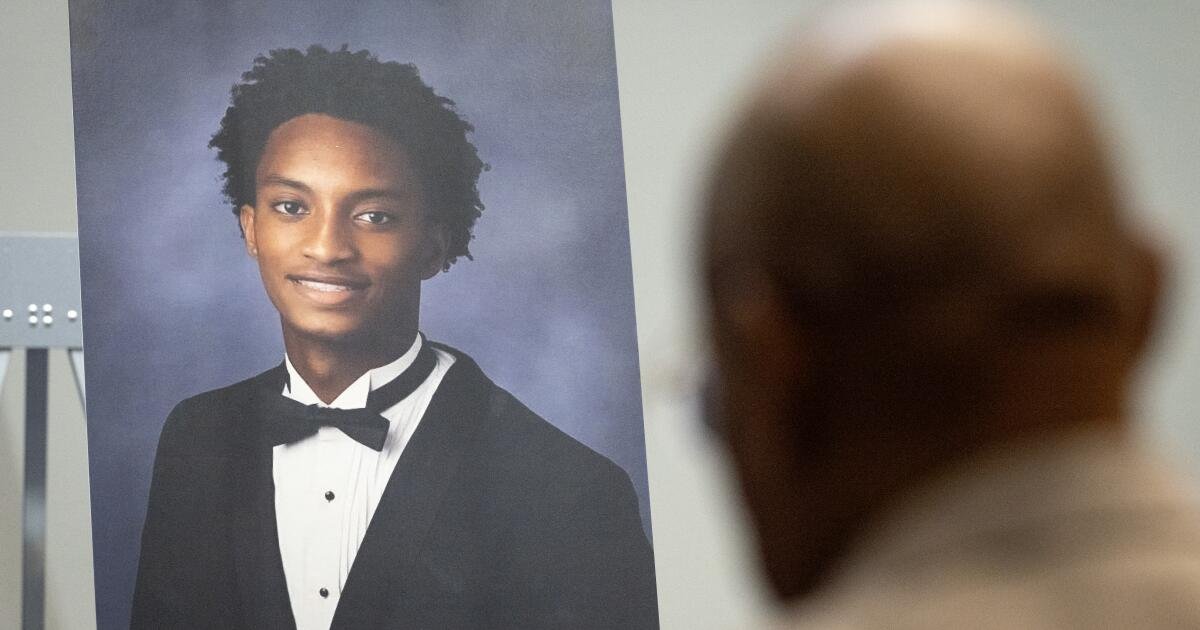
I’ve written quite a few columns about the death of student-athletes over the years.In 2011, I covered the story of Wes Leonard, the high school basketball player out of Fennville, Mich., who collapsed and died shortly after hitting the game-winning shot that preserved his team’s perfect season.Later that summer, at least six high school football players across the country died during or after preseason practices. I spoke with one father who told me he dropped his 15-year-old son, Montel Williams, off at practice in Gurdon, Ark., and never saw him live again. At one point during the interview, we both just wept.None of us know for certain when our time will come. Nevertheless, it is always unnerving when a young person dies. Especially one who excels at sports, because often they are the embodiment of perfect health. Medical examinations revealed that Leonard and Williams each had undiagnosed heart conditions that contributed to their deaths.The question of why God took them so young may never be answered, but at least their loved ones know the cause of death.It’s been two weeks since 18-year-old Nolan Wells died, and his parents still don’t know why or how. All they know for certain is he’s not coming home.The Southwest Mississippi Community College football player went missing after partying with friends on the Fourth of July. His body was found two days later, floating lifeless in the water.Wells was last seen alive on Horn Island, a thin stretch of land 10 miles off the shore of Mississippi. His parents began to worry about him late that night and tracked his cell to a mainland location — not the island. Wells’ car and his keys were at the home where he and his friends stayed the night before taking the boat trip.The results from the autopsy conducted by the Jackson County coroner have not been released, and the preliminary independent autopsy commissioned by the family is inconclusive. There was no evidence of fractures or deep tissue injuries. However civil rights attorney Ben Crump, who represents the family, said there was “red discoloration” on the back of Wells’ skull and that foul play can’t be ruled out.I’ve written quite a few columns about the death of student-athletes. It’s rare for grieving parents asking for an investigation into their child’s death to be seen as political. But because of the location of this story — and the fact Wells was the only Black person seen in any of the footage from that day — political is what this tragedy is. Mississippi politicians — most of them white — have thrown their support behind local authorities while the NAACP questions the reasons an investigation is taking so long.Why can’t we just grieve the loss of a young life?Why does everything have to be about race?Because so much has changed and so much is still changing. In between those two realities are Black parents silently holding the tension between wanting your child to see the world and knowing the world your child wants to see. You see, climbing the socioeconomic ladder and landing somewhere different, economically, than where you started, oftentimes leads to isolation.This is particularly true for Black Gen Xers, the first generation to integrate universities and corporate America en masse, and thus gained access to more of the country’s resources. Like good schools and a house in the suburbs. Few talk about what you leave behind to get there: your collective. Because more often than not, moving up means moving into spaces that are predominantly white. Sometimes you’re the only one in group photos. Sometimes you’re the only one in school or at the company… the neighborhood… the island.Explorer Matthew Henson understood something about this long before I did. In 1909, he stood at the top of the world — quite literally, alongside Robert Peary at the North Pole — because he trusted a white man enough to spend two decades traversing the Arctic with him, at a time when doing so meant betting his safety, his dignity and sometimes his life on that trust holding up.Henson made history. But he also made a calculation that — as a Black parent — haunts me most about Wells’ story. To be “the first one” or “the only one” requires trusting someone who doesn’t share your experience to actually see you when it counts.No matter what we ultimately find out about what happened July 4 on Horn Island, what will stay with me is this sick feeling that Wells was on an island full of people — and yet found himself alone when it counted most.YouTube: @LZGrandersonShow