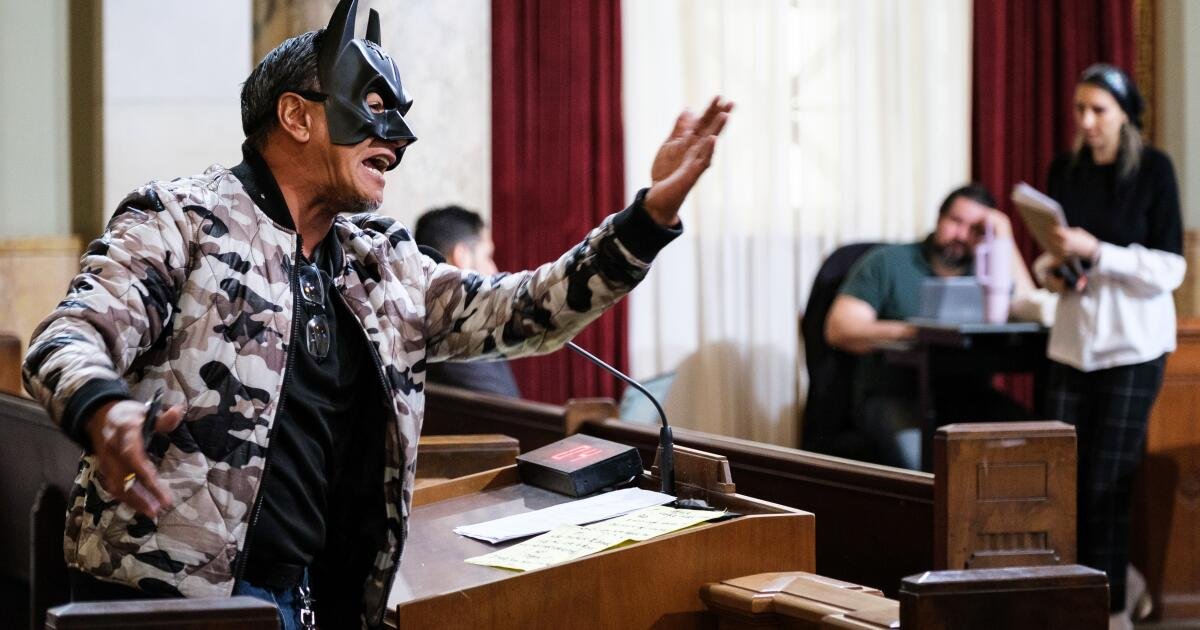
Members of the Los Angeles City Council would like a word or two — to ban.Last July, the council adopted a motion to prohibit two terms — a racial epithet and a slur against women — during the legally required public comment periods of their meetings. As the rules document states, anyone who says “any variation of either of these words” during public comment will be warned. If they say a banned word again at that meeting or any subsequent one, they’ll be removed. Ejected speakers automatically are prohibited from attending future meetings for up to six business days.This policy, championed by Council President Marqueece Harris-Dawson, is meant to push back against words he argues are “designed to attack someone’s personhood and their protected status.”Now, you may loathe the words in question and never use them yourself. You may share the council’s desire to make public comment more civil and appropriate. You may believe Harris-Dawson and the other council members’ hearts are in the right place.But make no mistake: The council is effectively claiming the authority to ban any words it decides are inappropriate or offensive in the future. That’s a very dangerous power to grant any government official. Even if you agree today, you might not always be so fortunate.Imagine a different council justifying bans on words like “trans woman” or “cisgender” because they’re “designed to attack someone’s personhood.” Imagine council members banning the phrases “from the river to the sea” and “globalize the intifada” because they believe these slogans are so offensive, they’re inherently disruptive. That’s the power the council is seizing.And before you raise the slippery slope fallacy, listen to the council president’s own words. Asked whether this was just the beginning of a more concerted effort to police “offensive” language during public meetings, Harris-Dawson replied, “Absolutely. This is as much a step as we can take at this moment, we believe. But we think it will open us up to take additional steps in the future.”We should take him at his word.It’s certainly true that things can get ugly during public comment. During a March 2025 council meeting, for example, a regular attendee spent his time at the podium leveling a series of expletive-laden complaints, hurling insults and slurs at council members, Jews, the pope and Black people.Council meetings are frequented by many characters of this type, and it can be an understandably difficult and frustrating experience for those on the receiving end of these tirades. But the 1st Amendment reflects a judgment that, in a free society, it’s safer to require officials to tolerate even vile language than to empower officials to decide what criticism is off-limits. The council can prohibit actual disruption of its proceedings, like speaking when not recognized, but it can’t conflate harsh words with disruptive conduct.Unfortunately, this is precisely the kind of conflation the council’s ban allows it to make, and the ban isn’t even limited to the use of slurs as insults. The rules make clear that speakers are prohibited from using the specified epithets during public comment “even though the speakers would use the words to express a non-offensive, non-vulgar viewpoint.” Put another way, the words are banned regardless of context, including when criticizing the ban itself — which is what resident Stacey Segarra-Bohlinger was doing during a council meeting last Halloween.Speaking during public comment, Segarra-Bohlinger protested the ban on the slur against women, saying the council was “afraid of the word.” In accordance with all other council rules, she remained on topic, did not exceed her allotted time and did not otherwise interfere with the council’s ability to conduct business. In other words, she didn’t disrupt the meeting. Councilmember Heather Hutt felt otherwise. She objected on the basis that the word offended her and insisted that the council president intervene. Segarra-Bohlinger was then warned and threatened with removal. When she protested again in a similar fashion the following December, she was removed and banned from future meetings in response.This unconstitutional overreach is why the First Amendment Coalition and my organization, the Foundation for Individual Rights and Expression, sent a demand letter to the council: Repeal these rules now or face a lawsuit.We’re doing this because defending our ability to speak, even when we offend others, is critical to preserving our fundamental freedoms. If we allow the government to decide what we can and cannot say, then our 1st Amendment right to speak our minds becomes a mere privilege granted at the discretion of the powers that be.It’s never fun to feel like you’re being verbally abused or insulted. But the point of public comment is to allow the public to comment, and that commentary sometimes will be offensive and upsetting to some of us. That is the price of public discourse in a democracy, especially if you are an elected official.It’s also how we ensure that our own right to speak freely isn’t infringed upon simply because some find it unacceptable.Angel Eduardo is senior writer/editor at the Foundation for Individual Rights and Expression.