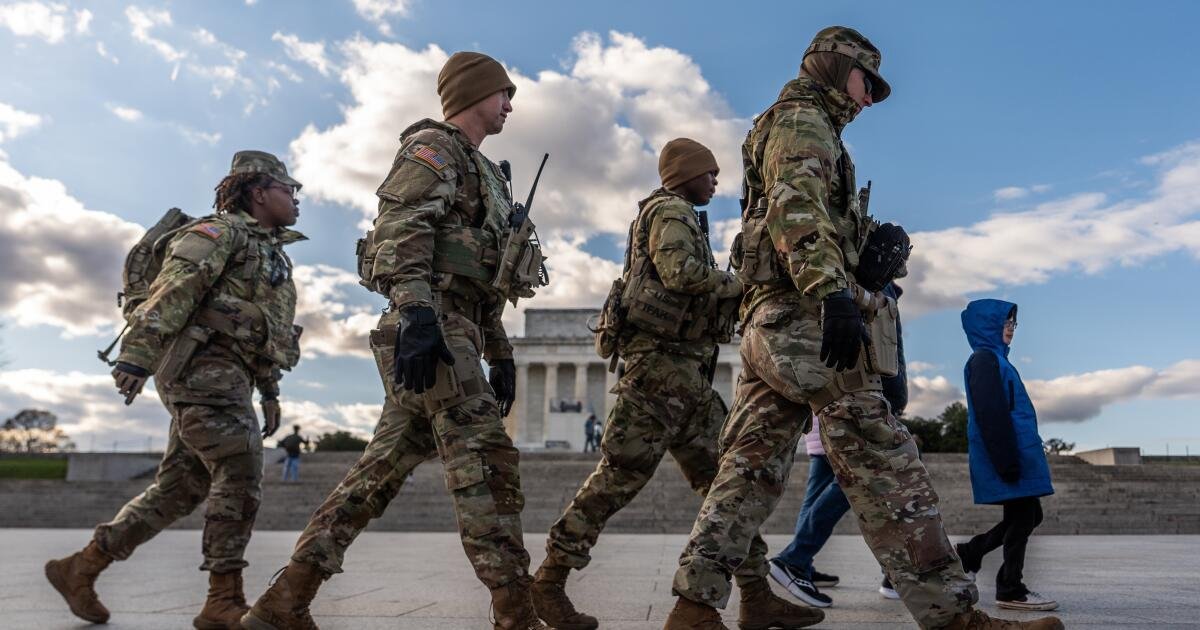
Earlier this month, the Pentagon quietly extended the National Guard’s “D.C. Safe and Beautiful” mission in Washington through Jan. 20, 2029. That date corresponds to no publicly identified security condition, crime objective or military task. It is simply the day President Trump’s term officially ends.The extension raises obvious questions: How will we know when this mission has been accomplished? If January 2029 is its only publicly announced endpoint, what tells the military its job is finished?Defense Department missions are supposed to begin with defined objectives and include clear conditions for ending them. Before troops are committed, civilian and military leaders are supposed to define what success looks like. The armed forces have not always lived up to this standard — Iraq, Afghanistan and now Iran remind us of that — but it remains one of the profession’s foundational principles. Americans should expect that discipline from their military leaders, especially when troops are deployed here at home.The Guard’s deployment in D.C. began last August after Trump declared “a crisis of violent crime” in the nation’s capital. This emergency deployment has since been extended twice. According to a Pentagon official quoted by Washington television station WJLA, the mission will now continue through the end of Trump’s term “or until terminated by the President.”The administration has yet to explain why Washington still requires a task force of more than 4,000 Guard members. If the emergency that justified the deployment persists, Americans deserve to know what conditions would support its conclusion. If the emergency has passed but the mission has changed, the administration should clearly identify a new objective. Instead, the deployment will continue without the administration ever revisiting whether the emergency that justified it still exists.Those omissions are critical. Military missions, especially ones conducted within the U.S., require continuing justification, not merely continuing authorization. If the crime rate falls, what tells the Guard its job is finished? If crime rises, what would justify extending the mission beyond 2029? No public answer has been offered by the president or the Pentagon.More fundamentally, extraordinary domestic military deployments should remain extraordinary. The burden should not fall on the public or on the elected leadership of Washington to prove these deployments are unnecessary. It should fall on the federal government to explain why the mission remains critical.This is more than a military planning problem. Maintaining thousands of Guard members on a standing domestic mission consumes money, leadership attention, training time and personnel who cannot be used for Guard missions elsewhere. Those costs may be justified during a genuine emergency. But they demand detailed public justification when a deployment stretches from months into years.The U.S. has spent more than two decades learning what happens when military missions continue well after their original objectives become blurred. Operations in Iraq and Afghanistan evolved as goals shifted, expanded or gave way to new ones. One enduring lesson from those wars is that missions drift when the continuation becomes its own justification. We should not forget that lesson simply because the military is now operating at home instead of overseas. In fact, that should demand an even higher standard.Mission drift is not just a theoretical concern. Earlier this month, Guard members deployed to assist law enforcement in Memphis fatally shot a man during an on-foot pursuit alongside local police. The shooting’s legality is for investigators to determine. Police officers sometimes must make split-second decisions about using deadly force. The more important question is why Guard members increasingly find themselves performing functions traditionally handled by civilian police.Washington and Memphis are different missions for the Guard operating under different legal authorities. But they point in the same direction. Military organizations adapt to the missions they are repeatedly assigned. Training evolves. Expectations change. Missions that begin as exceptional gradually become routine. That is why defining clear objectives and publicly explaining continued domestic military deployments are important safeguards against normalizing U.S. military presence in our cities.Healthy democracies have long been cautious about maintaining a visible military presence domestically, especially in their political capitals. That caution is not rooted in distrust of the military. It reflects an understanding that soldiers and police serve different purposes, answer to different legal authorities and are trained for fundamentally different missions. Maintaining that distinction protects both institutions and the citizens who interact with them.A date on a calendar is no mission objective. The Pentagon and the president have offered the public only political requirements where operational ones belong.Jon Duffy is a retired naval officer. He writes about leadership and democracy. Insights L.A. Times Insights delivers AI-generated analysis on Voices content to offer all points of view. Insights does not appear on any news articles. Viewpoint This article generally aligns with a Center point of view. Learn more about this AI-generated analysis Perspectives The following AI-generated content is powered by Perplexity. The Los Angeles Times editorial staff does not create or edit the content. Ideas expressed in the pieceThe article argues that extending the National Guard’s “D.C. Safe and Beautiful” mission through Jan. 20, 2029 ties the deployment’s end to a political calendar date rather than to any publicly defined security condition or operational objective, even as Pentagon and Guard officials confirm the mission will last until the end of President Trump’s term “or until terminated by the President.”[1][2][5][6][11]The piece contends that, under long‑standing U.S. military principles, missions should begin with clearly articulated goals and measurable end conditions, and that those standards are not being met in Washington, where the Guard was deployed after a declared “crime emergency” despite violent crime being near a 30‑year low and without a subsequent public explanation of what would mark success or allow the mission to conclude.[7][18][21]The column warns that extraordinary domestic deployments should remain rare and continuously justified, not simply reauthorized, criticizing the absence of any public criteria for either scaling down the force of more than 4,000 troops now on duty in the District or extending the mission beyond 2029 if crime trends change.[9][6][8]The article argues that maintaining thousands of Guard members in a standing domestic mission for years imposes significant financial and opportunity costs—citing estimates that roughly 5,000 troops in Washington cost taxpayers about $3 million per day and could total more than $3.4 billion by 2029—as well as diverting leadership attention and personnel from other Guard responsibilities, all of which the piece suggests require detailed, ongoing public justification rather than broad, open‑ended authorizations.[7][10][8]The piece suggests that long-running operations risk “mission drift,” drawing parallels to the wars in Iraq and Afghanistan where objectives shifted and expanded over time, and notes concerns from constitutional experts and former military officials that normalizing a visible, armed military presence on the streets of the nation’s capital during a nonemergency is a troubling signal for the health of American democracy.[7][10][16]The article raises alarms about the gradual blending of military and police roles, pointing to a recent shooting involving Guard members assisting law enforcement in Memphis and to litigation in Washington in which the city’s attorney general alleges that National Guard troops are effectively operating as a federal military police force in violation of the Posse Comitatus Act, underscoring the piece’s argument that soldiers and civilian police are trained for fundamentally different missions and answer to different legal authorities.[13][21]The column ultimately contends that the burden of proof should rest with the federal government to explain why a years-long domestic military deployment remains essential, to define specific conditions for success and termination, and to reassure the public that the Guard’s presence in Washington will not be allowed to become a routine fixture of urban governance based solely on political timelines.[2][6][11][20]Different views on the topicIn contrast, Pentagon officials and administration representatives argue that the extended National Guard presence is necessary to address what President Trump has described as a crime emergency or “crime epidemic” in the nation’s capital, emphasizing a commitment to “restore law and order” and to make Washington “safe and beautiful” by keeping thousands of Guard members deployed until those goals are met.[1][2][3][5][6][9]Supporters of the mission present the Guard’s role as one of assistance rather than replacement, stressing that troops are supporting the Metropolitan Police Department and federal agencies by providing monument and infrastructure security, conducting community safety patrols, protecting federal facilities, helping with traffic control, and even performing tasks such as snow removal and beautification projects.[2][9][11][12][15]Administration officials and allied law enforcement leaders point to early crime statistics to argue the deployment has produced public-safety benefits, noting that robberies, carjackings and violent crime fell sharply in the weeks after the Guard took control of key patrols and highlighting analysis that found a roughly 24 percent reduction in opportunistic property crime during the first months of the operation.[4][17][10]The Justice Department and task force leaders further cite concrete outputs—such as more than 13,900 arrests, the removal of over 1,500 illegal firearms and the recovery of 23 missing children—as evidence that the broader “D.C. Safe and Beautiful” effort, with the Guard as a central component, is disrupting criminal activity and warrants continuation through major events like the America 250 celebrations.[2][17][19]Administration spokespeople and some legal analysts emphasize that federal authorities are operating under established statutes, arguing that the president has clear legal power to federalize National Guard units, assume control of the D.C. police under the District of Columbia Home Rule Act, and deploy troops to safeguard federal assets and personnel, and therefore contend that the current mission is lawful even as it aids civilian law enforcement.[13][21][22]Officials who favor the extension argue that setting a long-term horizon through 2029 provides stability and planning certainty for multi-year federal crime deterrence efforts, with Pentagon and White House statements framing the continued deployment as part of a sustained national campaign against crime in the capital and asserting that the president will use “all available resources” until law and order are fully reestablished.[1][3][5][6][14]