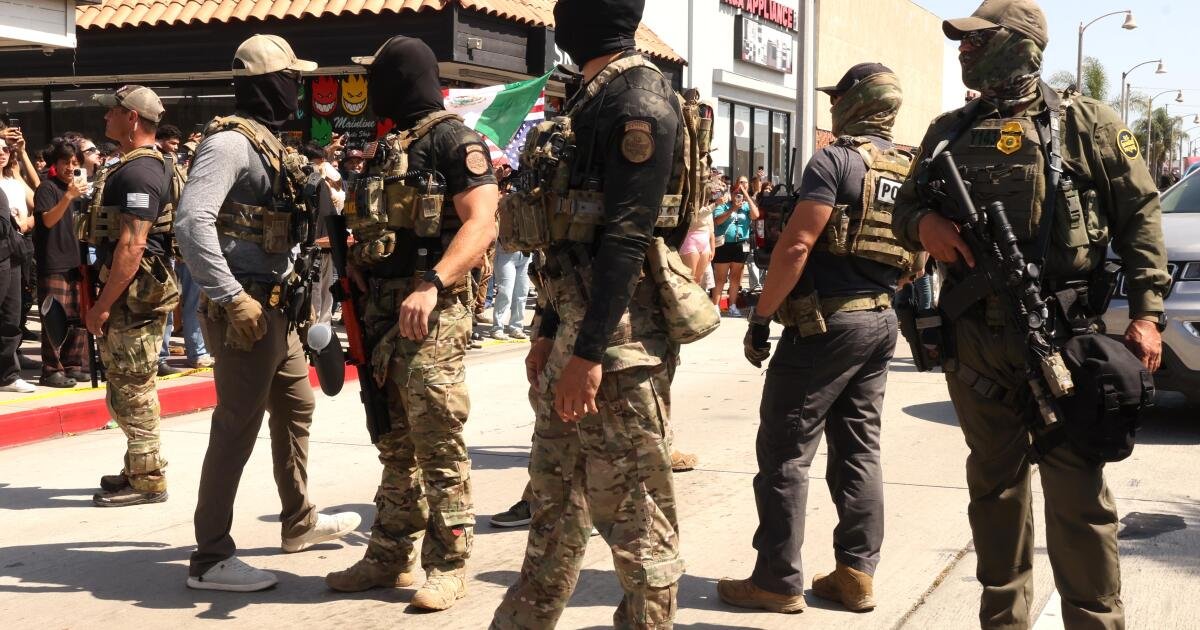
April Walker, a San Diego resident, was observing federal immigration agents in a Target Parking lot in April when she said they boxed her in and pointed a camera at her face and license plate. She said she never provided her driver’s license and the agents only moved their vehicles and allowed her to leave after she called 911. Five days later, she learned that her Global Entry had been revoked. It was only reinstated, she said, after she contacted a reporter who then reached out to the Department of Homeland Security to inquire about the revocation. Walker laid out her story in a federal lawsuit, filed Friday in the Southern District of California, alleging that agents working for the Department of Homeland Security deployed facial recognition technology and license plate information to surveil people observing and documenting federal immigration enforcement. Homeland Security then used that information to revoke Global Entry privileges in retaliation, the lawsuit alleges.“Now more than ever, those of us who have the privilege to speak out have a responsibility to defend the rights of everyone in our communities,” Walker said in a statement. “When people are punished for exercising their First Amendment rights, we begin losing the democratic principles that protect all of us. Every American should be alarmed by retaliatory action against one’s free speech.”In a statement, a spokesperson for U.S. Customs and Border Protection said “Global Entry or other CBP Trusted Traveler Program memberships are not revoked because someone exercises their First Amendment rights.”“Membership may be denied or revoked for reasons such as criminal activity (including pending charges or warrants), violations of customs or immigration laws, or inability to demonstrate low-risk traveler status,” the spokesperson, who did not provide their name, said. According to Homeland Security, members of the Trusted Traveler Program “use expedited clearance lanes on arrival at U.S. airports and when crossing international land and sea borders.”The lawsuit was filed by the Electronic Privacy Information Center and three legal observers around the country, including Walker, who allege they have been subjected to DHS surveillance and retaliation after peacefully monitoring federal immigration enforcement activity. They are represented by Democracy Forward and Hagens Berman Sobol Shapiro LLP.According to the lawsuit, Homeland Security adopted “a secret Protester Surveillance Policy enabling its agents to first collect records on Americans engaging in First Amendment exercise and then maintain them in DHS systems, where they can be used to retaliate against those Americans.” As a result of that policy, the lawsuit alleges, the department has recorded and retaliated against three women, located in Minnesota, South Carolina and California.The plaintiffs asked the court to declare the surveillance policy unlawful, vacate it and prohibit Homeland Security from continuing to collect and maintain records describing individuals’ protected First Amendment activities.“When our government compiles secret dossiers on everyday people for exercising their constitutional rights, it sends a chilling message: if you speak up, watch your back,” said EPIC Deputy Director and Director of Enforcement John Davisson in a statement. “If every protest, every recording, every act of dissent opens us up to surveillance and retribution, privacy and free speech are at risk of collapse.”According to the lawsuit, Walker began filming immigration agents in late March, after encountering a woman being detained in the San Francisco airport. She then participated in legal observation when she returned home to San Diego, keeping a safe distance from agents and never seeking to interfere with their activities, the lawsuit states.In April, in the Target parking lot, Walker said three federal immigration agents, wearing badges, exited their vehicles and approached her car on foot. She said one pulled on the door handled and pounded on her window, while the other two approached and took their phones out.She said one of the agents pulled out a credential that identified him as an agent with Homeland Security Investigations.Although her Global Entry has been reinstated, Walker “has received no confirmation that the government has expunged any record that triggered her revocation.”“She has continued to engage in constitutionally protected legal observation activities, but she worries that her identity is now on a list of Americans the federal government deems to be a threat as a result of her First Amendment exercise,” the lawsuit states.The 55-page lawsuit detailed similar cases around the country. According to the lawsuit, Nicole Cleland, 56, was engaging in legal observation in Minnesota in January when a federal agent approached her car and addressed her by name. The Border Patrol agent allegedly asserted that he had “facial recognition” and that his “body cam” was recording and he threatened her with arrest if she further “impeded” the agents’ work. Three days later, according to the lawsuit, Cleland received an emailed notice that her Global Entry/TSA Pre-check had been revoked by Homeland Security. The notice did not detail the reason that Cleland’s status was revoked.According to the lawsuit, “Cleland had no other interactions with law enforcement in between her encounter with federal immigration agents and the revocation of her Global Entry/TSA PreCheck status, nor had she had any since obtaining Trusted Traveler status in 2014.”“Cleland did not engage in unlawful activity or otherwise take any action suggesting that she posed a security risk during this time period,” the lawsuit states.Cleland’s “Trusted Traveler status” has not been reinstated, according to the lawsuit.Ten days after Jacquelyn Ivey, a South Carolina resident, interacted with federal agents, her Global Entry was revoked, the lawsuit alleges. “The only activity Ivey engaged in proximate to the revocation of her Trusted Traveler status that involved contact with law enforcement was her exercise of her First Amendment right to peacefully engage in legal observation of federal immigration agents’ activities,” the lawsuit states.The revocation of her status was later overturned, according to the lawsuit. In February, the legal nonprofit Protect Democracy and the law firms Dunn Isaacson Rhee and Drummond Woodsum filed a class action lawsuit in the U.S. District Court of Maine, alleging that federal agents are using facial recognition and license plate readers to surveil and threaten legal observers in the state. The named plaintiffs in that case were lawfully observing and recording Homeland Security operations in public and were threatened and called “domestic terrorists” as a result, according to that lawsuit.Homeland Security has previously told news outlets it not have a “domestic terrorist” database, but said it monitors incidents of “threats, assaults and obstruction” of its officers.