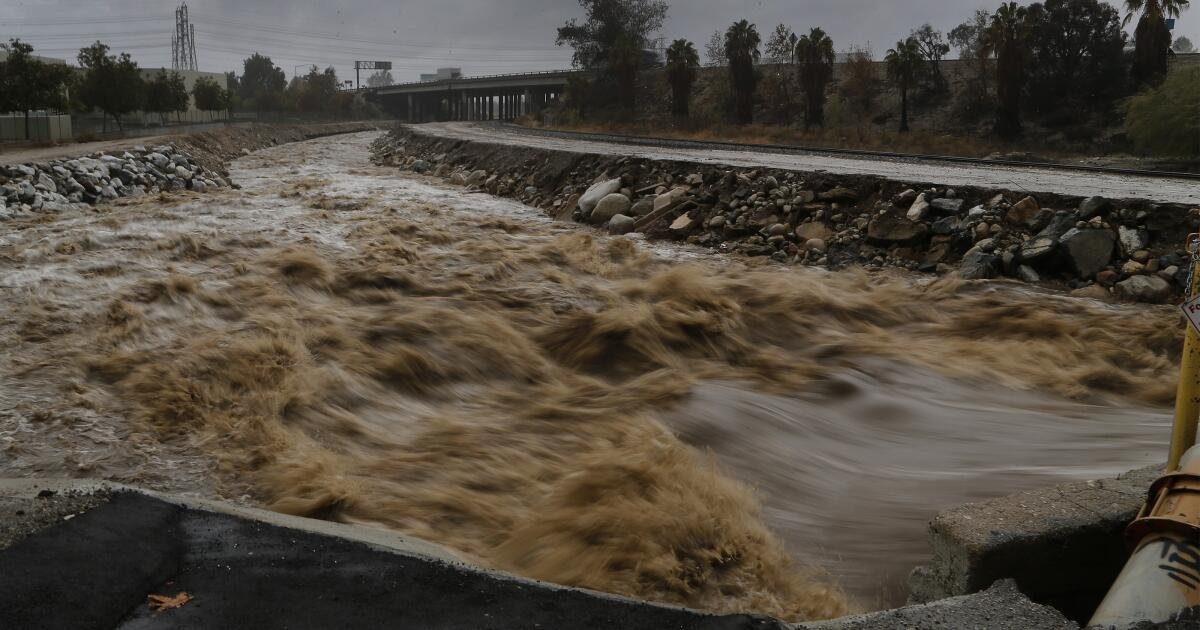
It’s been a little over a month since El Niño arrived, and California may be in for a wet and wild winter.Oceanic conditions have rapidly changed in recent months, giving scientists greater confidence of a strong or very strong El Niño later this year, my colleague Rong-Gong Lin II reports. You’re reading the Essential California newsletter Sign up to start every day with California’s most important stories. By continuing, you agree to our Terms of Service, which include arbitration and a class action waiver. You agree that we and our third-party vendors may collect and use your information, including through cookies, pixels and similar technologies, for the purposes set forth in our Privacy Policy such as personalizing your experience and ads. The National Oceanic and Atmospheric Administration’s Climate Prediction Center said earlier this month there’s a 97% chance that El Niño will be either “strong” or “very strong” over a three-month period ending this December.El Niño is associated with some of California’s most memorably destructive winter seasons.The strong El Niño of winter 2023-24 saw well above average rainfall across coastal Southern California and slightly above-normal precipitation in coastal Northern California, the state Department of Conservation said.During three of the four very strong El Niños in the global record, downtown Los Angeles received significantly more rain than average. In two — 1982-83 and 1997-98 — downtown L.A. got more than double its usual yearly rainfall.This year, forecasters are saying it may end up being one of the strongest such events on record.Let’s take a look at the weather phenomenon’s potential effects.What is El Niño?El Niño is a pattern that typically emerges every two to seven years and lasts nine to 12 months, according to NOAA.It is one of the most powerful climate patterns on Earth, capable of reshaping global weather and affecting rainfall and drought. (Paul Duginski / Los Angeles Times) Although it’s characterized by warmer water in the central and eastern tropical Pacific Ocean, it will also increase the risk of heat waves on land and at sea, which are already being exacerbated by human-caused global warming, Lin reports.What are its potential impacts?El Niño typically brings different weather effects across the world, depending on the season.As warm water extends off Mexico, Central America and northern South American during an El Niño, that usually causes jet-stream energy in the atmosphere to bring more stormy weather than usual to the southern United States, including Southern California, Texas and Florida, during the winter, said Ariel Cohen, a meteorologist with the National Weather Service in Oxnard.For Southern California, it would mean a higher chance of above-average rainfall, risking a winter of landslides and high-tide flooding.The very strong El Niño of 2015-16 brought “record coastal erosion along many California beaches,” the state Coastal Commission said.This year’s El Niño is expected to prolong an already existing marine heat wave — currently in effect for reasons unrelated to El Niño — off Southern California.Scientists are also raising alarms over the effects of warmer ocean waters on ocean life.“In the near future, we may expect to see an increase in tropical or warm subtropical species, which may include increased shark sightings off of the Southern California coast,” said Nate Jaros, the Aquarium of the Pacific’s vice president of animal care for fish and invertebrates. “In very rare cases, even whale sharks have visited off Catalina, including in the 2015-2016 El Niño events.”Marine mammals and other migratory species also may move closer to shore, “because they’re going to where their food is,” said Andrew Leising, a research oceanographer at NOAA’s Southwest Fisheries Science Center.In past strong El Niños, scientists have observed decreased plankton — an important food source for marine animals — and an increased probability of harmful algal blooms. Previous strong El Niños also have brought a lower abundance, and a more northward shift, of market squid, Leising told The Times.“We often have seen in the past with El Niños reduced productivity of California sea lions,” he added, “and the pups are often smaller.”Here’s more of our El Niño coverage:A ‘super’ El Niño is brewing. Experts fear historic dangers from ‘extraordinary’ weather Strong El Niño now a virtual certainty, forecasters say. What it means for California El Niño has arrived: 5 ways California could get pummeled Today’s top stories An 8-year-old boy was killed and four others injured after a head-on collision in Riverside on May 16, 2023. (Gina Ferazzi/Los Angeles Times) A proposed bill would allow insurers to track your driving habitsThe new Sacramento bill promises lower premiums for drivers who opt in and prove safer habits over time, but privacy and consumer advocates warn the proposal forces motorists to choose between data protection and affordable coverage.Safety groups and a booming telematics industry say the measure could reshape rates for 27 million California drivers.Why some patients are pushing to change Kaiser’s medical dispute processThe 2026 World Cup was a rousing success for FIFA, U.S. and fansWhat else is going onCommentary and opinionsThis morning’s must-readOther must-readsFor your downtime (Autumn Schrock / Visit Oxnard) Going outStaying inA question for you: As temperatures rise in SoCal, how do you stay cool?Email us at essentialcalifornia@latimes.com, and your response might appear in the newsletter this week.And finally … your photo of the day Shuting Zang, 28, is photographed on her wedding day at San Francisco City Hall, where Marilyn Monroe and Joe DiMaggio tied the knot in 1954. (Sarahbeth Maney/For The Times) Today’s great photo is from Times contributor Sarahbeth Maney at San Francisco City Hall, one of the most popular wedding venues in California.Have a great day, from the Essential California teamHailey Branson-Potts, staff writerHugo Martín, assistant editor, Fast Break deskKevinisha Walker, multiplatform editorAndrew Campa, weekend writerKarim Doumar, head of newslettersHow can we make this newsletter more useful? Send comments to essentialcalifornia@latimes.com. Check our top stories, topics and the latest articles on latimes.com.