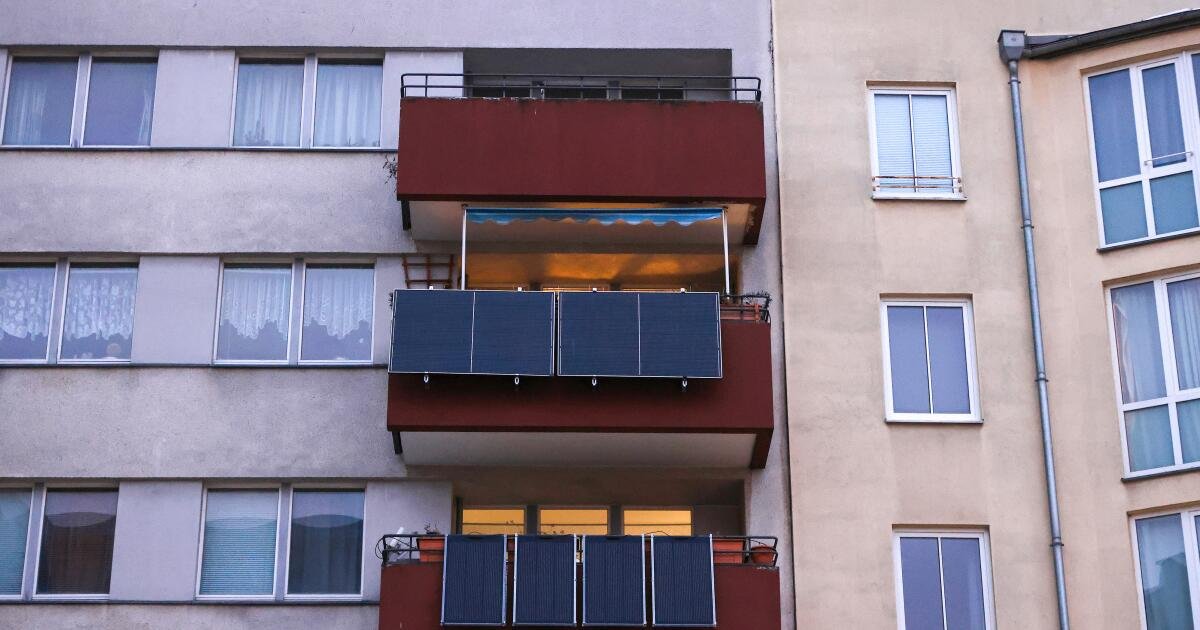
Battles over rooftop solar have been high-stakes and high-drama in California. Homeowners who install solar panels expect to see dramatically lower bills, but utilities have fought hard against that. As a climate journalist, I’ve waded in deep on this issue. Yet as a renter who won’t be putting up panels and reaping the savings anytime soon, I’ve sometimes felt a bit left out.That’s why I’ve been watching a bill in the California Legislature this year that would open the door for anyone to set small panels on their patio or hang them on their fence and plug them directly into wall outlets to lower their bills.The systems, called “balcony solar,” are catching on in Utah, which last year became the first state to legalize them. This year, nine other states followed. Germans have been buying lightweight panels at big-box stores like IKEA for years, plopping them in their yards, and seeing savings right away. California still has not blessed the practice. But people here are going for it anyway. Michael Scott, a philanthropy officer at the Oakland Zoo, said he’s wanted a solar system on his roof, but the upgrades he needed were always too expensive to justify. After reading about balcony solar in the news, he ordered two 180-watt panels directly from the energy nonprofit Bright Saver for about $680 last month. “Immediately it’s providing me savings,” said Scott, adding that his midday energy consumption from Pacific Gas & Electric has dropped to zero. “It’s like plugging in a toaster, there is nothing complex about it at all.”Bright Saver said hundreds of Californians have ordered its panels. Even more — thousands — have purchased them from a Texas-based company called CraftStorm. Yet the systems exist in a regulatory gray area in California.People who install solar are supposed to get permission from their power company in a process that can be costly and cumbersome, said Bernadette Del Chiaro, a senior vice president at the nonprofit Environmental Working Group. And none of the porch panel setups sold in the U.S. have been certified as safe by gold standard testing groups such as UL Solutions. A bill from Sen. Scott Wiener, co-sponsored by the Environmental Working Group, would address both these issues by exempting plug-in solar from all utility permissions and requirements as soon as manufacturers get certified. Advocates say those approvals should come any day now for the handful of products already on the market.Southern California Edison, which once opposed the legislation, dropped its fight in June after the bill was tweaked to let utilities make sure that panels are certified, said spokesperson David Eisenhauer. Utility workers and firefighters have also gone neutral. But the Southern California Rental Housing Assn. is fighting the bill because it would let tenants plug in solar without notifying property owners. And both San Diego Gas & Electric and PG&E oppose the bill, the latter saying it still “does not adequately address concerns about grid reliability, electrical safety, and potential cost shifts to customers who do not participate in the program.” The bill blocks panels from sending electricity back to the grid during power outages, an important safety feature. The utilities want to see this also required when the grid is running normally, but advocates say that would require an electrician, counter to the spirit of plug-in solar. The risks posed by such small panels are minimal, they say.PG&E is also worried that as people generate their own power, they will buy less from the utility and the costs of maintaining the grid will fall more on those who do not have solar. Wiener doesn’t buy it. “That’s the same argument that someone could make to say that we shouldn’t offer people energy efficient appliances because they will use less electricity and lower their bills,” he said. “But we would never make that argument.”The bill faces its next big hurdle Thursday in the Assembly Appropriations committee. In other energy newsThe Assembly and Senate Appropriations committees will decide the fate of hundreds of bills Thursday. A solar push by Assemblymember Christopher M. Ward (D-San Diego), AB 1813, would force the Public Utilities Commission to create a community solar program with better savings for developers and customers. I covered how California had failed to launch a successful community solar program in March.Energy watchers also have their eyes on a bill by Sen. Steve Padilla (D-Chula Vista) that would require data centers to cover the costs of new grid upgrades and new clean energy to serve them. Another big energy bill this session, SB 905, would tackle electricity costs on a number of fronts, including lowering allowed profits for utility wildfire spending. That one, by Sen. Josh Becker (D-Menlo Park), could get wrapped up in a broader deal that Gov. Gavin Newsom is pursuing this month to limit utility wildfire liability. My colleague Melody Petersen reported Wednesday that lawmakers are “deeply troubled” after utilities warned they might make spending cuts if the reforms they want don’t come through. A lithium extraction project by the Salton Sea faced a setback on Tuesday after the California Court of Appeals 4th Appellate District said the project’s approvals did not adequately account for its water use, inewsource reported. An environmental justice group in Imperial County and a mining-focused nonprofit had sued over the project.The impacts of artificial intelligence on climate change could be worse than we thought, reports Emily Atkins in her Heated newsletter. Beyond the electricity consumption of data centers, AI is helping oil companies find oil, drill wells faster and extract more. A new study found that the climate impact of that could be 3 to 13 times more than the impact from powering data centers with fossil fuels.And once again, jellyfish have clogged the filters of a nuclear power plant in France, forcing a shutdown. Other environmental newsCalifornia will phase out paraquat, regulators announced this week. All pesticide manufacturers that use the toxic ingredient have voluntarily agreed to remove their products from the market. Paraquat, associated with thyroid problems, birth defects and Parkinson’s disease, is banned in more than 60 countries, but not in the U.S., my colleague Hayley Smith reports. Californians are fighting back hard against the Trump administration’s efforts to strip the California Coastal Commission of its power to block projects such as oil drilling in federal waters, the Times’ Rosanna Xia writes. Trump’s National Oceanic and Atmospheric Administration’s Office of Coastal Management launched its “performance review” of the state agency this week. Hundreds of Latino workers who cut artificial stone countertops in California are falling ill from a deadly lung disease at an alarming rate, my colleagues Karen Garcia and Clara Harter reported. It’s all for “a product we do not need” and that “cannot be manufactured safely,” the authors of a new report said.R.I.P Jackie, the beloved and famous Big Bear eagle who passed away Monday at an Ojai rehabilitation center after battling a mysterious illness.This is the latest edition of Boiling Point, a newsletter about climate change and the environment in the American West. Sign up here to get it in your inbox.For more energy news, follow me at @blancabegert on Bluesky.