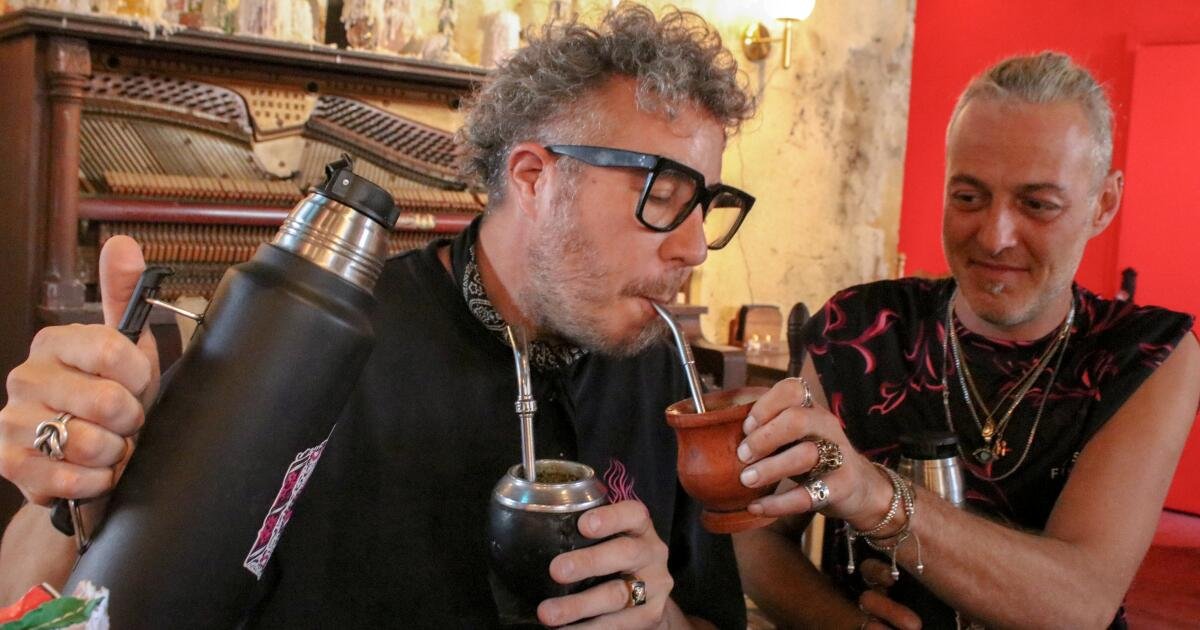
When an elderly woman walked into Mate Conmigo on a recent Saturday morning, she let out a sigh of comfort. Gabriela Simoni, owner of the Northridge cafe, had spoken to the retirement home resident on several occasions. The woman usually introduces herself politely and grabs a seat to listen to the whistle of hot water pouring from a thermos. Her son tells Simoni that his mother’s memories, including her time living in Argentina, have faded, but whether it’s the mate leaves cradled in her hand, the bitter yet full flavor of the drink or Simoni’s distinctive Argentine Spanish, he noticed her eyes get bright again after each encounter.Mate — a hot, caffeinated herbal drink sipped through a bombilla (metal straw) from a dried gourd — is the national drink of Uruguay, Argentina and Paraguay, and is beloved in Southern Brazil. The Guaraní people of Paraguay were the first to harvest leaves from the wild yerba mate tree to brew them as an everyday drink. As Jesuit missions and Spanish colonization took over the continent in the 16th century, mate was popularized across other countries and between settlers and natives alike to become the region’s largest export. Mate, a centuries-old drink from Paraguay, Uruguay, Brazil and Argentina, is traditionally sipped from a metal straw, or bombilla, in a gourd of a dried squash, wood, or leather. Katerina Portela has mate the traditional style at Mate Conmigo on July 15. (Calvin B. Alagot / Los Angeles Times) “Back home, you wake up and drink mate, drive somewhere and drink mate, and come home and sit around with family to drink it,” said Simoni, who was born in the Cordoba province of Argentina. “For me it’s an important tradition … when I lost my old job, I turned to mate to start a business and support my family.”In Mate Conmigo’s warm social atmosphere, Simoni introduces new visitors to the brewed herb’s earthy, slightly bitter flavor. At one table, 25-year-old Kayleen Lugo shared sips of tereré, a chilled summertime preparation of mate with her friend, who nodded as he tried it for the first time. Traditionally, mate is passed around a group, with friends and family members often drinking from the same bombilla. For Lugo, mate was never present in her Mexican-Puerto Rican household. One day, her cousin pushed her to visit Mate Conmigo; she‘s come back with friends ever since.“I think the nice thing about mate is that it opens conversation. Even now, I’m bringing my friend here and we’re talking and passing the drink back and forth,” Lugo said. “The people yearn for community.” Christian Martinez tried mate for the first time July 15 with his friend Kayleen Lubo at Mate Conmigo. (Katerina Portela / Los Angeles Times) Juan Rivera tried mate for the first time from his now wife Tiffany, who whipped it up for him while manning a beverage booth at a music festival. The couple now run Erva Brew Co., a pop-up that appears at festivals like Coachella and farmers markets across L.A.“I grew up in my grandma’s restaurant in Lima. I was in the kitchen with her, I saw how food and beverage can just bring a community together,” Rivera said. “Mate has that ability to make you slow down and enjoy your company.”In 2020, they opened a brick-and-mortar location in Pasadena, where the couple experiments with tereré in eclectic flavors, like tamarind, mint, and chocolate. Itzel Celis laughs over mate with friends July 15 at the Northridge cafe Mate Conmigo. (Katerina Portela / Los Angeles Times) “Mate brought my wife and I closer together,” Rivera said. “L.A. as a city that’s a melting pot, mate makes sense here.”Most recently, mate reentered the American consciousness as World Cup stars like Cristiano Ronaldo and Lionel Messi drink it off-field, leading to American cafes reporting increased demand for mate and news outlets documenting the significance of the drink. In the United States, mate was once advertised as a 1960s housewife aphrodisiac and in the 2000s as a mass-bottled health superdrink from California-based brands like Guayakí (later renamed Yerba Madre). In the latest hop on the mate craze, Barron Trump, President Trump’s youngest son, started a canned mate line of his own (at a $39 per pack price tag). As the trend grows in mainstream American fascination, South American communities continue to treat mate as sacred.“There’s a saying in Uruguay that you haven’t grown up until you start drinking mate,” said Paula Garcia, who moved to L.A. from Montevideo, Uruguay, 12 years ago. “You always picture mate in your family. It’s like a companion.”After teaching at a local elementary school for the day, Garcia stopped by El Gaucho Meat Market in Redondo Beach, an Argentine butcher and grocery store that supplies products from across South America. As she checked out, she looked up behind the cashier to the line of mate gourds and hot water thermoses emblazoned with Messi and various South American flags.“It’s difficult to be an immigrant and to find a place that feels like home, like your culture,” Garcia said in Spanish outside of El Gaucho. “The closest I could find was this market, and here I’ve met other Uruguayans and Paraguayans. But always, preparing mate is what transports me. Or when I’m with a friend and we have to talk, we have to make the mate.”Garcia looked for places to drink mate in company and found social club Argentinite on Instagram. Along with its wide variety of beach days and soccer watch parties, it also hosts “mateadas,” gatherings entirely centered around sharing mate. At a mateada, or mate gathering in Santa Monica’s Airport Park last summer, Angelenos from South American diasporas pass around thermoses and mate to share a moment of connection over the drink. (Damian Funes) Argentinite founder Damian Funes missed the natural gathering of friends around mate and hosted his first mateada to a surprising response.“People thanked me, because for a moment, it felt like they were home,” Funes said. “I saw people from Mexico and even France try mate and love it and make friends.”According to Neilsberg data, California is home to the second-largest Argentine and fourth-largest Uruguayan communities in the United States, with L.A. being the most populous California city for both groups. Brazilian and Paraguayan diasporas are more centered in Massachusetts and Florida, according to U.S. census data, although Brazilian markets like HiBrazil in Redondo Beach carry the drink.Erick Viet, the Peruvian-born manager of Catalina’s Market, one of the first Latino grocery stores in L.A. founded in 1967, says he orders pallets with hundreds of mate packages weekly because, “there’s such a great demand.” 1 2 3 1. Erick Viet looks over the mate stock in Catalina’s Market in East Hollywood, one of the first Latin grocery stores in L.A. He says customers sell out the mate section and will often gather to drink it in the market’s dining area. 2. Gabriela Simoni, owner of cafe Mate Conmigo, pours hot water into a customer’s gourd at Mate Conmigo. (Katerina Portela / Los Angeles Times) “That’s how I know the South American community in L.A. is still strong, because people come and buy mate by the kilo,” Viet said. “It’s definitely a big part of people’s lives.”Inside Fuegos LA, an Argentine restaurant-cafe-cultural hub outside of USC, co-owner Federico Laboureau shook his head as I poured hot water over all of the mate leaves.“It’s wrong, the way you did it,” he said, playfully. “I will show you how.”Growing up, my dad drank mate, the leather-bound cup a permanent fixture in the cup holder of his Ford Focus. His Uruguayan dad drank it too, but I couldn’t stand the taste until years later, when he lived across the country and my grandfather passed away. That was when mate became a comfort that tied me to them.Laboureau carefully poured the mate leaves into the cup until a mound, or montañita, formed on one side of the metal straw. Then the hot water, from a thermos, an unusual sight in an L.A. summer, poured until the mound is a little island. The Buenos Aires native recalled watching his grandfather holding two things in his hands every evening: in one, a small radio to listen to tango, and in the other, mate.“I always thought it was so old-fashioned. But now I want to hold the radio up to my ear, to listen to tango and drink mate and show that I am Latino,” Laboureau said. Federico Laboureau, co-owner of Fuegos LA, demonstrates the steps of making mate. First, Laboureau pours the leaves, then shakes the “montañita” or mountain of leaves and finally pours water from a thermos. (Katerina Portela / Los Angeles Times) When he moved to L.A. to work as a production designer, he felt the pressure to fit in, or as he calls it, “be gringo.” When he traveled to work on a show, the first thing he packed was his mate.“I started drinking it in front of my co-workers, and it felt like saying, this is me,” Laboureau said. “It was how I introduced myself, like a symbol to show people my background and not feel like I have to be perfect to be American.”It also takes him back.“When I would get home late, my mom texts me, ‘I am waiting for you with the mates,’” Laboureau recalled. “It means, somebody’s taking care of you. They’re waiting for you. It’s not about the mate. It’s about getting together for a moment, and that somebody cares for you.”He wiped his eye.“I don’t know why I get emotional. Mate reminds me,” Laboureau said. “I miss my family.”