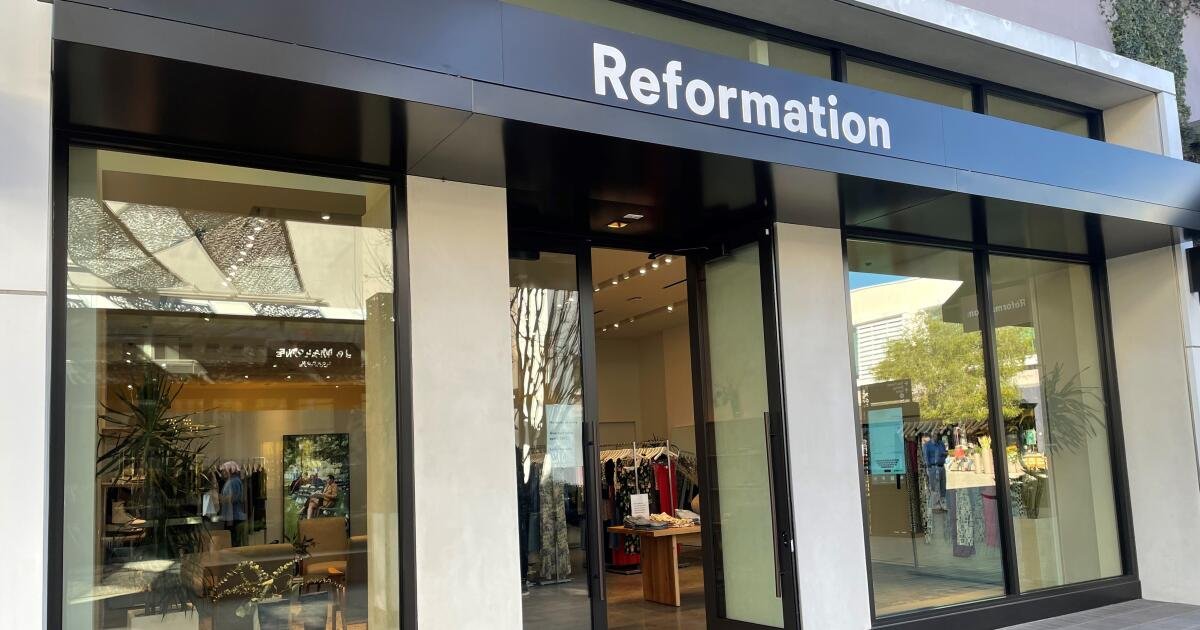
What started as a little tailored vintage clothing store on La Brea Avenue blossomed into a billion-dollar company. Reformation, the women’s clothing company, is known for its sustainable mission and slogan: “Being naked is the #1 most sustainable option. We’re #2.” Its clothes have been spotted on the shoulders of celebrities such as Taylor Swift and Hailey Bieber for more than a decade, but it wasn’t until last week that Reformation was listed on the stock market, and with a rise in its share price midday Monday, its market value climbed above $950 million. It has been a stunning rise, starting with management and manufacturing out of Los Angeles and expanding to 70 locations, mainly in the United States, with 13 in California and storefronts in Canada, France and the United Kingdom. It plans to use the money it raised to open 12 to 14 stores each year. “We’re still really early on in our inning,” Reformation Chief Executive Hali Borenstein said in an interview with CNBC. “We have less than 1% penetration of our core market, and so you’re going to see a lot more from us.”Still, some consumers and analysts are concerned that growing too much could damage the brand and the quality and sustainability it is known for. “At one point I feel like Reformation was trying to grow too fast, and that’s where they lost sight of quality,” Jessica Ramirez, co-founder of the Consumer Collective, a consumer insights company, said. “I wouldn’t want that same pressure to come back once they’re public, which is what tends to happen.”The apparel company was founded by Yael Aflalo, a California native, in 2009. It started with Aflalo customizing vintage clothing in the back of a store and selling it before transitioning to producing its own clothing using sustainable materials. In 2013, Aflalo started designing and manufacturing clothes along with tailoring, and began selling them through a website. Reformation opened a factory in Los Angeles the same year. At the time, the company was best known for its dresses, but over the next few years expanded its offerings to more apparel.Reformation opened its first international stores in Toronto and London in 2019, when it partnered with private equity firm Permira to further scale. Aflalo continued to lead the company until 2020, when Borenstein took over as CEO.On its website, the company lists Tencel, recycled cotton and dead-stock fabrics as some of its preferred materials to meet its sustainability standards. It also discusses practices such as limited collections it uses to keep the environmentally friendly label. It found a niche of fashionable consumers who wanted cutting-edge clothes you could wear to a wedding but also something that could last and was better for the environment than mass-produced products. “They were a sustainable apparel brand that wasn’t a potato sack,” Ramirez said. “For a long time, that’s really what we had: product that was sustainable and it wasn’t good-looking”.The brand emphasizes that its pieces are meant to last even with heavy use and not just be tossed. One Reformation fan once wrote in the New Yorker that the brand’s sustainable, minimalist dresses developed a cult following for finding the right price point, “mostly priced in the low three digits — just the right amount to blur the lines between those who thought of a two-hundred-and-eighteen-dollar jumpsuit as an affordable basic and those for whom it would be an impractical splurge.”Although it has done well in its sweet spot, it could face the headwinds that many hot brands do as they struggle to grow beyond their hardcore fans and remain relevant. Reformation has tried to position itself outside of other millennial brands, analysts say, but the cyclical nature of the apparel market makes the category a tough sell.Apparel companies, including Allbirds, which has pivoted since listing, can often struggle in the stock market as they lose buzz after their initial public offerings. “Look at Birkenstock. It hasn’t been a bad company, and there’s still always a lot of questions around it,” Ramirez said. “On Running has been having year-over-year growth that is unseen, and they still get tanked when earnings come through.”Reformation has faced worries it was growing too much in the past. A few years ago, the brand started facing criticism for lowered quality as it began rapidly opening more stores and introducing new product offerings such as bags and shoes. Some fans said they noticed that dip in quality back then.Felipe Caro, a business professor at UCLA, said he was skeptical of Reformation’s ability to hold on to its sustainable image after going public, which is part of the brand’s popularity. He said investors may have to compromise on scale in order for the brand to continue to see success with its current customer base.“I’m not seeing them growing to the scale of H&M or Uniqlo,” Caro said. “But that doesn’t mean it’s necessary. Given that they charge higher prices, they might be able to remain very healthy financially without having to have the numbers that you see at the fast-fashion brands.”It might also struggle with balancing its sustainability goals with shareholder pressure to lower costs. Ramirez said Reformation may see some difficulty with investors understanding the brand and the uncertainty around direct-to-consumer brands.“When you’re private, you can just say, ‘I want to do it this way,’ and maybe forgo a little bit of profit in order to achieve other things that are considered important,” Caro said. “Do they just say we only care about profit, forget about the sustainability part? That might kill the brand.”Reformation says it has only scratched the surface on its potential customer base. And now it has the war chest to go after more types of consumers. Borenstein said the company isn’t feeling the same pressures as the rest of the retail industry, because of the wide customer base it attracts. “Our active customer numbers are incredibly strong, and so we are feeling really good about our ability to continue to execute throughout the year, even with all of the dynamic environment that we are operating in.”