Throughout the 2010s, a single night of events in Barrio Logan reliably enticed curling lines of art-goers on the corner of Logan Avenue and Sampson Street. The neighborhood’s arts and culture scene was booming.
But a cultural bust loomed. The area was hit by a number of gallery closures including Voz Alta in 2014 and TheChrch in 2017, followed by La Bodega and Chicano Art Gallery in 2019.
While the neighborhood’s cultural vibrancy is still there, real estate prices pose a continual threat, and the Covid-19 pandemic only made things worse. According to Marketpointe Realty Advisors, San Diego’s median monthly rent has nearly doubled since 2014.
For local art spaces that dare to exist outside of tourist-driven trends, or that lack institutional support, making ends meet is an art of its own. Side jobs, day jobs and online fundraising campaigns galore help fill that void.
But for many arts-minded people in Barrio Logan, that hustle feels second nature.
“I come from a world that didn’t have funding to begin with,” said Bucky Montero of The Woo, an up-and-coming art space in Barrio Logan. “Everything was grassroots. Meaning we tapped into our own resources, we asked friends for help, we asked for donations, we took over, we occupied undesirable spaces.”
“We can still have an art show without funding. Someone just needs to give me a building,” he said, adding jokingly, “What’s in the storage closet right now?”
A Land Trust to ‘Build a New World’
What would happen if rent was removed from the equation entirely?
Enter: Tierras Indígenas Community Land Trust in Barrio Logan. The nonprofit received a grant to purchase their building and now the organization is only responsible for property taxes.
Since then, they’ve organized community members to challenge displacement in a neighborhood that has faced the threat of gentrification.
Traditional property ownership isn’t central to their operation. Rather, they practice community-ownership while harnessing a decolonial practice rooted in indigenous land stewardship.
“We hope to access further parcels from the city,” co-founder Julie Corrales said. “We’re really trying to increase communal ownership because we have to continue to grow our consciousness to collectively create not just the infrastructure systems but the social networks to withstand collapse.”
“We are definitely a hub of resistance and leftist thinking and progressive action and the art reflects that. The art mobilizes that.”
But art is only one part of the picture. The organization’s stated pillars include: creating affordable housing, decommodifying real estate, restoring the environment and creating accessible art spaces.
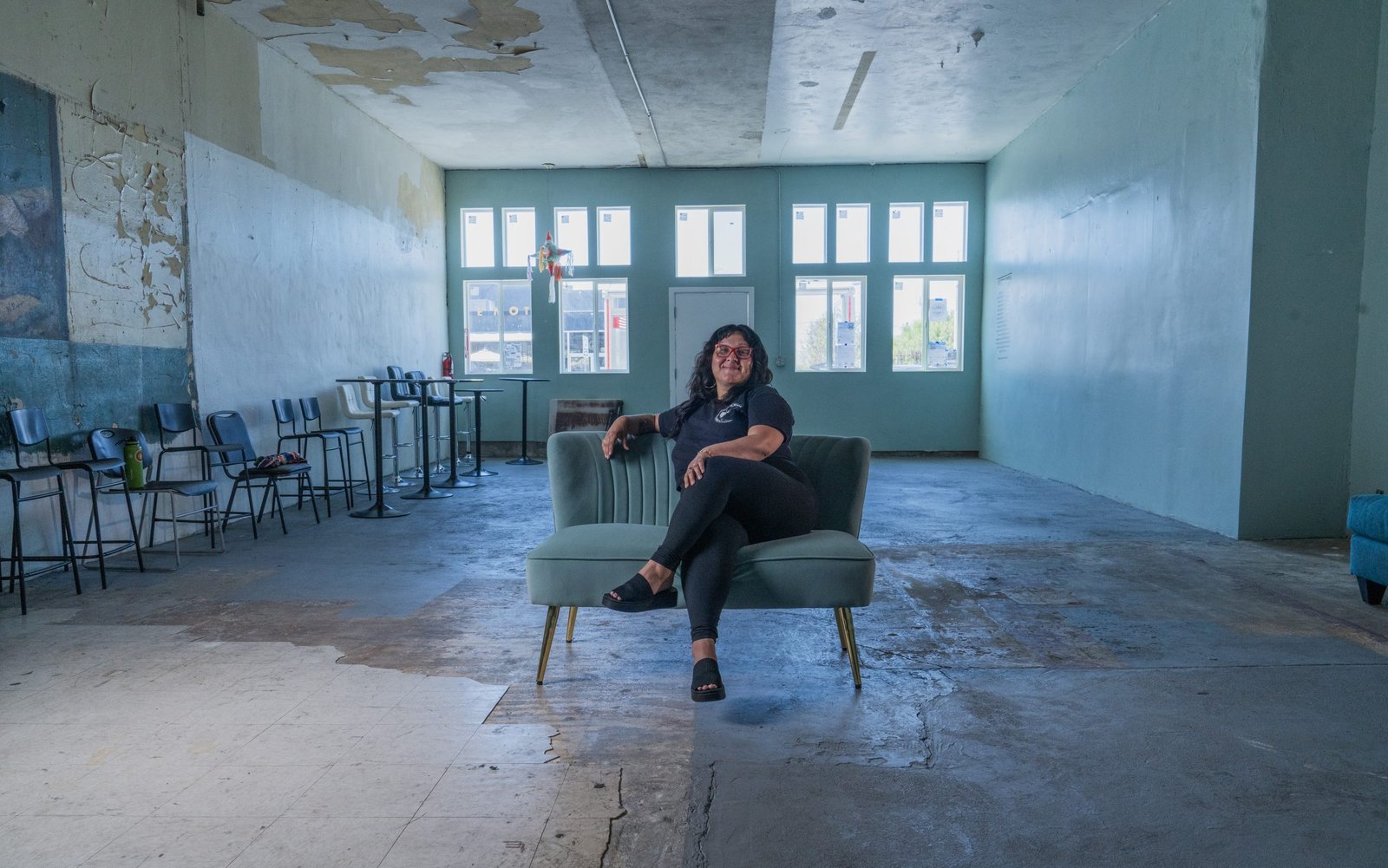
Upon entering the building from the corner of 26th Street and National Avenue, the organization’s offices exude a palpable energy of hard work and imagination. The expansive room next door, however, is where that energy has space to take flight. It houses a gallery for alternating art exhibitions, events and programming. Having once been a bar, the room showcases a small deteriorating mural of the American Southwest, a subtle gesture to imagining new futures in tandem with the past.
“I’m so tired of fighting the old system,” Corrales said. “I want to focus on building a new world.”
A Place For Vulnerability
Deny Yourself, by longtime Deixis salonist Elizabeth Juarez. Credit: Photo & Studio
Just a few blocks from Tierras Indígenas, another space exercises a different type of agency over cultural production –– ownership of their own labor.
Deixis Gallery, helmed by Bilal Bikile, is an independent exhibition space founded in 2022 that runs on a generative but informal incubator model. Every Tuesday the gallery hosts a salon, inviting the public to open-ended conversations, each focused on a different topic ranging from politics to religion to love, loss and grief.
While the salons are hosted in the gallery, they decidedly don’t get lost in the weeds of the creative process.
“We don’t talk about art,” said Bikile with a laugh. Instead, salonists build community by converging philosophies from differing dispositions.
“It feels like Alcoholics Anonymous sometimes,” Bikile said. “It feels like group therapy sometimes. Attendees are not concerned about talking about process or artistic mediums. They want to talk about ideas.”
However, the salons do influence Deixis exhibitions. Their latest, Deny Yourself, by longtime Deixis salonist Elizabeth Juarez, forges a conversation between ironic meme-like quips and deep, often vulnerable, diary-like inquiries. Juarez’s work speaks to the culture of acceptance that Deixis has cultivated, manifested as large, painted tile arrangements entirely in black and white.
In Juarez’s piece, Pursuit of Desire, an idealized landscape rendered in simplistic line work represents a pop-vision form of utopia. At the center of the square composition, an easily consumable phrase akin to an advertisement reads –– “You are in pain, in part due to your relentless pursuit of desire.”
“The other day I came in (to the gallery) and (an exhibition visitor) was in here just bawling,” Bikile said. “She was standing here crying and was just saying, ‘It’s just so good to read these things.’”
“Everyone is so quick to say, ‘Art is needed. Art heals.’ So I want to be very conscious in terms of what we’re providing beyond the decorative, beyond the avant garde. We want it to be accessible but to a high taste,” Bikile said.
Last June, Bikile launched an online fundraiser to offset rent after covering the gallery’s bills entirely out of pocket since its founding. The gallery currently has no other major sources of income, but he hopes to establish an economic model to help the space thrive in the same independent fashion.
More Than a Venue
Marisa Aguayo (left) and Bucky Montero (right). / Photo by Evan Apodaca for Voice of San Diego
Just a few blocks west of Deixis, The Woo stands with a vision as large as its square footage.
The 27,000-square-foot building, previously home to a snowboard manufacturer and the Woodbury School of Architecture, had run its course. Now, it hosts several large studios.
After the school closed in 2024, Woodbury alumni Tony Salamone and his architecture firm MISCELLANEOUS Office for Architecture took over the building. After a quick rebranding, The Woo is strategizing to become more than just another venue. They envision binational artist residencies, institutional partnerships, artist studio rentals and a diverse array of programming.
Now, tenants Bucky Montero of Subcultura Curation and Marisa Aguayo of All For Logan are helping forge The Woo’s identity as a cultural avenue. Together they helped mount a number of outward-facing programs, including two massive group exhibitions – “The Artist’s Duty” with Monica Delgadillo of the Chicano Park Cultural Center and “Viva La Raza” with Aztlan Libre – as well as a yearly artist residency for Día de Muertos.
“For me, the first thing is that people feel welcomed,” Montero said. “You know the artists that we’ve worked with, they’re all local, either from Barrio Logan or San Diego. But we’re also trying to build bridges between Tijuana, San Diego, Los Angeles and even the East Coast.”
Aguayo and Montero are helping illuminate overlooked chapters of local history. A section of Viva La Raza included Las Hermanas: Queer Chicano Histories of San Diego, curated by Montero, Betty Bangs and Paulina Lara. The archival exhibition highlighted the queer Chicanx experience, including the history of Las Hermanas Women’s Cultural Center and Coffeehouse founded in San Diego in 1974. The exhibition concluded with a screening of “ASCO: Without Permission” directed by Travis Gutíerrez Senger about the LA-based foundational Chicano Art Collective that transgressed the norms of not only the art world, but also of popular representational culture through avant garde barrio aesthetics.
“Right now we’re showing a lot of artwork that has the spirit of resistance, of self-determination,” said Montero.
“We need art that speaks to us,” echoed Aguayo.
Still, the Woo team admits that economic sustainability remains a work in progress. As of now, they’re just breaking even.
In 2017, Barrio Logan was designated as a cultural district by the State of California, but the state’s cuts to the 2026-27 budget threaten the premise of economic growth through cultural designation.
Nonetheless, the future holds promise. The Woo has numerous partnerships in tow, including the American Institute of Graphic Designers and SALAA, a Tijuana-based platform for architects. The space will also be the next home for Burn All Books, a mainstay for independent publishing and distribution in San Diego that was recently displaced from Normal Heights due to a rent hike.
“I just want us to survive this dystopia, and the only way I can see that happening is through art,” Montero said.
Related Posts