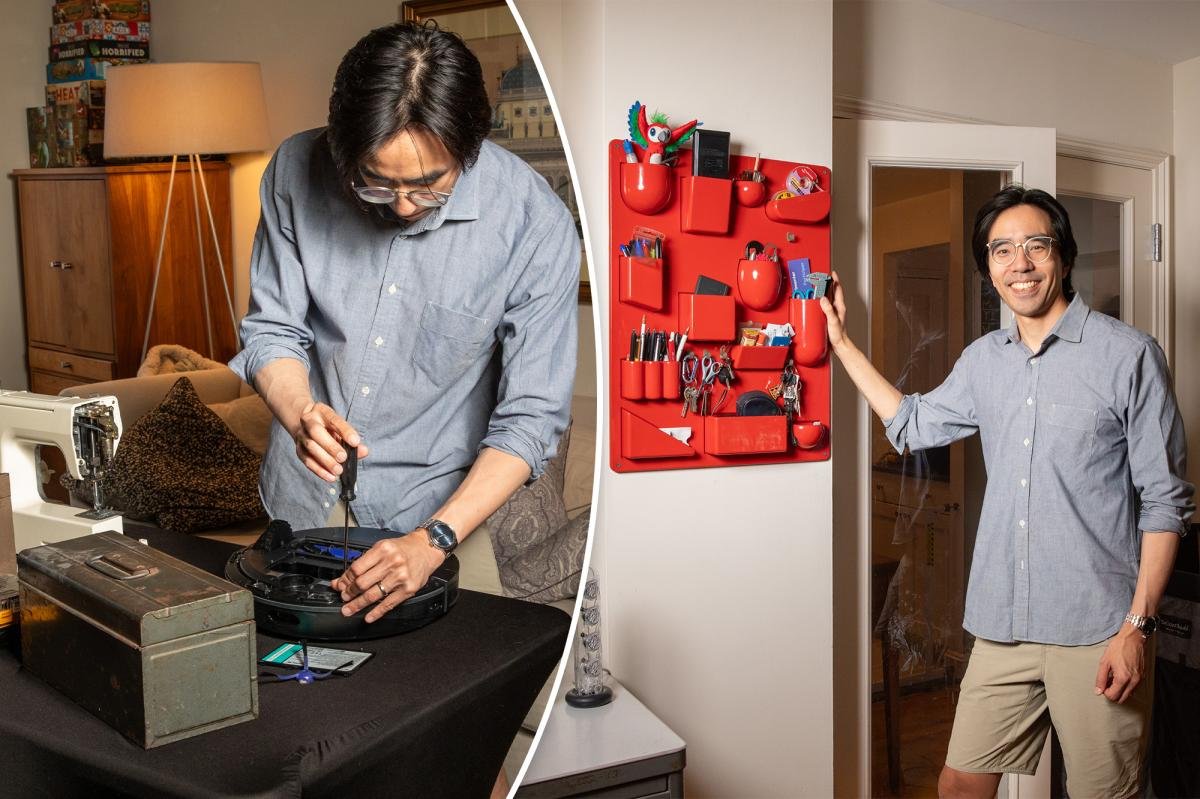
One man’s trash really is another man’s treasure.
Darrick Lo’s neighbors throw out everything from broken strollers to coffee grinders to chairs. He’s the guy who digs through their trash and fixes it all himself.
Growing up in New Jersey, Lo liked to watch his mother sew on her Singer Stylist 534, circa 1975.
One day, it stopped working.
“It needed its hook and feed gears replaced because the original parts were made of materials that degrade over time,” Lo told The Post. Once he found the service manual, he repaired it.
Lo went on to earn undergraduate and graduate degrees from Cornell University in mechanical and biomedical engineering. Now, finding joy in the forensic work of figuring out what’s wrong and correcting it, he solicits broken toys, gadgets and appliances from his Manhattan neighbors — things that would otherwise be thrown away — so he can repair them and teach himself as he goes.
A Manhattan engineer has turned dumpster-diving into an art form — and he’s saving the city’s broken junk one Craigslist find at a time. Olga Ginzburg for the NY Post
Lo is pictured at his home office with his red tool organizer kit. Olga Ginzburg for the N.Y. Post
Most items come from Craigslist or his local Facebook Buy Nothing group. He admits to taking things off the street on recycling night.
It’s not a repair service, he said, because he doesn’t want the pressure or logistics of fixing things on a timeline.
“I view these items as machines that follow the basic laws of physics,” said Lo, whose day job is at a medical-device company. “The core engineering principle that was instilled in me is to break down complex systems into their simplest forms. Failure can be caused by one specific thing, but it is usually a multitude of things and is not very obvious.”
As a high-schooler, Lo had a part-time job at an electronics store. After college, he took his motorcycle apart and reassembled it.
“I have done house calls for friends to repair washers, dryers, refrigerators, ovens, water heaters and furnaces,” he told The Post.
The UPPAbaby Vista V2 stroller that Lo fixed and uses is pictured. Olga Ginzburg for the N.Y. Post
Lo recently found himself with two broken UPPAbaby strollers. They were “structurally compromised,” he said. “They have complex features and brake mechanics. The body construction is aluminum but it is also susceptible to fatigue and it is difficult to reweld.”
Unlike steel, which can withstand minor repetitive strains, “aluminum weakens with every bump and curb it encounters, until it eventually breaks,” Lo said. Rewelding destroys the metal’s strength, making it prone to breaking again. He researched the two strollers and found that despite being two model years apart, they shared many of the same components.
“I decided to take them both apart — to essentially cannibalize the two strollers — and combine them into one fully working unit,” he said.
Lo has reverence for product design and the work that goes into making user-friendly items. He calls headphones “a modern miracle,” available for a reasonable price after enormous amounts of time and money spent in development.
“That is the framework I cherish about every product that comes into my hands,” he said. “It is an acknowledgment of the hands that have touched it before me.”
A Harman Kardon Soundsticks III speaker fixed by Lo. Olga Ginzburg for the N.Y. Post
On Craigslist, he spent $20 on a coffee grinder advertised in “questionable condition.” The motor, caked with coffee grounds, had stalled.
“The seller was very honest,” Lo said. “They said, ‘I don’t know if it works.’” He didn’t know either, but figured he could make it work.
If a grinder isn’t regularly cleaned, fine coffee dust combines with the bean’s natural oils to create a kind of glue inside the machine. “This mixture hardens into a solid brick that physically locks the paddle wheel and burrs, causing the motor to jam,” Lo said. All it needed was a good cleaning.
The grinder, which now lives on his kitchen counter, inspired him to become more of a coffee connoisseur. He later found a broken espresso machine for $35, also on Craigslist. Such machines intrigue him for their fluid mechanics.
“Fundamentally, an espresso machine can be boiled down to three basic systems — a water heater, a high-powered pump to push that water with intense force, and an overpressure valve to keep that force under control and regulate the hydraulic pressure to the espresso puck,” he said. “An espresso machine is a modern marvel.”
His machine’s problem was solved with a new overpressure valve.
“And now I drink too much coffee,” he said. “A lot of my family and friends would call me a home barista at this point. I am kind of a perfectionist.”
Nina the cat sits on a restored chair with new caning. Olga Ginzburg for the N.Y. Post
Lo gives away the items he doesn’t keep — to his Buy Nothing group, a nearby thrift store or friends. He once fixed an old chair with a broken seat that concealed an array of perimeter holes, revealing that the chair originally had a hand-woven cane seat.
“I purchased raw materials, taught myself the meticulous art of weaving and successfully restored the piece to its authentic design,” he said.
Lo, who has three toolboxes, laments today’s throwaway consumer culture. He prefers high-quality items that can be repaired if broken. Still, not everything can be fixed.
Cellphones once opened with a screwdriver, and parts such as the camera, microphone or battery could be replaced, he said. Now they’re tightly sealed.
“For most modern cellphones, you need a heat gun to melt the adhesive so you can take the glass off and access the internals,” Lo said. “A lot of people are comfortable throwing their old phones out.”
It’s also simply more convenient to toss old things than to get them repaired. There are so few repair shops left that people don’t even know where to take a broken item, said waste expert Anna Sacks, known as the Trash Walker, who scours the city’s trash for reusable items herself. People might have to wait for a part to arrive. Or it might cost as much to repair the item as to replace it.
Repairing something is doubly valuable, Sacks said.
“You are preventing things from going to landfills, but you are also preventing the need to buy a new one,” Sacks told The Post.
Lo works on a 1990s Kenmore 385 sewing machine with jammed gears alongside his cat. Olga Ginzburg for the N.Y. Post
Lo’s own sewing machine is a Singer Fashion Mate 258, circa 1974 — a model that does decorative stitches — that had been missing several parts. A sewing machine is complex, and a lot can go wrong.
“Some of the gears are made from polymers, but they oxidize and crack over time,” Lo said. That was the problem his mother’s machine had. “There is a whole segment of science called tribology — the science of friction.”
Lo uses his Fashion Mate for fabric repairs and projects.
“Every intricate stitch, feed cadence and needle swing is choreographed through gear trains, rotating cams and interlocking linkages,” he said.
“These sewing machines do require electricity, but everything else is mechanical. These systems rely entirely on the laws of physics and metallurgy. There are no circuit boards or microprocessors, and that is exciting to me. It’s magical.”