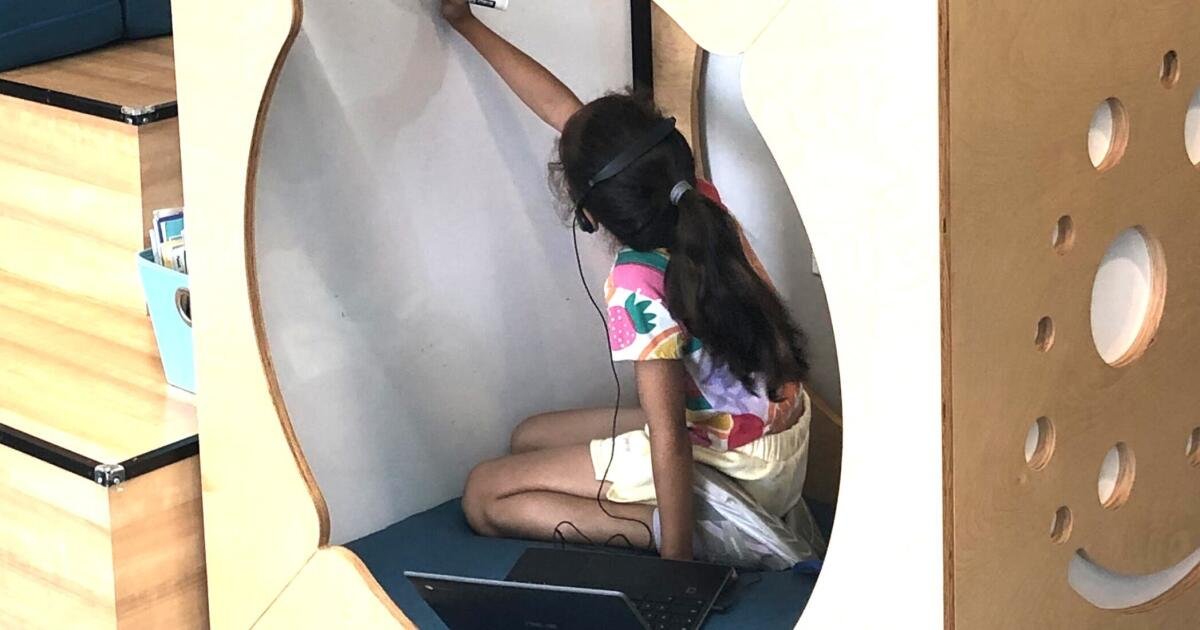
After a recent playground disagreement, a first-grader at Pacific Sky Elementary School in San Diego County came back to class in tears. The youngster asked her teacher whether she could enter a classroom “cozy cube,” a cushioned box big enough for one child to stretch out in some privacy — but with cutouts allowing a teacher to see inside.“It was her idea. She went in there, and maybe five minutes later, came back and rejoined the group,” her teacher, Veronica Jones, recalled. “I asked her: ‘Do you want to talk about it?’ And she said, ‘No, I just needed a few minutes in the cozy cube.’”The student, Jones said, was able to “self-regulate, use the space to calm her body, and then come back.”Those nooks and other functional furniture are increasingly showing up in schools across California and the country. For example, Compton Unified School District recently spent $3.1 million for calming corners this summer in 790 classrooms, from TK to high schools, officials report.Nooks or calming corners can vary. Some are cut into walls; others are moveable booths enclosed on three sides. Some are little couches in corners partly shielded by screens. In adopting nooks, more campuses are changing physical designs along with philosophies about accommodating students’ emotions, experts say. This reflects a less regimented and punitive mindset than prior generations, partly in response to more students diagnosed as being neurodivergent or on the autism spectrum. Pacific Sky student Paxton Tracy works in a private wall nook. (Larry Gordon / EdSource) Education leaders concede that the nooks are not the solution to major classroom disruptions or violence. Traditionalists might think it wasteful and possibly dangerous to provide students with spaces to be alone. To be sure, no large studies have investigated possible impacts. But school officials say nooks can deescalate troubles and avert the need for disciplinary actions.A school’s learning environment can often improve by adding spaces designed for wellness and privacy, according to architect Kari-elin Mock, who represents the Southwest region for the Assn. for Learning Environments, an organization that works to design better schools.Children like “quiet spaces that they can go to reset and to help them show up as their best selves,” explained Mock, who is also with Cuningham, an architecture firm that has designed numerous schools around the country.Compton district redefines classroom spacesInstalled this summer at Compton schools, the calming corners — also called sensory stations — are partly screened-off areas in classrooms with small couches, stools and a low bookcase with sand clocks and fidget hand toys.The district wants all students, not just those in special education, to “have access to supportive self-regulation resources within their learning environments,” according to Alicia Weyeneth, director of special education.“While the financial commitment was significant … early feedback from school sites has been overwhelmingly positive,” she wrote in an email to EdSource. A “cozy cube” inside a Pacific Sky classroom. (Larry Gordon / EdSource) Compton High School Principal Larry Natividad said the calming corners will be “a method of inclusion” helping to keep students in classes “if any kid needs a timeout or just needs a little bit of a break.” Of course, if a teacher or other students feel threatened, removal will still occur, he added.Jenzy Guzman, 17, a rising senior, predicted the corners will be popular when the fall semester begins.“If you are stressed and need some time alone, you can come here for 10 minutes, and that can help you feel less stressed,” she said during a break in a summer class.One feature, however, has already been eliminated at Compton High: play putty, originally part of the things available in the calming corners. It is just too messy, officials said.Nooks help students self-regulateThe “quiet space” movement began about 10 years ago as more students were diagnosed as being on the autism spectrum but also integrated into mainstream learning, experts say. A retreat from sensory overload, the nooks have also been increasingly used by all kinds of students in the last couple of years.Janet Barbieri, deputy director of the Assn. for Autism and Neurodiversity, described that expansion as positive. “I feel like neurodiversity is the tide that raises all ships,” she said. “It’s really great that educators are thinking about the design and layout of their schools and classrooms, and I think it really supports the student community beyond the neurodivergent student community.”Some of the booths at Washington Elementary are called Think Nooks, manufactured by Haskell Education, a firm that produces school furniture. Nearly six feet high, those booths — which sell for about $3,000 each — have upholstered benches open in front, with side walls and a narrow roof. Compton HIgh student Jenzy Guzman shows what’s available in one of the school’s many “calming corners.” (Larry Gordon / EdSource) Sixteen recessed wall nooks in the hallways are in the plans for a new two-story annex at Palisades Charter High School in Los Angeles in the wake of the 2025 fire that wrecked part of that campus, according to lead architect Alenoush Aghajanians, of the DLR Group firm. She also led the company’s design team for the new Compton High.Pacific Sky Elementary, an architectural gem that won numerous design awards for the Lionakis firm, is located on a bluff eight miles east of Del Mar. Classrooms feel like art studios or science labs, and public spaces are topped with skylights and timber beams. Besides sitting in wall nooks, students can climb into tubular reading chairs. In early grades, cozy cubes allow a student to close a front curtain but remain visible through an open roof and side cutouts.Pacific Sky principal Chelsea Moore said those spaces are not the answer to disruptions that still might require a visit to a counselor. But for a student who is having a hard day or needs a private spot for some work, a brief time in the nooks often works, she said.Children are not sent to the cubes and nooks as punishment, she said. “I don’t think that you would hear a teacher say, ‘Go to a nook and calm down.’ A teacher might say, ‘It looks like you’re upset. Remember you have some spaces you could go to if that feels better for you.’ It would usually be a choice.”Gordon writes for EdSource, a nonprofit, nonpartisan journalism organization covering education in California.