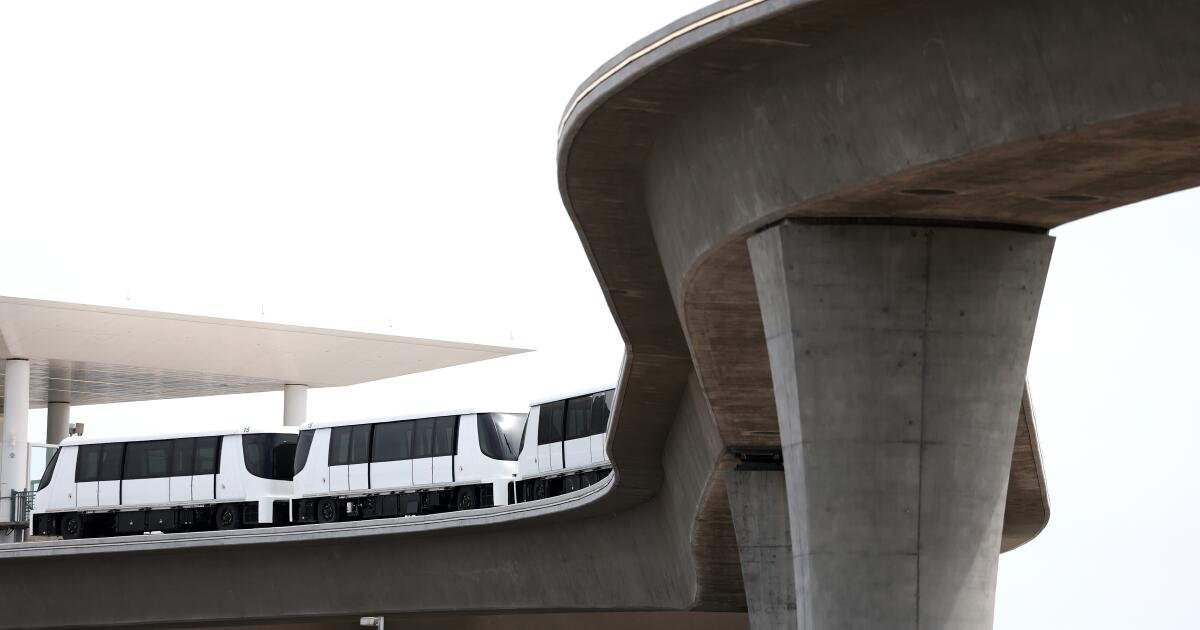
The long-awaited Automated People Mover train at Los Angeles International Airport is expected to transform traffic ahead of the 2028 Olympics. Visitors to the airport have been able to watch the trains in action, but travelers have yet to benefit. Despite months of test runs and finishing touches near completion, the people mover, dubbed Skylink, faces financial scrutiny and new uncertainty as the project approaches a final deadline amid escalating tension between the airport and the contractor.Fitch Ratings recently moved the credit rating of the project’s $1.2-billion senior bond to its negative watch list. The California Municipal Finance Authority’s bond issued on behalf of project contractor LAX Integrated Express Solutions, known as LINXS, was downgraded deeper into junk territory, from BB+ to BB, a move that highlights the project’s vulnerability to default risk as it gets closer to the drop-dead date of completion, or longstop.In its report, Fitch said further delay “leaves the project in a precarious position with a limited margin of safety before it could breach the lenders’ longstop of Oct. 8, 2026, and the project longstop date of Dec. 8, 2026.” In that unlikely scenario, the project with LINXS could be terminated and Los Angeles World Airports, which manages LAX, would have to find a new contractor, further delaying the train’s future.“There’s a big difference between a project that is only 25% done or 50% done, versus something that is 99.6% done,” said Seth Lehman of Fitch. “All the hard infrastructure of the project is there; all rail cars that serve the project are being tested.”It would be extremely difficult and expensive for the airport to distance itself from the contractor if the project failed. “We think that LAX would not likely want to go down the road of going through a formal termination process because it becomes a big challenge for them to kind of then separate themselves from the current parties they’re working with.” Fitch cited a “rising discord between the project parties over outstanding claims and obligations, even though the project is 99.6% complete and both parties have economic incentives to complete it.” In 2024, the credit agency downgraded the bond rating from BBB- to BB+. The credit agency said the current rating is unlikely to improve without completion or major progress.Construction for the 2.25-mile elevated train started in 2019. It was originally slated for a 2023 opening, but negotiations over timeline, production and compensation between LAWA and LINXS and discussions during multiple closed door board meetings led to extensive setbacks.Officials were hopeful that it would open before the 2026 World Cup, which would have been a crucial test run ahead of the 2028 Games. But it missed that goal date, prompting L.A. City Councilmember Monica Rodriguez to introduce a motion, which passed, for LAWA to report back on the ongoing delays.“With the 2026 FIFA World Cup now underway, the project missed its long-anticipated target of being operational before the event,” the motion states. “With testing continuing and airport officials remaining optimistic about opening later in 2026, the repeated delays have raised concerns about whether the project can finally meet its latest timetable.”The $3.3-billion endeavor is the most anticipated project in the airport’s $30-billion overhaul. When the train opens, it will offer a direct connection to the L.A. Metro and will shuttle passengers and employees between the terminals, a new rental car center, parking lots and the rideshare lot. But ongoing disagreements between LAWA and LINXS continue, and extensive 30-day testing that would need to be completed before the train’s opening would move the project date back further to late 2026. Neither LAWA nor LINXS responded to inquiries from The Times about the most recent bond rating.The credit agency’s downgrading comes after LINXS filed a lawsuit last month against the city of Los Angeles and accused Los Angeles World Airports, a city department, of misleading the public about reasons for project delays, changing drawings that affected the scope of the plans and creating obstacles to progress.The lawsuit was filed ahead of an October deadline to finish the project or risk lenders’ demand for repayment from LINXS, according to the complaint. The mayor’s office and LAWA did not comment directly on the lawsuit.Last year, a Los Angeles County civil grand jury investigated more than $880 million in change orders that LAWA paid to LINXS over delays and found that it was the contractor, not the airport, largely to blame. The report said that since the train was based on a design-build contract, it fell on the contractor to meet all necessary criteria.The grand jury reported that LINXS — a private-public partnership headed by Fluor that also includes Balfour Beatty, ACS Infrastructure Development, Dragados USA, HNTB and others — should have caught an early design flaw that led to delays. The grand jury believed that LINXS took advantage of the urgent need to get the project done for high profile sporting events as a way to leverage change order demands.The report also said that a single person who was tapped as a neutral negotiator between LAWA and LINXS became a de facto arbiter of disputes around large money claims who instructed LAWA to pay $97 million to LINXS.“We believe … that the Contractor could have been able to exploit the deficiencies in the Contract to their maximum benefit,” the report reads. “What happened during construction of the People Mover is important, but not as important as preventing some of the missteps from happening again.”