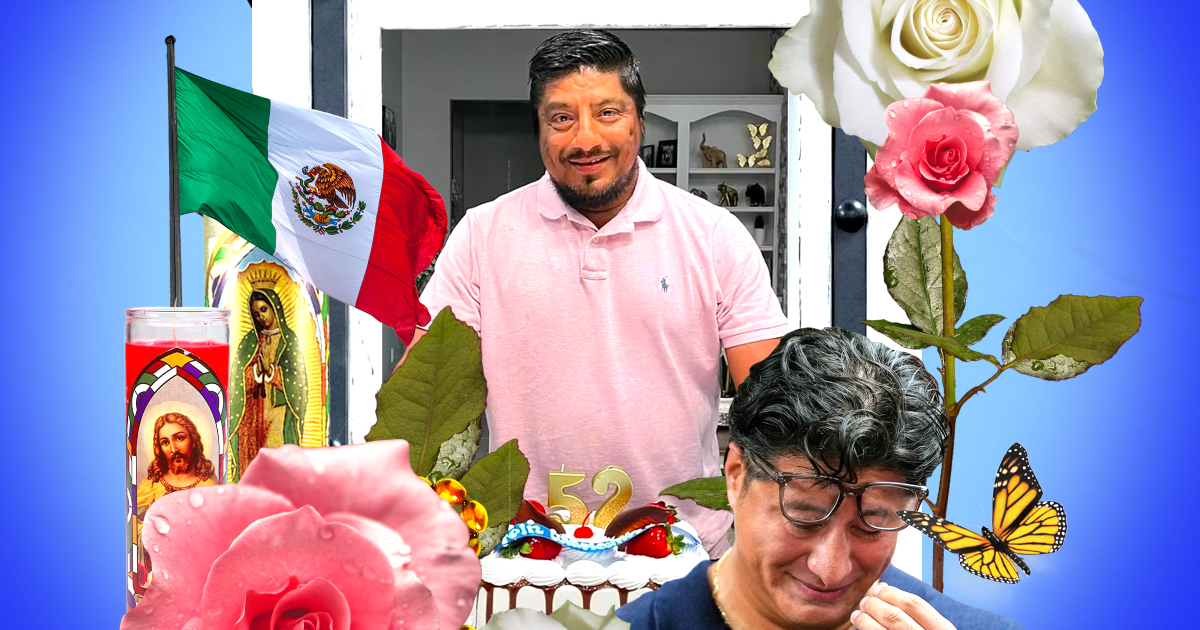
Well, this is not the newsletter I wanted to write this week.I had originally planned to write about Mexico’s World Cup run and how it filled people with hope and pride in a time when those emotions feel particularly hard to come by.While the joyful chant of “Y si sí” was a distillation of Mexican optimism, there is a startling duality that comes with being a Mexican in the U.S., and no amount of World Cup fervor can or should cover up the other side of the coin. I am speaking of the reality for many Mexicans — and Latinos as a whole — who fear for their livelihoods and lives every day due to operations by Immigration and Customs Enforcement. Last summer, ICE raids made national news as federal officials were heavily deployed to cities like L.A., Chicago and Charlotte. It felt as if every day was filled with heartbreaking story after heartbreaking story about the aggressive nature of the operations and how so many families — largely Latino families — were torn apart.It all appeared to reach a tipping point early this year in Minneapolis after ICE agents killed U.S citizens Renee Good and Alex Pretti. The deaths of Good and Pretti caused grand scale outrage and even inspired a national shutdown protest day in late January.In the three months after those slayings, the Associated Press reported that ICE arrests nationwide dropped nearly 12%. But don’t be fooled by that dip. The Trump administration is still going hard on its all-out immigration blitz; it’s just happening a little more quietly this time around.Over five days in late June, ICE arrested 10,000 people — a sharp increase in the daily number of ICE arrests over the last few months. The Department of Homeland Security recently bought two of the largest immigrant detention facilities in California for $1.5 billion. But the quieter maneuvering by ICE turned back into a blaring alarm siren on Tuesday when federal agents shot and killed Lorenzo Salgado Araujo in Houston. The shooting occurred in the predominantly Mexican American neighborhood of Magnolia Park. According to a Homeland Security statement, ICE agents were attempting to conduct a vehicle stop on Salgado Araujo as part of a targeted operation when he “attempted to evade arrest.”“[H]e rammed an ICE law enforcement vehicle, refused to follow multiple verbal commands, and weaponized his vehicle in an attempt to run over an ICE law enforcement officer resulting in our officer firing his weapon in self-defense,” Homeland Security claimed. “The driver was struck, and emergency services were immediately contacted. The driver was transported to the hospital where he passed away from his injuries.”The agency also noted that the incident is now being investigated by the FBI as a “potential assault on a federal law enforcement officer.”Not that it matters, but Salgado Araujo — a Mexican national — lived in the U.S. for decades and had no criminal convictions. The narrative that a federal officer was going to be rammed by a vehicle was also used as a justification for the killing of Good in Minneapolis. Salgado Araujo’s death is at least the eighth fatality that has resulted from immigration sweeps since the start of 2025.In an emotional news conference Wednesday, Salgado Araujo’s son, Ronaldo Salgado, claimed that his 52-year-old father was on his way to a construction job when the incident occurred. Salgado said he found out about his dad’s death from a social media post.“I saw a video posted on Facebook that he had been shot,” he said. “I recognized him immediately, not from his appearance, but from his voice crying for help as he laid on the street bleeding out.”Salgado later voiced anger and disappointment about the nature of his father’s last moments.“He did not deserve to die. He did not deserve to be reduced to a headline of Mexican man shot and killed by ICE,” he said. “He deserved to live a quiet life as Lorenzo Salgado Araujo, a husband, a father and a job creator for dozens of men who also wanted the American dream.”Salgado also added that there were three other men in the vehicle with his father — one of which was Salgado’s uncle — and they were “rounded up.” He noted that he had not heard from any of the men since their detainment. On Thursday, Texas Democratic Rep. Sylvia Garcia revealed that Salgado Araujo and his passengers were not even the initial targets of the ICE operation.“The acting director of ICE has confirmed that Salgado was not the target, and neither was his brother,” Garcia said. “But he provided no information as to why, if he was not a target, he ended up being the fatality. And that’s the question that the family needs answered.”Each one of these ICE deaths cuts deeply, but this one resonates at personal level. A 50-plus-year-old Mexican construction worker who has been in the U.S. for decades and living in a predominantly Latino area is also a very accurate way of describing my own dad. That could’ve been him in that car. I’m guessing for many of you reading this, that would also be a spot-on description of your own father. Latino advocacy organizations like the League of United Latin American Citizens have expressed their dismay and called for a transparent investigation into the shooting.We’ll just have to wait and see if an investigation into the situation will yield a punishment for the offending officers.To make matters worse, Homeland Security confirmed Thursday that the ICE agents involved in the shooting were not wearing body cameras.A Homeland Security spokesperson told KHOU 11 — Houston’s CBS affiliate station — that the officers didn’t have cameras on “due to back-to-back Democrat shutdowns.”“The process of purchasing and issuing body-worn cameras to all of our ICE field offices was interrupted by the Democrats multiple government shutdowns,” the statement continued. “Body cameras have been deployed to more than half the field offices, with the remaining half to receive them in the next 60 days.”When it comes to the officers being held accountable, I won’t hold my breath.But I do have a couple of questions.Where is the widespread national outrage? Where is the economic boycott for Salgado Araujo?Immediately after the killings of Good and Pretti people across the nation took to the streets — as they should’ve. I haven’t seen a makeshift national shutdown made by the general public the same way it was expeditiously put together after white Americans were terrorized by ICE.I can’t help but notice that same level of action doesn’t take place after ICE agents kill Latinos— who make up the majority of the individuals killed by the agency. Americans have always been so quick to consume the parts of the Latino experience that provide dopamine hits. For example, more than 44 million people in the U.S. watched the Mexico-England World Cup match over the weekend, making it the most-watched soccer game in U.S. history.But when it comes down to being there with us through the hardest parts of our experiences, where is everyone now?Mexico World Cup emotions (Silvia Izquierdo / Associated Press) Here’s a version of what I originally planned to write about — which I decided to keep in the newsletter because if I’ve learned anything from Mexico’s soccer team it’s that you have to appreciate the moments of light even when living in a sea of darkness. On Sunday night, the Mexico men’s national team was eliminated from the World Cup by England after an emotionally turbulent loss at the famed Estadio Azteca in Mexico City.The Mexican squad’s joyful and optimistic chant of “¿Y si sí?” suddenly yielded the answer: “Fíjate que no.”In many ways, it was a classic Round of 16 exit for Mexico, over-matched by a technically superior opponent filled with players who lead top-level club leagues internationally.But this time around the Mexican team displayed a level of tenacity and effort that it hadn’t shown in previous World Cup outings. They left it all out on the pitch against England and pushed a world-class crew to the brink.Tears streamed down the faces of El Tri’s players after the crushing loss, yet pride swelled within the souls of Mexicans across the world after the squad’s valiant run.But it was more than just the footballing display that helped Mexican achieve such an inspired run at the tournament.Social media was plastered with videos showing Mexicans having playful and wholesome interactions with fans from throughout the world. Korean fans were embraced with chants of “Coreano, hermano, ya eres Mexicano,” Mexico fans consoled a tearful Japan supporter after his team lost to Brazil in the Round of 32 and in the moments after the crushing loss to England, El Tri fanatics congratulated fans of the Three Lions outside the Azteca.Additionally, Mexico fully embraced the Iranian national team after it had to unexpectedly relocate its World Cup home base from Arizona to Tijuana due to the ongoing conflict between Iran and the U.S. Mexicans eagerly awaited the arrival of the Iranians and greeted them with cheers as they landed at a Tijuana airport back in June. Mexicans then gave the squad an emotional send off after they were eliminated from the tournament. Seeing Mexico be such a gracious host for the World Cup highlighted the true spirit of Mexicans. They welcomed the turbulent emotions that come with football fandom and lovingly partook in cultural exchanges. And no matter what people in the U.S. might claim, Mexico really established itself as el equipo de todos this World Cup cycle. I wasn’t the only Mexico supporter who felt a plethora of emotions after El Tri’s tournament run. I asked a few of my colleagues to share what they were feeling in their World Cup haze.Andrea Flores, De Los staff writerI think what made it really special was seeing how much support there was for Mexico. After they were eliminated, one of my friends posted something to the effect of “We always knew no, that Mexico wouldn’t win. But for a while we imagined, what if it could?” I think having that radical hope is truly what made this World Cup so special.Eduard Cauich, L.A. Times en Español sports reporter Having now covered four World Cups as a journalist, here’s what I’ve learned as a Mexican fútbol fan watching El Tri play on the biggest stage.It is obvious that Mexico doesn’t have the talent or depth of elite teams. Everyone knows that. And yet, somehow, this team gave us four incredible nights of joy and celebration, and made people dream that it could be done. I watched people in Mexico go from skepticism to full belief. Millions of them packed into the Ángel de la Independencia, enjoying each victory. Those are the moments we should hold onto. Fans from other countries came to Mexico and fell in love with the culture, the noise and the passion we bring to fútbol. Once again, Mexico proved it’s one of the best hosts the World Cup has ever had and that you cannot buy passion for soccer and love for your country’s team.Mexico not making it into the top eight teams is not on the fans. And I would argue that it’s not even the current players’ fault. It’s on everything that’s missing, such as opportunities, the player development pipeline, and everything a young player needs and often doesn’t get in Mexico’s complex and dysfunctional fútbol system.Given all that, this group gave us everything they had. They overachieved.As for us fans, there’s an old saying: lo bailado nadie te lo quita — no one can take away the joy of dancing that you’ve already experienced. So let’s remember it this way: a great summer of soccer with four unforgettable nights and a battle against a team like England at the Azteca that will go down in World Cup history as a classic.Fidel Martinez, De Los editorial directorIn my time living here, I don’t think I’ve ever seen Los Angeles be so outwardly proud to be Mexican. I saw so many cars with Mexican flags on them. The national team’s green jersey became the Angeleno uniform. The city became the world’s largest block party every time Mexico played. In the words of José Alfredo Jiménez, the greatest Mexican bard, que lindo es lo bonito.On a personal note, this World Cup was particularly hard for me — it was the first tournament since my dad, the person who made me love El Tri and being Mexican, died. Still, he was with me for every match. Ahead of the Mexico-England game, I grabbed a photo of him from the shelf and placed it in front of the television. If we were going to do something historic that evening, he needed to watch.In the end, jugamos como nunca, y perdimos como siempre. We played like never before but lost like we always do. That defeat really hurt — it still does — but I’d be lying if I said I didn’t find comfort in its familiarity. I thought of past conversations of commiseration I shared with my father, and how despite our generational differences, our pain was always identical. Never in my life have I felt more seen by him than after a heartbreaking Mexico World Cup loss. I have a kid of my own now, and she’ll inherit this love and allegiance for Mexico. And when El Tri breaks her heart, I’ll tell her that the man that meant the most to me in this world felt exactly how she’s feeling.Diana Ramirez Santacruz, De Los art directorThis World Cup was incredibly eye-opening for me. As someone who doesn’t usually follow soccer, I never expected to feel so emotionally connected to it. Watching Mexico compete filled me with a deep sense of pride, not just in the team, but in what it means to be Mexican.Honestly, I don’t think the biggest takeaway was winning the World Cup. I mean, don’t get me wrong, that was everything lol. But for me, the real prize was seeing how it brought people together. It reminded so many of us, especially Mexican Americans, of our shared identity and gave us a reason to celebrate it so loudly.At a time when so many in our community are carrying fear, uncertainty and frustration because of what’s happening in this country, it felt really special to experience that kind of joy together. For a little while, we weren’t thinking about politics or headlines. We were just proud to be Mexican. And I think that’s something I’ll remember after this World Cup.Stories we read this week that we think you should readUnless otherwise noted, stories below were published by the Los Angeles Times.Politics and immigrationArts & EntertainmentSouthern California