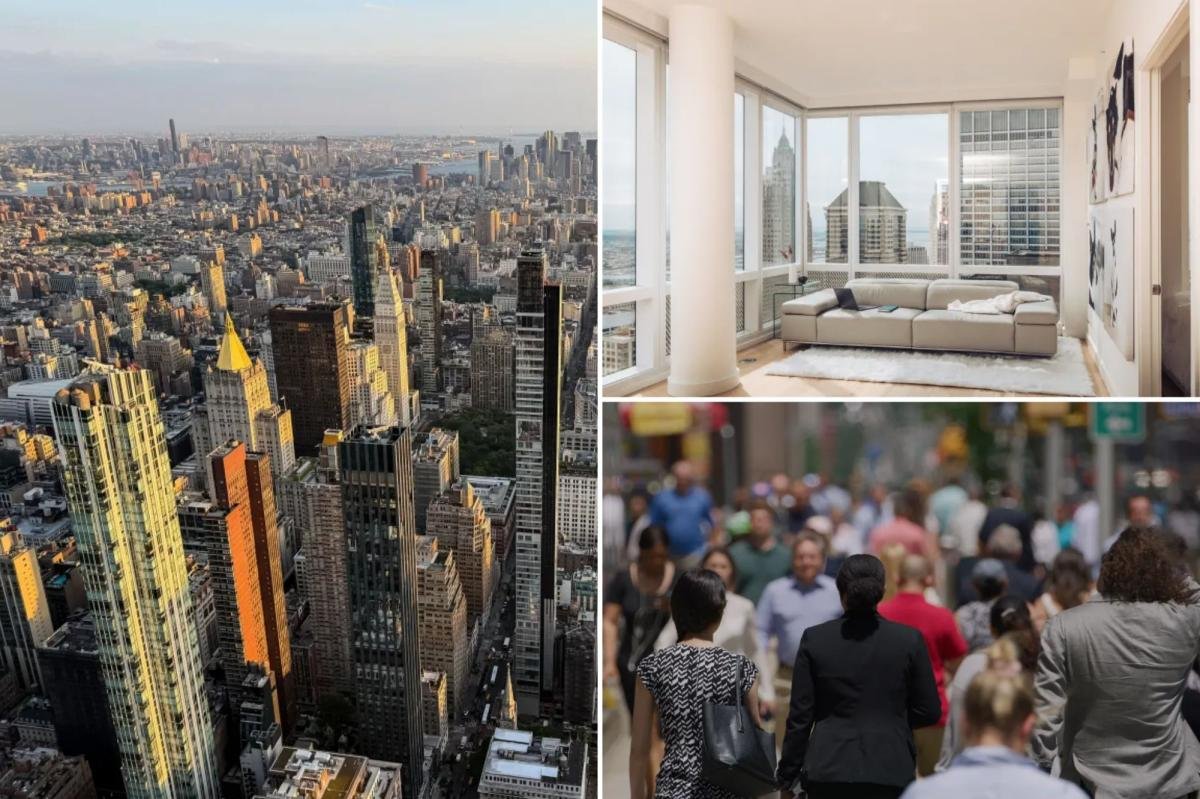
Manhattan renters, brace yourselves.
The average price tag for a place to live just hit a jaw-dropping $6,655 a month, an all-time high, according to fresh data from Corcoran Sunshine Marketing Group.
That’s a brutal 10% jump from a year ago, and real estate pros are pointing straight at Mayor Mamdani’s incoming rent freeze on stabilized units as one of the culprits, along with a looming pied-a-terre tax that brokers say is only going to squeeze the market harder. The pain is compounded by a record-low number of vacant apartments across the city, leaving desperate renters with almost nowhere to turn.
The median rent, meanwhile, sits at $5,295, up 6% from last July, though it held flat month over month after climbing 3% in both June and July from May’s previous record of $5,125.
Manhattan rents have hit a record $6,655 average a month, up 10% year-over-year, as brokers blame Mayor Mamdani’s incoming rent freeze on stabilized units, a new pied-a-terre tax, and a historic housing crunch for driving prices to breaking points. UCG/Universal Images Group via Getty Images
Every size apartment is getting hit, with average prices up double digits for two- and three-bedrooms. Studios now average $4,088 (up 8%), one-bedrooms are at $5,486 (up 7%), two-bedrooms have soared to $8,054 (up 13%) and three-bedrooms are averaging a staggering $12,228 (up 12%), all year-over-year. Studios, one-bedrooms and two-bedrooms have all hit all-time highs.
A market with nowhere to go
New York’s rental vacancy rate has cratered to just 1.49%, the tightest it’s been since 1968, and down from 1.57% previously. Experts consider anything under 5% a landlord’s market. This is far worse than that.
Separately, state registration data self-reported by landlords shows about 57,000 rent-stabilized apartments sat empty citywide in 2025, roughly 5.6% of the regulated stock and up from 3.7% a decade earlier. Tenant advocates argue landlords are warehousing units rather than renting them at capped rates, while owners say the 2019 rent laws make renovating and re-renting those apartments financially unworkable.
The median rent sits at $5,295, and studios, one-bedrooms and two-bedrooms have all reached all-time highs, with two- and three-bedrooms posting double-digit annual gains. Getty Images
The city’s rental vacancy rate has cratered to 1.49%, the tightest since 1968, leaving almost no breathing room for renters. blvdone – stock.adobe.com
Gary Malin, chief operating officer of The Corcoran Group, points the finger squarely at Albany and City Hall.
“Misguided New York City and State legislation, like ‘good cause’ eviction, the FARE act, and the 2019 rent laws, have in large part created this perfect storm for sky-high rents,” Malin told The Post. “These laws have curtailed the supply of rental housing. This has caused demand to build up to a boiling point and pricing for available apartments to reach all-time highs. Legislators seem to care more about optics versus the actual impact of their policies. Their initiatives may be well intentioned, but there’s been severe unintended consequences, and today’s apartment seekers are literally paying the price.”
And the incoming rent freeze won’t be the relief tenants are hoping for, Malin warned, since landlords still have bills to pay.
“One thing is for certain, landlords’ costs will still go up regardless of the new rent freeze,” Malin said. “While the freeze may be good news for rent stabilized tenants, the bad news for market rate renters is that these increased expenses will likely be passed on to them, in the form of higher rents when it’s time to renew their lease.”
And brokers say that shift is already underway, well before the freeze officially kicks in on October 1. Landlords who know their rent-stabilized units are about to be locked in place are padding rents on their free-market apartments now to cover the gap.
Corcoran’s Gary Malin says landlords facing frozen stabilized units and rising costs will pass those expenses onto market-rate tenants. Matthew McDermott for NY Post
He also sees the new pied-a-terre tax scaring off would-be buyers and pushing them straight into the already-slammed rental pool.
“The new pied-a-terre tax may have an impact on the rental market as well, especially at the high-end,” Malin said. “People who were in the market to purchase a part-time home in New York, may instead look to rent — to avoid the liability and hassle associated with the surcharge. In addition, current homeowners now faced with the tax may choose to sell their pied-a-terre and rent as an alternative. Overall, both new policies will likely cause additional demand to hit a rental market that’s already incredibly stressed.”
“It is not supernatural, but it is the ‘perfect storm’”
Douglas Elliman’s top-producing rental broker, Keyan Sanai, says it’s a collision of forces: high mortgage rates keeping buyers on the sidelines, a housing shortage that never gets fixed, and policy blunders piling on at the worst possible moment.
“It is not supernatural, but it is the ‘perfect storm,’” Sanai said. “There is no single reason Manhattan’s average rent has reached $6,655. It is a collision of economic headwinds, a structural housing shortage and public-policy mistakes, all pushing rents up at breakneck, or in this case, wallet-breaking speed.”
With 30-year mortgage rates back up near 6.69%, Sanai says plenty of would-be buyers are staying renters instead, especially when the stock market has outperformed Manhattan real estate for a decade. He also blames the FARE Act, which shifted broker fees onto landlords, for quietly fueling rent hikes as owners folded that cost into monthly rents instead of eating it.
Douglas Elliman’s Keyan Sanai points to high mortgage rates, a construction slowdown, and policy missteps like the FARE Act as compounding factors, calling it a “perfect storm” that’s left tenants exhausted and paying hundreds more than they did a year ago for the same apartments. Christopher Sadowski for NY Post
He also says tenants are just plain exhausted by it all.
“They walk into a listing already frustrated even when they genuinely want the apartment because they feel that, year after year, they are paying more and receiving less,” Sanai said. “The same apartment may now be listed for $500 to $1,000 more per month than it was just one year ago, so tenants often arrive disgruntled before the showing has even begun.”
Even Sanai admits the old rules of the game have flipped.
“I used to tell clients, ‘In life, you get what you pay for and in Manhattan, you get a little less than that.’ At today’s prices, even that may be optimistic,” Sanai said.