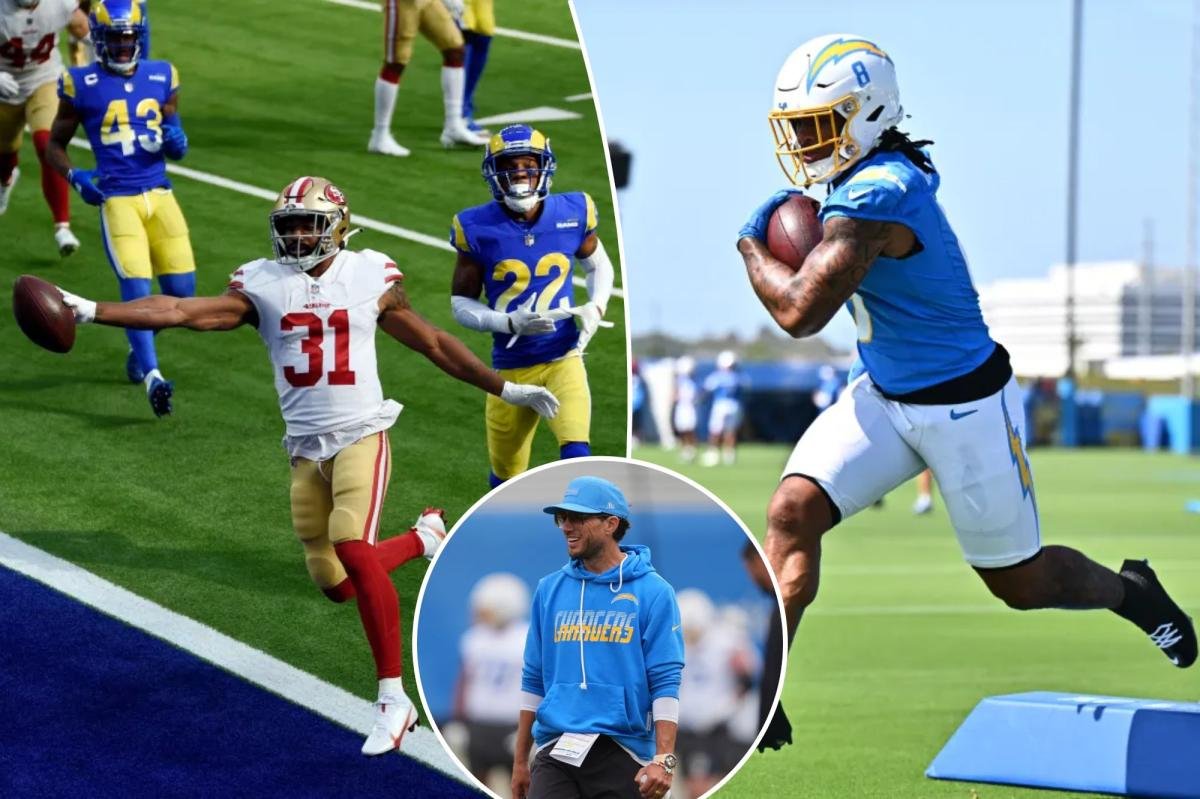
Mike McDaniel is not trying to reinvent the running game with the Los Angeles Chargers. He is looking back at the flexible backfields he helped construct during five seasons with the San Francisco 49ers.
Although McDaniel is regarded as one of the NFL’s most creative offensive minds, he said innovation for its own sake does not drive his process.
“I think the most important thing—the thing that I don’t think about—is inventing stuff,” McDaniel said during an appearance on “NFL Daily” with Gregg Rosenthal and Jourdan Rodrigue. “If you stay true to your core of what your job is, and for me, I see it as creating advantageous situations for all these players, then you’re kind of solution-oriented, reverse-engineering issues.”
Los Angeles Chargers offensive coordinator Mike McDaniel smiles during an NFL football training camp on Wednesday, Aug. 5, 2026, in San Diego. (Copyright 2026 The Associated Press. All rights reserved) AP Photo/Gregory Bull
That philosophy helps explain how McDaniel views a Chargers backfield featuring Omarion Hampton, Keaton Mitchell and Kimani Vidal. Instead of assigning fixed workloads before kickoff, he plans to select the back best suited for the opponent and adjust according to who produces during the game.
“You kind of play the hot hand once you’re into games,” McDaniel said. “Specifically, I’ll use all three of those guys probably every game. The relative ratio? That will be based on opponent and what we’re asking the guys to do.”
It is a familiar formula for McDaniel, who worked alongside Kyle Shanahan in San Francisco from 2017 through 2021, first as the team’s run-game specialist, then as run-game coordinator and eventually offensive coordinator.
During that stretch, the 49ers rarely depended upon one permanent workhorse. Injuries contributed to the constant movement, but performance also allowed backs to rise and fall within the rotation.
The clearest example came in 2019. San Francisco began the season with Tevin Coleman and Matt Breida leading the backfield, but Raheem Mostert forced his way into a larger role. After Coleman started against Baltimore, Mostert took control and rushed 19 times for 146 yards and a touchdown.
San Francisco 49ers running back Raheem Mostert scores a rushing touchdown against the Los Angeles Rams during the first half of an NFL football game Sunday, Nov. 29, 2020, in Inglewood, Calif. (Kelvin Kuo) AP
“The way he was going, we just stuck with the hot hand,” Shanahan said afterward.
One week later, Shanahan said Mostert had “given us no choice” but to expand his role. Mostert finished the regular season with a team-leading 772 rushing yards before producing 220 yards and four touchdowns in the NFC Championship Game.
Yet the arrangement remained fluid. Coleman reclaimed the leading workload one round earlier, rushing 22 times for 105 yards and two touchdowns against Minnesota while Mostert received 12 carries.
Offensive coordinator Mike McDaniel of the Los Angeles Chargers looks on during the Los Angeles Chargers Training Camp at The Bolt on Wednesday, July 29, 2026, in El Segundo, California. (2026 Getty Images) Getty Images
San Francisco continued shuffling backs throughout McDaniel’s tenure. Breida led the 49ers in rushing in 2018, Mostert did so in 2019, Jeff Wilson Jr. took the honor in 2020 and rookie Elijah Mitchell emerged with 963 yards in 2021.
The names changed, but the offense continued producing by featuring the running back whose skill set best attacked that week’s defense.
McDaniel now has comparable flexibility in Los Angeles.
Los Angeles Chargers running back Omarion Hampton runs a drill during practice at the team’s training camp on Wednesday, July 29, 2026, in El Segundo, Calif. (Copyright 2026 The Associated Press. All rights reserved) AP Photo/William Liang
Hampton remains the favorite to lead the Chargers after rushing for 545 yards and four touchdowns while catching 32 passes in just nine games as a rookie. His combination of power and receiving ability gives him the clearest path to a three-down role, and McDaniel has said there will be opportunities for him to receive “a ton of touches.”
But Hampton’s place atop the depth chart does not make the distribution automatic.
Mitchell, whom the Chargers signed to a two-year contract, averaged 5.78 yards per carry last season and generated 10 runs of at least 10 yards on only 59 attempts. Vidal led Los Angeles with 643 rushing yards, surpassed 100 yards three times and supplied value as a receiver and pass protector.
Los Angeles Chargers running backs Keaton Mitchell (34), Amar Johnson (35) and Kimani Vidal (28) pose at training camp at The Bolt in El Segundo, California, on Thursday, July 30, 2026. (This asset – including all text, audio and imagery – is provided by Imagn Images. Reuters Connec) IMAGN IMAGES via Reuters Connect
Each back offers McDaniel a different answer. Hampton can provide the broadest solution, Mitchell can inject speed and explosive plays, and Vidal can handle the less glamorous responsibilities that keep an offense functioning.
Jim Harbaugh has already described the group as a potential “Thunder and Lightning” backfield. McDaniel said all three are capable of starting and expects each to play in most games. He also prefers keeping his backs fresh against defenders who cannot substitute as frequently.
That may produce a committee some weeks and a clear lead back in others. The decision will depend on the opponent, the assignment and which player makes himself most difficult to remove.
“If a player is playing really well, I’m not going to take him out,” McDaniel said. “That’s bad business.”
For all of McDaniel’s creativity, his plan for the Chargers’ rushing attack is not a new invention. It is a return to the adaptable model he helped build in San Francisco: arrive with multiple answers, identify the one working best and continue calling its number.