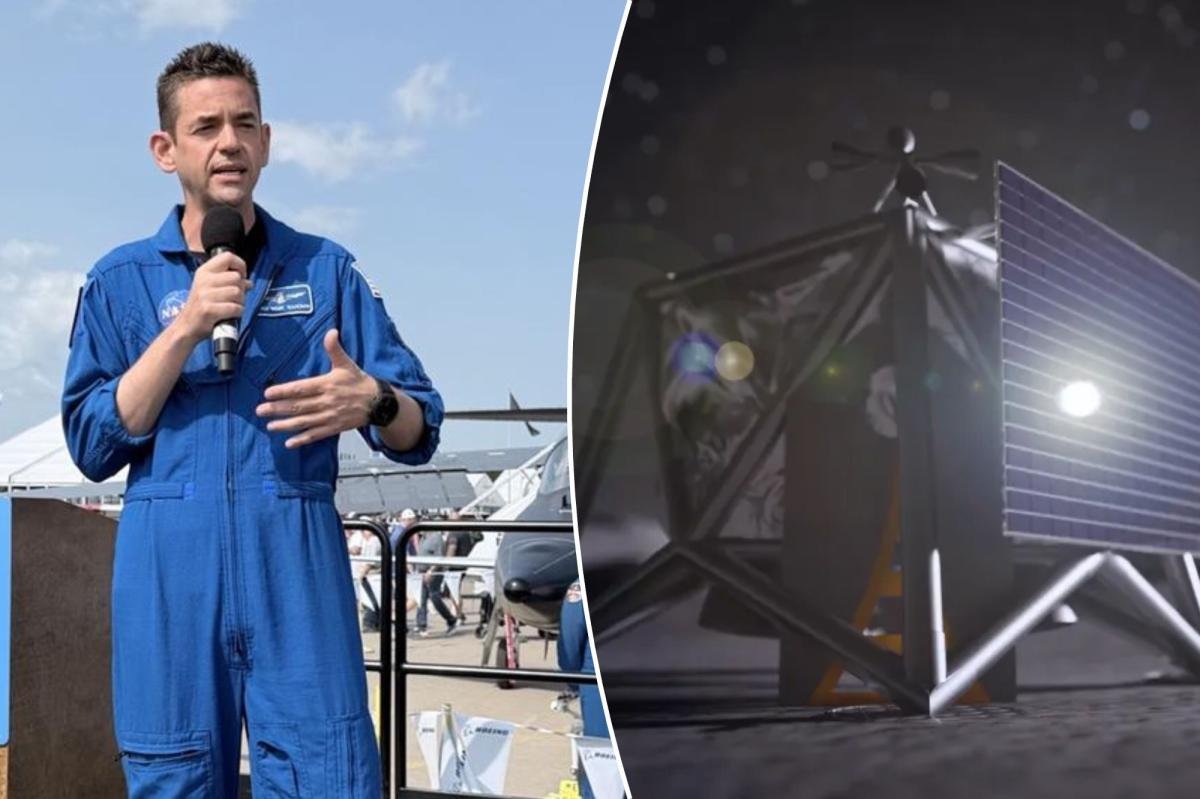
Fifty-seven years after Americans first landed on the moon, NASA is going back — not to plant another flag, but to build a permanent lunar base as it pushes to make humans an interplanetary species.
It is all part of a big push by the space agency’s Administrator, Jared Isaacman, 43, to develop nuclear-powered spacecraft, grow a real space economy and eventually put Americans on Mars. The ambition comes at a time when the American public has never been more excited about NASA.
“We’re polling at like 70% [for] America’s support to return to the moon, which is double that of during the Kennedy era,” Isaacman told me.
For NASA, the moon is foundational to any lasting presence beyond low Earth orbit. It could serve as a proving ground where astronauts extract water ice and turn it into oxygen, hydrogen, and propellant — the basic building blocks of life and transportation.
NASA Administrator Jared Isaacman fist-bumps astronaut Anil Menon through the quarantine glass ahead of the Artemis II launch that sent a crewed ship to deep space. Bill Ingalls/UPI/Shutterstock
The long-term goal is greater self-sufficiency, though Isaacman is careful not to oversell it. “I don’t know who’s rushing to have the first glass of moon water,” he quipped.
After the inspiring success of the Artemis II mission this past spring, which marked the first return to the moon in over half a century, NASA has an aggressive timeline in the coming years.
In 2027, it will launch Artemis III, which will put commercial lunar landing systems in low orbit, and start sending robotic landers and rovers to the south pole on a near-monthly basis to begin constructing a base.
“The three most powerful rockets in the world are going to launch in a span of about a week. It’s going to be really quite cool,” Isaacman said.
In 2028, NASA will endeavor to put astronauts back on the lunar surface with Artemis IV. This will lay the groundwork for the commercialization of space, with private companies building out their presence beyond Earth.
Fifty-seven years after Americans first landed on the moon, NASA is going back — not to plant another flag, but to build a permanent lunar base as it pushes to make humans an interplanetary species. NASA
“If we do want to have that extraordinary future that many of us imagine, you have to have some sort of a space economy to fund it,” he said.
That shift is already underway. Launch, Earth observation and communications have all moved from government-dominated projects into markets where private companies like SpaceX compete, innovate and drive down costs.
The next challenge is figuring out how to create more value in space than it costs to operate there — and make missions sustainable if and when taxpayers grow tired of subsidizing NASA.
Early research suggests that some of the most valuable work in space may come from industries that benefit from microgravity. Pharmaceuticals can be tested in an environment where proteins crystallize differently, potentially helping researchers better understand disease and drug development. Biological materials and organics may grow in ways that are harder to replicate on Earth.
In September 2024, Isaacman became the first private astronaut to conduct a spacewalk on the privately funded Polaris Dawn mission. USA TODAY Network via Reuters Connect
Orbital AI data centers, meanwhile, could benefit from continuous solar power and the ability to operate without the land, cooling, and community constraints that limit them on the ground. While many of these are still moon shots, that could change quickly over the coming years.
“I would not bet against the orbital data centers,” Isaacman said.
We may also finally get an answer to whether there is extraterrestrial life. Isaacman thinks there is “a very good chance” that samples returned from Mars in the next decade or so will prove microbial life once existed there — and we could see similar evidence from other worlds, like some of Saturn’s moons.
Isaacman, a private astronaut and billionaire entrepreneur who made his fortune in payments, is uniquely positioned for this moment.
He left high school at 16, founded what became the payment company Shift4 in his parents’ basement, and grew it into a multibillion-dollar public company listed on the New York Stock Exchange.
In 2027, NASA will launch Artemis III, which will put commercial lunar landing systems in low orbit, and start sending robotic landers and rovers to the south pole on a near-monthly basis to begin constructing a base. Chris McQuin
“I’ve absolutely lived the American dream,” Isaacman said. “None of that should happen and only did because of the nation that we live in right now.”
He was captivated by space from a young age: As a kindergartener, he told his teacher he would become an astronaut, and he later became a pilot because he thought that was the closest he would ever get. It wasn’t.
In 2021, he commanded Inspiration4, the first all-civilian orbital mission. In September 2024, on the privately funded Polaris Dawn mission, he became the first private astronaut to conduct a spacewalk.
When President Trump nominated him to run NASA a few months later, in early December 2024, Isaacman had only recently returned to Earth.
Some of the most valuable work in space may come from industries that benefit from microgravity — like pharmaceuticals that can be tested in an environment where proteins crystallize differently, potentially helping researchers better understand disease and drug development.
“There was no way I was going to turn it down,” he said of the out-of-this-world opportunity. “I had no problem walking away from my other life … I had a huge debt to repay to the nation.”
He brought his private sector ethos and Silicon Valley ethos with him to NASA — pushing it away from its bureaucratic background into a leaner and more efficient operation.
“We have got to stop trying to please everybody right now, we need extreme focus,” he said. “We’re supposed to be doing what no other government agency, no company is capable of doing, no other nation around the world.”
That has meant focusing on nuclear power and propulsion. NASA is targeting the launch of its first nuclear-powered spaceship in 2028.
It’s also meant attacking internal inefficiency. Roughly 75% of the agency’s workforce, more than 40,000 people, are contractors.
Isaacman said he was captivated by space from a young age: As a kindergartener, he told his teacher he would become an astronaut, and he later became a pilot because he thought that was the closest he would ever get. Getty Images
“As a taxpayer that should really bother you,” he said. “It’s $4.5 billion a year that we are paying to rent our workforce.”
NASA is now reversing that model, he said, by bringing contractors into civil service roles tied to core competencies: designing, building, testing, launching, and operating spacecraft.
“It’s saving taxpayers lots of money without canceling a program or firing anyone,” Isaacman noted.
Part of Isaacman’s urgency comes from an acknowledgement that America is in a new space race with China.
“We’re not going to lose,” he said.
And the challenge is worth it because — as figures like Isaacman and Elon Musk describe it — it is about diminishing humanity’s “massive concentration risk on Earth” if and when something happens to our planet.
This spring’s Artemis II launch was the first crewed mission to deep space since 1972. Getty Images
Still, for all of his ambition and enthusiasm, Isaacman is pragmatic about what the future in space might actually be like — more Antarctic expedition than glamorous vacation.
“Mars is going to suck to live in. You’re going to live in a bubble. You’re going to get pelted with radiation all the time. You’re never going to have a beach day,” he said. “Earth is the nice house in the neighborhood. Pretty much everything in our solar system is going to be a significant step down from Earth.”
But he’s very excited about the future — both in the near term and in the long term.
“I can’t wait for Halloween because I think the number of kids dressing up as astronauts for Halloween is probably one of the best indicators of how good of a job we’re doing,” he said. “I suspect the numbers will be up this year.”