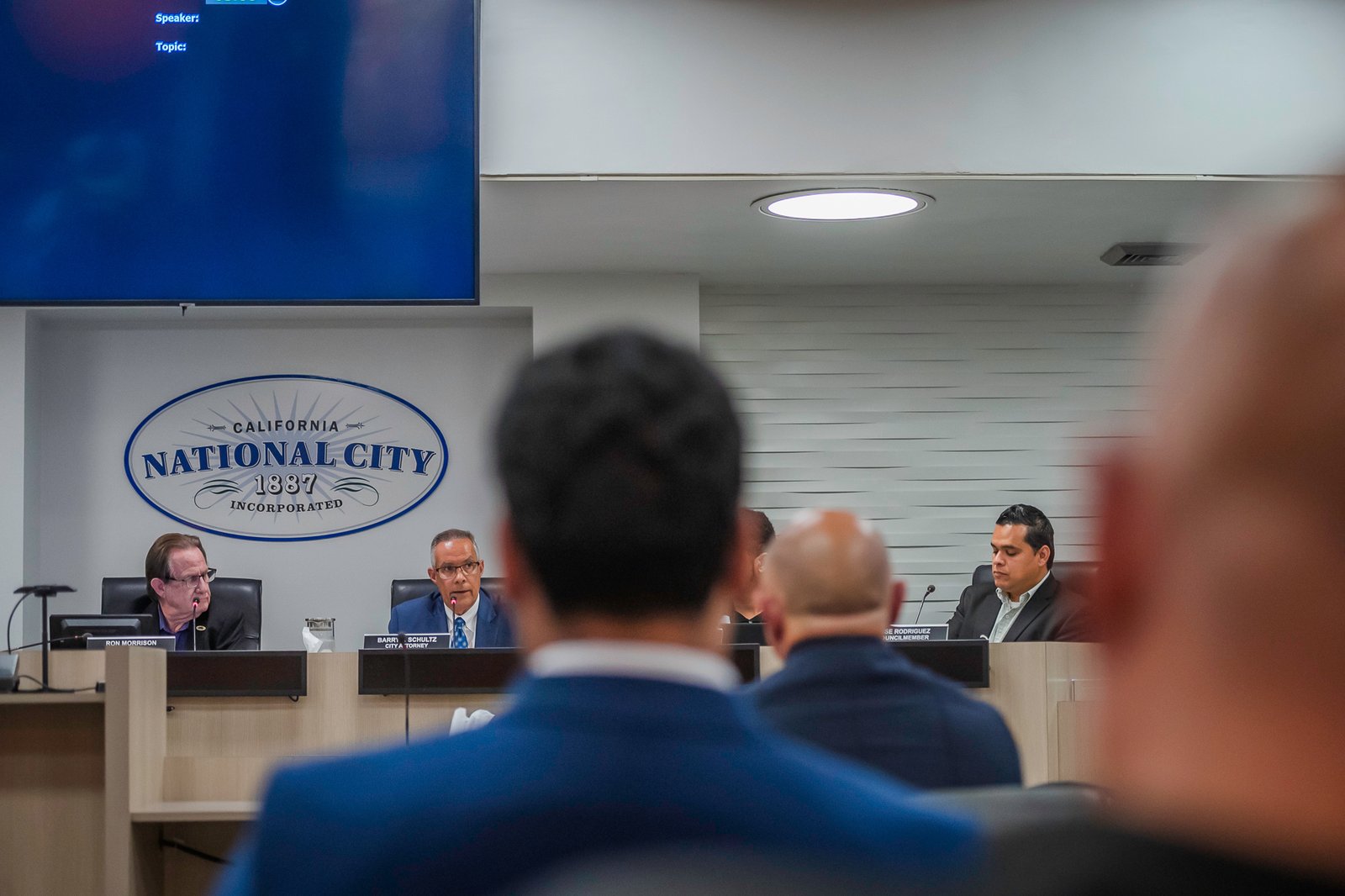
Near the end of a contentious National City Council meeting Tuesday, City Manager Doug Schulze made a startling announcement.
National City, he said, is going broke.
“By 2030, there is a strong possibility the city is no longer solvent,” Schulze said. “I don’t want to sound like I’m trying to scare the Council…This is a real problem.”
The audience, focused on a debate over a controversial tax proposal, didn’t seem to grasp the importance of Schulze’s bombshell.
But he’s right.
The current National City budget, which councilmembers approved in June, authorizes spending $13 million more than the city expects to earn in revenue.
To make up the difference, the $89 million general fund budget drains the last of a reserve fund the city has been tapping in recent years to cover deficits.
With those reserves now gone, Schulze said, the city’s funding gap will widen rapidly in coming years, leading to insolvency by 2030.
The city’s business community celebrated the results of Tuesday’s debate over a proposed business tax increase. The Council voted to shelve the proposal and instead approved a plan to work with businesses on new revenue-generating ideas.
But the city’s problem is not simply a lack of revenue.
Until last year, budget documents show, National City’s revenues and expenses were holding steady or growing modestly each year, ending each year in balance.
Then, in 2025, city councilmembers began approving a series of raises for city employees that councilmembers said were long overdue.
Many city workers earned far less than the county median for municipal employees, councilmembers said. They deserved better.
Though some on the Council, notably Mayor Ron Morrison, warned the raises would result in deficits, all the councilmembers, including Morrison, approved them anyway.
Councilmember Jose Rodriguez, who is running for mayor this year and long has championed workers’ issues, batted away concerns, saying Morrison and others were always predicting financial doom, only to be proven wrong at the end of each fiscal year.
This time, the doomsayers were right.
In the 2024 fiscal year, budget documents show that the city spent $41 million on personnel – slightly less than in 2021.
The following year, that figure jumped to $47 million. Last fiscal year, it jumped again to $54 million. This year, the city expects to spend more than $60 million on personnel.
That’s a nearly 50 percent increase in just three years. During the same period, revenues barely budged.
Put a different way, personnel costs rose from making up a little more than half of the city’s general fund budget to accounting for more than two-thirds of all general fund expenditures.
Even accounting for inflation, personnel costs are by far the fastest growing line item in the city’s general fund budget. All other categories remained flat or grew slightly.
In other words, if the City Council had not awarded employees those raises, National City’s budget problems would look a lot different.
Councilmembers on Tuesday seemed to grasp the problem.
“We did give [employees] historic raises,” said Councilmember Marcus Bush. “They needed that and deserved that. But there’s a cost to that…We should just be honest about that.”
Even Rodriguez, who earlier this year mocked Morrison’s budget warnings as the tired refrain of a longtime leader who has outstayed his welcome, acknowledged the city faces a grim future.
In an effort to build support for the business tax increase, he asked Schulze a series of pointed questions about what would happen if the city fails to generate more revenue.
That’s when Schulze said the city would go broke.
“The city manager is gone,” Schulze said, describing what happens when a city declares insolvency. “Councilmembers are replaced by a receiver or a trustee, and that individual makes all the decisions.”
Under questioning from Rodriguez, Schulze confirmed that, if the city slashes discretionary spending to close its budget gap, the pool and library would close, the city’s feeding program would end and the senior center would shut its doors.
“I’m not asking these questions to sound grim,” Rodriguez said. “I just want us to make an informed decision.”
Councilmembers on Tuesday shelved the business tax increase in part because, as Molina put it, it wasn’t fair to ask “businesses and voters to trust us with more money when we haven’t made good decisions.”
Left unanswered is what the city will do now.
Rodriguez appeared to issue a veiled warning against touching the employee raises. He repeatedly mentioned that the city’s main employee union is a bargaining unit of Local 221 of the Service Employees International Union, one of the county’s most powerful labor organizations.
Bush called the SEIU mentions a “scare tactic,” which Rodriguez denied.
Still, it’s almost certain that the union, along with the unions representing police officers, firefighters and city administrators, will be up in arms if city leaders seek to balance the budget by slashing salaries.
With the tax increase on the shelf for now, the Council is unlikely to put forward any major budget-fixing plans before the November election.
The city’s fiscal situation likely will be the main issue in what everyone expects will be a bitterly fought rematch between Rodriguez and Mayor Morrison, who said he plans to announce by Friday whether he intends to see re-election.
Whoever runs, they will seek to assign blame for the city’s fiscal mess.
And the election likely will become a contest between competing visions for putting the city on a path toward fiscal stability.
Given the city’s predicament, it will be one of the most consequential mayoral races in recent city history.
Meet the Beat
Want to meet the reporter behind this newsletter and all my other coverage of our part of San Diego County?
I’ll be hosting a free in-person Meet the Beat event at 5 p.m. Thursday, Aug. 27, at the Civic Center Branch of the Chula Vista Public Library, 365 F St. in Chula Vista.
I’ll talk about stories I’m reporting and investigations I’m working on, plus answer questions from readers like you. It’s a chance to get an inside look at our region’s top issues and meet others in the Voice community.
And did I mention it’s free?
More information and a link to sign up here.
See you there!
Politifest 2026
Fall is right around the corner. Which means Politifest, our annual October gathering of San Diego’s top politicos and public affairs junkies, is almost here.
We’re working on a South County session focused on our region’s consequential mayoral races. Mayors’ seats are up for grabs in all three South County cities at a time when our region faces rising costs, strained city finances and the ever-present Tijuana River sewage crisis.
For more information and early bird pricing, check out our Politifest homepage.
See you there!
Related Posts