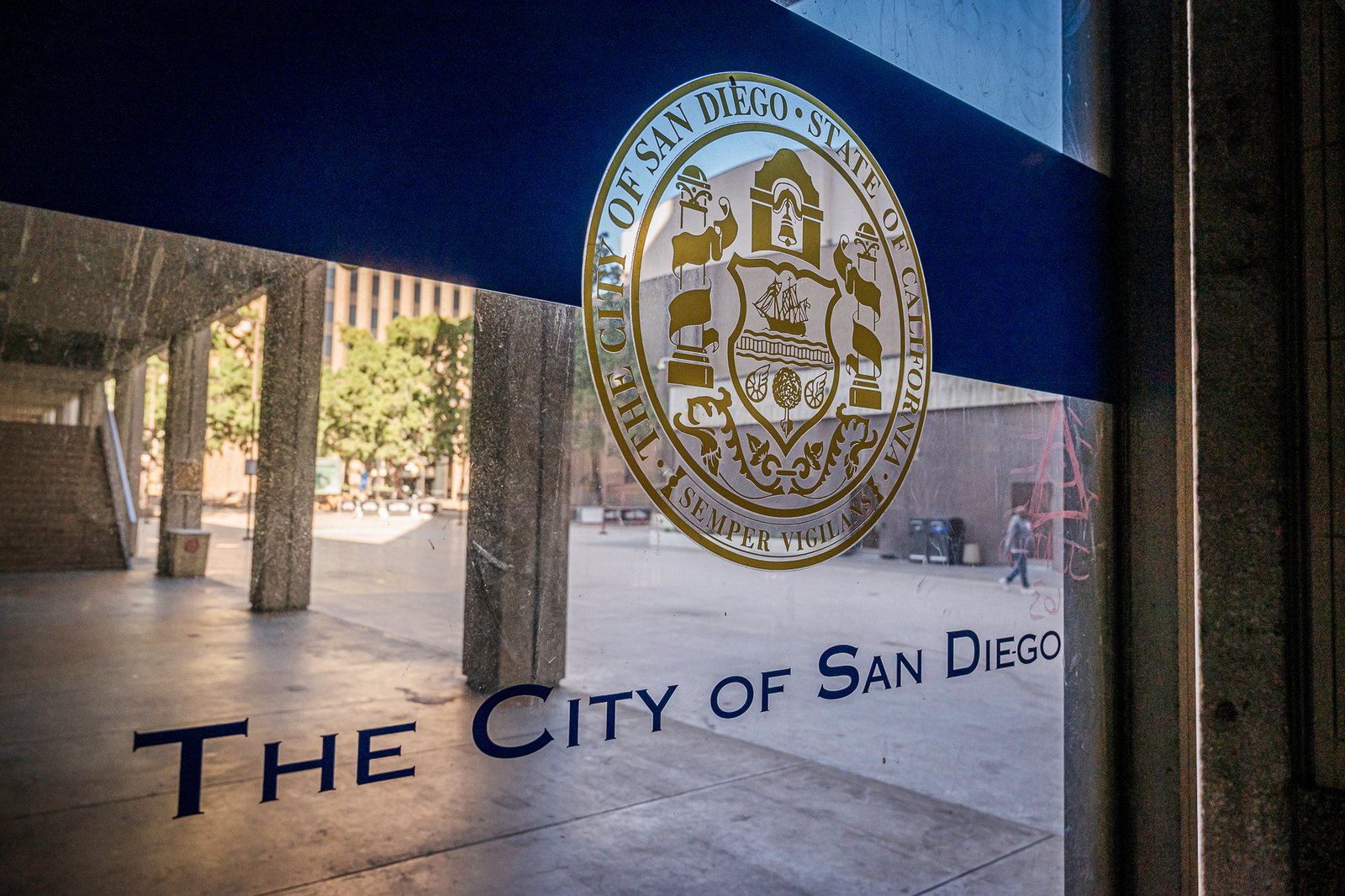
This week, City Hall’s budget decisions began coming home to roost.
San Diego city leaders had to cut $100 million in spending to keep a balanced budget last month. As one way to find some savings, they decided to close half the public restrooms at Mission Bay. The budget process is very hard to follow and I dare say some citizens tuned out when the topic of bathrooms came up.
But now the doors are locked and the people have nowhere to piss.
“We pay our taxes and this is what we’re gonna get, after everything? It’s not fair,” one woman told NBC 7.
This anger over the closures puts City Hall’s defining crisis into stark relief.
Charles Modica, the city’s independent budget analyst, said it to me like this a few weeks ago and I haven’t been able to stop thinking about it: “Expectations for what services the city can perform are out of line with the revenues people are willing to trust the city to have.”
The city desperately needs voters to approve new revenue to even be able to keep its current level of government services going — much less provide new ones. And yet voters have a deep distrust of City Hall. As I wrote at the beginning of June, the percentage of people who believe the city is on the wrong track has grown immensely.
This is starting to feel like a death spiral.
City Hall cuts services to balance the budget. Voters get angry. City Hall asks for new revenue for services. Voters say no.
Any political leader who wants to be truly effective — rather than just hold office — will have to find a way to break the cycle.
About Those Epic Vacancy Rates
Most of the major local news outlets have covered a very interesting piece of housing news: Apartment vacancy rates are at 6.2 percent, the highest they have ever been in the 2000s
The last few years, a lot of new apartments have been built in San Diego, so this increased vacancy rate isn’t really a surprise. The question is does the supply boom and increased vacancies mean anything good for affordability, as housing advocates have told us it would.
The news stories mostly pointed to the same data that show rents have been stagnate, but haven’t gone down. There’s other data that points in a different direction.
In March, KPBS reported that rent declined more in San Diego than in all of the 20 largest housing markets except for one. Rent for a one-bedroom apartment went down 5.6 percent and for a two-bedroom it went down 7.5 percent. These declines coincided with a big increase in listings.
That’s far from nothing, but we probably shouldn’t base our final judgement of housing policy on a study by Zumper.
At the neighborhood level and within economic stratas, supply is clearly affecting price. A building boom in market-rate apartments downtown has meant that prices have gone down and landlords are offering more deals on market-rate apartments downtown.
The question is how much further do the effects ripple out — or, ugh, trickle down. It’s very reasonable to think the price of older, cheaper apartments near downtown have also benefited from the building boom. In Golden Hill, where I lived until recently, this seemed to be true anecdotally. The overall decline in price for one-bedroom and two-bedroom apartments noted by KPBS would also back this up.
But there’s clearly a limit. Building more market-rate condos in certain parts of the city is going to have a limited impact on other apartments in other neighborhoods — especially in the near term.
My friend Jesse Marx recently wrote in the Jumping Off Place that some research shows a “weak” connection between supply and price. Journalists and researchers now have a case study in waiting to try to figure out — between weak and strong — how the influx of new apartments will affect San Diego.
In the meantime, it’s imminently clear that city leaders are going to have to come up with strategies beyond build, build, build to make a meaningful, wide scale difference for working class people trying to keep a roof over their heads.
Spencer Pratt to Get Local GOP Hyped
In August, the Lincoln Club Business League will host a dinner in San Diego to honor 250 years of the American experiment. Who better to get the party hyped than recent-election-integrity-questioner Spencer Pratt.
Pratt, the reality TV star, had appeared as if he would make it through to the run off to face incumbent Karen Bass in the race for LA mayor. However, as the weeks ticked by and the mail-in votes rolled in, Pratt got displaced from the run off. He’s now raising questions about California’s electoral process.
“Spencer Pratt represents a new kind of American voice: entrepreneurial, fearless, and willing to shake up the conversation,” said Kevin Faulconer, president of the Lincoln Club Business League in a press release. “At a time when voters are looking for leaders who understand how to communicate in a changing world, Spencer brings a perspective that is timely, relevant, and exactly the kind of energy we want at this year’s Annual Dinner.”
Related Posts