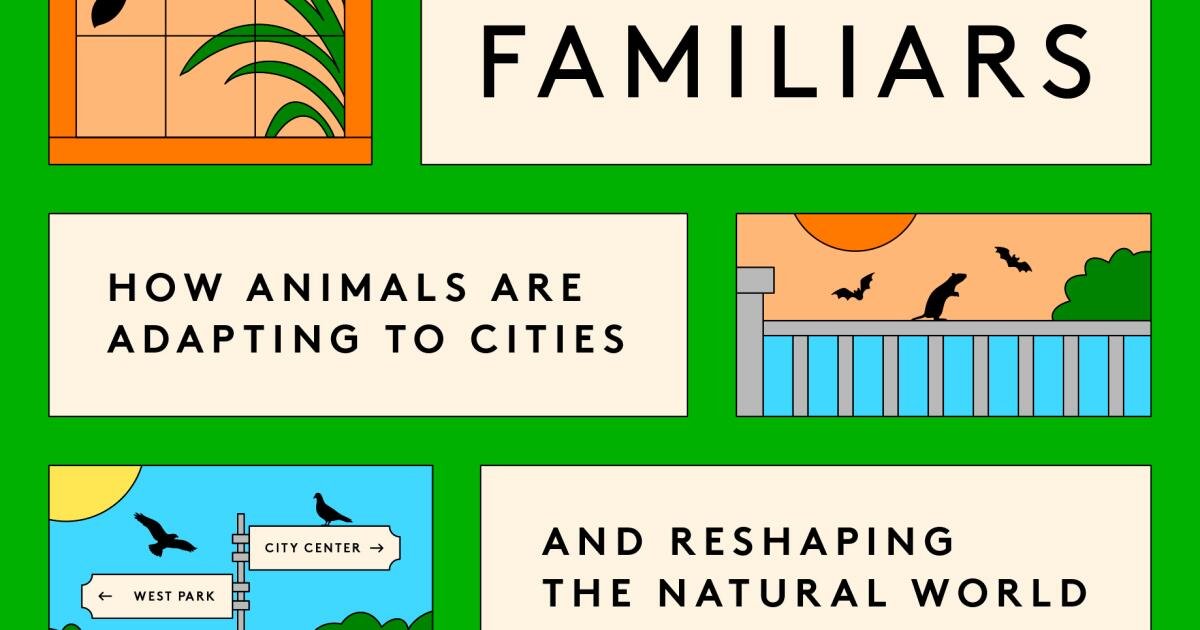
In 2007, for the first time in recorded history, more humans were living in urban spaces than rural ones. The animal kingdom has followed suit. In our cities, we are surrounded by synanthropes — wild animals that have adapted to human-modified environments and have learned to thrive in them — yet most of us are unaware of the biodiversity of this urban wildlife and how it functions along a parallel track with its human brethren.Dan Werb’s latest book “Our Wild Familiars” explains how these “soil churners … epidemic vectors and ecosystem partners” have a crucial role to play in the future sustainability of our communities. I talked to Werb about coyotes, the health benefits of birdsong and seagulls with junk-food issues. You’re reading Book Club An exclusive look at what we’re reading, book club events and our latest author interviews. By continuing, you agree to our Terms of Service, which include arbitration and a class action waiver. You agree that we and our third-party vendors may collect and use your information, including through cookies, pixels and similar technologies, for the purposes set forth in our Privacy Policy such as personalizing your experience and ads. ✍️ Author ChatYou are an epidemiologist.I was trained as a social epidemiologist — somebody who can look at how societal factors influence the health of populations. I study how society determines who lives and dies, who is sick and who is healthy.I’m wondering if it was your interest in Zoonotic viruses that led you to this subject?The last book I wrote was called “The Invisible Siege.” It is an overview of the history of coronavirus science, starting in the ‘80s, braided with the much longer history of the coronavirus family. And it ends with this scientist who is describing being in northern Thailand and moving through Myanmar and Yunnan Province in China in the ‘90s. And he stumbles upon this exotic animal market near the Shan Autonomous state, which is an ethnic enclave in northern Myanmar that’s been at war with the junta there forever. And this market’s got cloud leopard skins, civets and every crazy, exotic animal that you can imagine. And they were all being sent directly into China. And it’s exactly this kind of trafficking that is carrying all these viruses, like this superhighway of exotic animals into urban areas.But not all urban animals are vectors for disease. In fact, we have fostered very cushy urban environments for many different species. Pigeons, for example, who don’t have to fly in cities because they have no natural predators. Chris Shell, a coyote expert from Altadena that I interviewed, pointed out that pigeons do have to worry about predators now, because there are red tail hawks and coyotes and other creatures. Our urban ecosystems are becoming more complex. There are some biologists that are describing our time right now in North America as the great urban shift. They’ve done modeling exercises showing that over the next few decades there are literally going to be thousands of species moving into urban areas. They’re increasingly going to be mega-fauna, much larger animals.Why is that happening?We’re seeing the continuing acceleration of the transformation of wild spaces into human modified spaces. But it’s also because of extreme weather events. If you look at the horrible fires that occurred in Los Angeles last year, one of the things that happened was hundreds of thousands, even millions, of animals had to flee those areas that were on fire, and they fled into urban areas. What do urban areas provide? Constant sources of freshwater, continual sources of food waste, and other prey. You’ve got climate change happening, and that’s causing this real shift of animals moving into different places. Dan Werb, author of “Our Wild Familiars,” a new book about wild animals who’ve managed to survive in human communities. (Joseph Fuda) What about a less traditional metropolitan space, like L.A. County, which is a hodgepodge of so many different kinds of topography and terrain.L.A. is super fascinating because lot size isn’t directly related to income. It’s very much more heterogeneous and variable, even within neighborhoods. The wealthier a neighborhood is, the higher the biodiversity is going to be, because we’re going to have larger lots, more green space, fewer fences, things like that.We have a complicated relationship with coyotes in L.A., especially those of us who have lost pets to them. But according to your book, we have trapped them in our cities. Coyotes need to have pathways that allow them to move in and out cities. As it is now, they move into urban environments looking for food and water, and they can’t get out. They get trapped in cities, and conflict happens. Like black bears in suburbs across large parts of North America that dig into people’s garbage.And bears and other animals eating, say, fast food leftovers is a nutritional disaster as well. It’s like an ecological trap. They see no reason why they would leave, even though staying is actually more dangerous for them. And there are all kinds of ecological traps across cities that manifest in different ways. One that I always think about is seagulls at the seashore that have evolved over tens of millions of years to be able to hunt fish and shellfish. And the fish are right there, yet they’re eating french fries because it’s slightly less work.You mention the Wallis Annenberg Wildlife Crossing that spans the 101 freeway in Agoura Hills, the first animal crossing of its kind in America, as a potential solution to this problem. I think it’s great. One hopes there will be more projects like that undertaken in other cities around the world.We’ve discussed all the rotten things that are going on with animals in cities. Why is it a wonderful thing that animals have come into our cities and our lives?If we hear birdsong, we’re less stressed. If we hear additional birdsong, it multiplies the stress-relieving effect. Being close to animals is biologically beneficial for us. It’s really about connection. I look at AI, and there’s this kind of sense that an AI chat bot can decrease loneliness. But it’s just an echo chamber. I think a true connection is bridging some kind of divide in the way that you think or perceive the world. And in that sense, being aware of an animal who is aware of you takes you out of yourself in a way that I think is really, really special.This Q&A was edited for length and clarity.📰 The Week(s) in Books Book jacket for “You Won’t Get Free of It: Stories of Mothers and Daughters” by Rachel Aviv (Los Angeles Times illustration; book jacket from Knopf) The ostensible topic of Rachel Aviv’s new essay collection, “You Won’t Get Free of It,” is mothers and daughters, but according to Julia M. Klein, Aviv’s sparkling, sharp-eyed pieces “involve the slipperiness of truth and the crushing inadequacy of our mental-health system and social safety net.”“Cool Machine,” the final volume of Colson Whitehead’s Harlem trilogy, is an “American epic disguised as a heist novel,” writes Leigh Haber. “Whether or not New York is your jam, or a place you have escaped from or to, Whitehead’s Harlem Trilogy is destined to live on as an American classic.”Whitney Friedlander profiles Jessica Knoll, one of America’s most successful authors of sexy thrillers that “depict the absolute worst things one person could do to another — but in such a sensational, tongue-prickling-sour-candy kind of way that her books come off as devilishly evil beach reads.”Finally, Dan Tana’s book about his legendary, eponymously-named restaurant in West Hollywood, “Everybody Came to Tana’s,” has been posthumously published. 62 years after opening, it’s still a tough reservation to snag. “In a town that’s always trying to be something that it’s not, it’s not trying to be anything,” his daughter Katerina tells Maddie Connors. “Dan Tana’s is longevity in the midst of ephemera.”📖 Bookstore Faves The Philosophical Research Society is a Los Angeles Historic Cultural Monument located in Los Feliz. (Courtesy of Philosophical Resear) There is nothing else in L.A. like The Philosophical Research Society. The non-profit was founded by scholar Manly Hall in 1934 as a place for the curious to explore wisdom, philosophy, mysticism, and mythology across all cultures. Its visually striking Mayan Revival Los Feliz campus, a Los Angeles Historic Cultural Monument, features an auditorium, a galley and a library of 30,000 volumes. The PRS bookshop is its own gem, a well-curated miscellany of books for spiritual seeking and enlightenment.In a joint email exchange, PRS staffers dama, Jarrett Schaefer, Kelly Carmena and Amanda Brass explain what makes the store a sui generis experience.How does the bookshop tie in thematically with the Philosophical Research Society?The PRS Bookstore is a reflection of all that we do here at PRS. It is an extension of the library created by Manly Hall where you will find foundational texts in alchemy, mythology, philosophy, astrology, and art. You will also find a selection of books based on themes explored in our talks and screenings and from recommendations made by the team at PRS.It’s a very well-curated inventory of new and second-hand books — I assume you’re very careful about what you stock on the shelves. We select works that are meaningful to us and hope that they will resonate with everyone too. We highlight works by mystics and visionaries. In our staff recommendations section you’ll find titles like Ben Caldwell and Robeson Taj Frazier’s “Kaos Theory,” art books by Penny Slinger, Betye Saar and Remedios Varo, Yoko Ono’s “Grapefruit,” “Red Tarot” by Christopher Marmolejo, “The Bhagavad Gita,” and “Time, Myth & Matter” by LD Deutsch. We also feature items from local artists like Moss Candles, Black Willow Jewelry, and perfume by Syd Botanica. Our secondhand books are donation-only and are a kaleidoscopic bag of surprises. The Philosophical Research Society features an auditorium, a galley, a library of 30,000 volumes and a bookshop. (Courtesy of Philosophical Resear) What book genres tend to sell well? Esoteric art, mythology, tarot and divinatory practices, ancient philosophy, and hermeticism are all popular subjects. The top selling book every year is Manly Hall’s seminal work “The Secret Teachings of All Ages” which is an encyclopedic outline of symbolic philosophy. The used astrology books and children’s books are quite popular too.Do you have author events? We’ve hosted book talks with Mark Mothersbaugh, Michelle Coltrane, Mitch Horowitz, and Susan Orlean. We regularly co-present events with publishers like Hat & Beard Press, Angel City Press, The Library of Esoterica, Sky Press, Ouroboros Press, and Bibliomancers. There are also monthly events that are centered around the bookstore: The Manly Hall Book Club, Astro Study Group, Surrealist Study Group, Tarot Salon and an Esoteric Game Night.Philosophical Research Society is located at 3910 Los Feliz Blvd in Los Angeles.(Please note: The Times may earn a commission through links to Bookshop.org, whose fees support independent bookstores.)