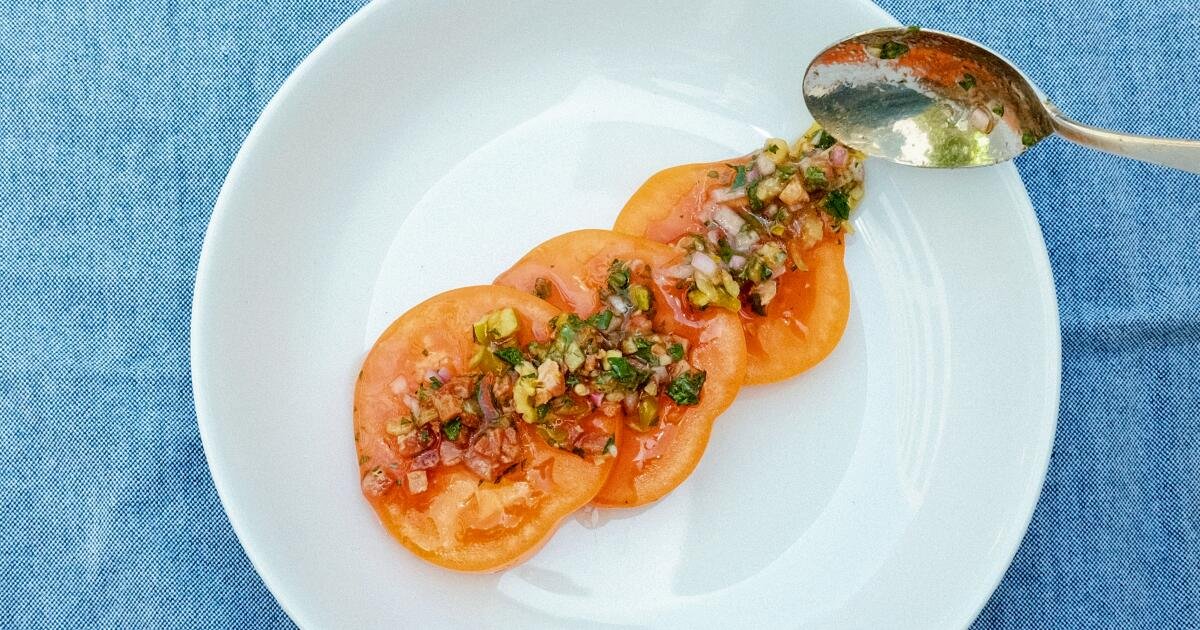
A lot of salads suck. Whether you’re eating a prepackaged Cobb from your favorite grocery store, a conveyer-belt kale Caesar from a fast-casual joint, or a green salad at a friend’s dinner party (sorry, friend) — it is maddeningly rare to encounter a truly great, delicious salad.When the average person eats a bad salad — whether it’s dull, under- or over-dressed, or just lacking life, tension or depth — they might be quick to think: I don’t like salads. Or: Salads, in general, suck.But that’s not true. Salads can be incredibly exciting and nourishing.The problem is rarely the lettuce, and it’s probably not the mix-ins.No. It is the dressing. Luckily, there is one fundamental principle at the core of every good salad dressing. Master it, and you might never have to make (or eat) a bad salad ever again. That principle is:Balance. You are reading our Cooking newsletter Sign up to get a taste of Los Angeles — and the world — in your own home and in your inbox every Friday By continuing, you agree to our Terms of Service, which include arbitration and a class action waiver. You agree that we and our third-party vendors may collect and use your information, including through cookies, pixels and similar technologies, for the purposes set forth in our Privacy Policy such as personalizing your experience and ads. A basic vinaigrette is a balancing act between acidity and fat. Salt and other flavorings also play their part, but acidity and fat are your foundation. Add too much vinegar and the dressing goes out of balance one way. Add too much oil and it goes out of balance the other way.If you put only vinegar on salad greens, they would taste electric, but intense. Only olive oil, rich but flat. Only salt, tasty but incomplete. Only garlic — blegh. Combine them all in your preferred proportions, however, and you end up with something bright, rich and delicious.Before we get into how to balance, let’s take a deeper look at the role of the main components in a vinaigrette:Fat: In this case, olive oil. The fat is a lubricator and an enricher. It gives the dressing body and a savory counterbalance to the vinegar. Acidity: Here, red wine vinegar. The acidity provides a sour, electric brightness. It makes the dressing taste “alive” and exciting to eat. Salt: Makes the lettuces taste more like themselves and the dressing taste “good,” turning up the volume knob on the complex flavors of the rest of the ingredients. Other stuff: In a basic vinaigrette, this is often Dijon mustard, garlic and black pepper. All three add their own pungent, savory piquancy. The garlic (or any other allium) is macerated in the vinegar to mellow some of its inherent raw “bite,” while the mustard acts as an emulsifier, helping hold the opposing forces of oil and vinegar together. Finding your balance:So where do we begin?I’d recommend starting with a classic ratio of one part acidity (vinegar) to three parts fat (olive oil).From there, your job is to mix, taste, think and adjust, adding more vinegar or oil until you reach your own ideal balance.When I was learning to balance dressings at Chez Panisse, a fellow cook taught me a trick: When she tasted her vinaigrette, she knew it was in a good place if she could feel a slight burn in her throat.Try to clue into these sensory experiences — they’re helpful markers on your journey to understand balance intuitively. If your mouth puckers, the dressing is too sour, and if there’s no burn at all, there’s probably too much fat.Taste, think, adjust.Then, dunk a leaf into it and keep adjusting the dressing until you like the way it tastes.When it’s right, I’ll get that subtle burn in my throat, a hint of the mustard’s pungency, a lingering perfume of the garlic and enough seasoning from the salt to think: “yum.”I’d say the most common dressing mistakes are not having enough acidity or salt.An even more basic version of this dressing is the old “drizzle some olive oil, squeeze some lemon, and sprinkle some salt over your greens or vegetables” trick that calls to mind breezy fantasy lunches on the Mediterranean Sea.That totally works, and seasoning things simply with olive oil, lemon and salt is a very worthy skill to nurture — just know that, without an emulsifier like mustard, you might quickly end up with oil-slicked leaves and a shallow pool of lemon at the bottom of your bowl.A basic vinaigrette recipeAs you hone your dressing making and acidity balancing skills, I’d like to give you a generalized vinaigrette recipe to help you conceptualize the ratio.The ratio is just a starting point. It can change depending on your taste and preferred ingredients. Some vinegars are more acidic than others, and sometimes you might want to make a slightly brighter vinaigrette, perhaps to avoid overdressing delicate greens like arugula.Use this recipe as a guide: ¼ cup acidic liquid (lemon or lime juice and wine vinegars are great)1 small allium (perhaps a shallot, minced, or a half clove of garlic, finely grated on a Microplane)Small quantity of potential extra flavorings: Dijon mustard, chopped soft herbs (parsley, basil, dill, etc.), citrus zest, spices (black pepper, ground cumin or fennel), heat (chile flakes, hot sauce).Salt ¾ cup of fat (nice olive oil, a blend of olive oil and neutral oil or sesame oil)1. Prepare your dressing in a jar with a lid, so that you can easily shake the dressing to emulsify. Add the juice or vinegar, your allium, a small spoonful of mustard (if using) and a healthy pinch of salt to the jar. Shake, and set aside for 10 to 20 minutes while you prepare your salad.2. Add in three times as much fat as the acid you started with. Shake thoroughly, and give it a taste.3. Consider your salt. If it doesn’t make you want to dip a piece of lettuce into it, add small pinches of salt, shake, and taste until it does. If you add too much salt, and the dressing tastes salty, add more acid and oil to dilute the salinity while still keeping the acidity in balance.4. Add any additional flavorings you like.5. Shake the dressing, and taste again. Is the salt and acidity level still good? If not, adjust. Shake the dressing, then dip a leaf of lettuce or vegetable into it and give it a taste. Still tasty? If not, continue adjusting until it is. Then: You’re ready to make your salad.Once you understand the balance at work in this general recipe, you’ve unlocked so much more than a basic vinaigrette. As you get more comfortable, I encourage you to ditch the measuring spoons and try to make your dressings by sight and taste. The more you rely on your senses, the more intuitive your cooking becomes.You can create endless variations, building dressings around what’s at the market and what you have on hand.Olive oil can become a mixture of grapeseed and sesame oil. Red vinegar can become rice wine vinegar. Salt can become soy sauce. Shallots can replace garlic. And all sorts of additional flavorings — like fresh herbs, citrus zest, spices or ginger — can take the dressing in completely different directions.The ingredients and amounts can change, but the final balance stays the same.To see this theory in action, check out my latest recipe: Pancetta, tomato and pickled pepper vinaigretteHere, pickled pepper liquid replaces some of the red wine vinegar, pancetta takes the place of some of the salt and olive oil, and the tomato adds enough richness and body that only a little additional fat is necessary. It’s a wonderful summer dressing that goes great on pasta salad, grilled vegetables and roast chicken. Get the recipe. Cook time: 25 Minutes. Makes 2 cups. (Stephanie Breijo/Los Angeles Times) Talk soon,Cody