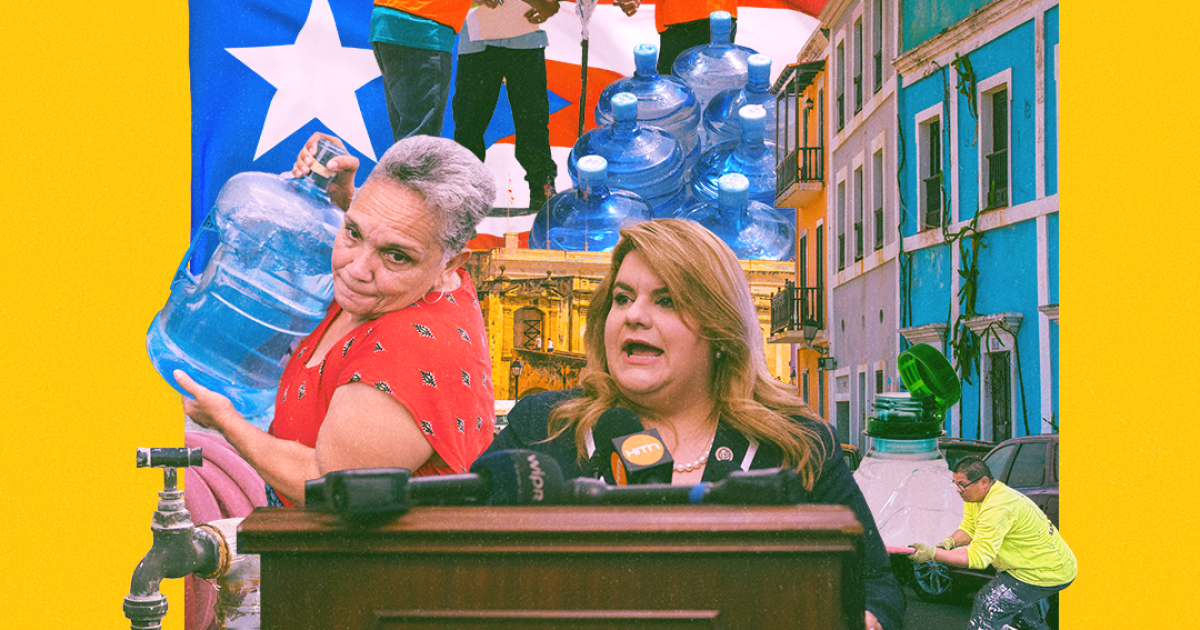
Last week in San Juan, Puerto Rico, the water taps ran dry.The Caribbean island experienced its driest July on record, with more than 60% of the territory — more than 3 million residents — facing drought conditions according to the U.S. Drought Monitor. Many of the major water reservoirs are at critically low levels, resulting in an increased lack of access to water for locals as extreme heat conditions continue. In an attempt to combat the limited water supply, the Puerto Rican government is turning off residents’ access to the necessity on a rotating 48-hour basis.“This situation is beyond our control,” said Puerto Rican Gov. Jenniffer González in a statement. “It is the result of the weather conditions we have been facing, which experts had warned about weeks ago. … Nothing prevents this from worsening.”The governor has said she does not know when the rationing of water will end.Large trucks filled with potable water have been sent throughout the island to help residents, with the sick and elderly given preference.But this dire water situation didn’t just happen overnight or even over the course of the past few months.“The current water crisis in Puerto Rico is a complex issue. What is undeniable is that Gov. Jenniffer González and her administration were aware of the issue and failed to prevent what was an already intolerable situation,” said Frankie Miranda, the president and CEO of the Hispanic Federation: a nonprofit Latinx community advocacy operation. “For decades, communities have lived without fair access to water resources, and experts have repeatedly warned that the lack of infrastructure maintenance and poor watershed management would lead Puerto Rico to the water crisis it faces today.”Charlotte Gossett Navarro, the Puerto Rico chief director for the Hispanic Federation, echoed Miranda’s sentiments in an interview with The Times.She noted that as early as January, communities on the island had raised the alarm that there wasn’t enough water to go around.“The challenge comes from two key issues,” Navarro said. “One is an ongoing challenge that we’ve had for decades related to infrastructure and then there are the challenges that get exacerbated by the climate crisis … we’re struggling with a drought and it’s making the infrastructure issues even worse.”The main issues with Puerto Rico’s water infrastructure are the aging pipes that transport the resource across the island to residences and businesses and a lack of funding allocated to restoration projects.“We’re talking about years where we have seen that infrastructure be aged and Puerto Rico not making the investments necessary to maintain it,” Navarro said. “In May, a major water pipe broke here that left over 100,000 in the metro area without water for over a week. They repaired it and that was supposed to be a basic maintenance, but because of challenges, it turned into a much bigger repair project than they originally expected.”It’s currently estimated that approximately 60% of water that travels through Puerto Rico’s geriatric pipes is lost due to leaks and other infrastructural issues, Navarro mentioned. So even when it does rain, and a percentage of that water lands in accessible reservoirs, citizens are only able to use a fraction of that fraction.These outdated systems and government ineptitude have caused outrage among Puerto Ricans, who have taken to the streets to demand that government officials step up to get the crisis resolved. “There was an expert committee that presented to the legislature on how Puerto Rico needed to prepare for climate change, including things like drought and made a lot of very concrete recommendations on steps that could be made,” Navarro said. “But, they haven’t approved that plan and the government of Puerto Rico has made no investments towards the recommendations, so it’s not that there isn’t knowledge about what needs to be done to address these issues.”Driving the anger from residents is the fact that money is not what’s holding back elected officials from enacting change.“We have billions of dollars in federal funds that we are still sitting on, that are intended to do things that are going to make Puerto Rico’s basic infrastructure stronger,” Navarro said. “And both the federal government and the local government need to move that money towards solutions that experts have identified. Some of the decisions that are being made on how to spend it are not actually in the best interest of Puerto Rico, in the long term.”Even the measures that have been put forth by the government have been poorly executed. Announcements for who will have water access (and when) have been jumbled. People who expected to have water are left with dry taps, while the pipes of those who had prepared for scarcity remain filled with water. All of this has created confusion on the island and has made it nearly impossible for residents to plan around the rationing cycles. “It’s supposed to be 48 hours on, 48 hours off. In some places, it’s more than that, it’s extended periods, it’s been a week at a time,” Navarro said. “And so, for the most vulnerable communities — think of people who are elderly, people who have physical disabilities — that makes it a challenge for them to go out and get water.” This water struggle is also heavily affecting Puerto Rican farmers, as the ongoing drought has left them unable to produce, which may lead to food insecurity on the island. All of these problems are taking hold as the peak of this year’s hurricane season looms in the Caribbean, which has historically led to electrical issues across Puerto Rico.“We are hoping that Puerto Rico doesn’t face any major hurricanes this year or any hurricanes at all,” Navarro said. “Were we to be hit, it puts us again in even more risk of what the impact of a hurricane would be and how prepared we would be as communities to respond.”While the situation in Puerto Rico is reaching dire levels, Navarro emphasized that the island is not a “hopeless place.”As government help has stalled, Puerto Ricans have activated among themselves to take care of their neighbors.“A lot of Puerto Rico has been trying to develop more community resiliency hubs across Puerto Rico, so that each community has a place a safe place where you have resilient access to water, where you have access to energy through solar energy and generators, where you have community kitchens, so you can get a hot meal if you can’t cook at home,” Navarro said. “We’ve seen some community leaders actually organize and find water trucks to bring and distribute water in their own communities.”Navarro’s hope for those outside the island is that they continue to advocate for Puerto Ricans beyond just the lifespan of a flashy news story. “We need the rage that others are feeling in the United States to keep that attention,” she said. “We get mad, we see this terrible thing that happened to Puerto Rico, we’re upset about it and then there’s new news. We turn the page and we don’t hear about it again until a new crisis hits Puerto Rico. We need allyship year round to be putting pressure and to question whether the federal government is doing right by Puerto Rico — because for so many decades it has not.”So if you’re reading this and feeling rage (as you should), hold on to that and try to do something about it. (Jackie Rivera / For The Times; Martina Ibáñez-Baldor / Los Angeles Times) How to help Colombian earthquake victims Residents and rescue workers search through the rubble after an earthquake struck Cali, Colombia, Monday, Aug. 10, 2026. (Santiago Saldarriaga / Associated Press Photo) On Monday, a 7.4 magnitude earthquake struck western Colombia, killing more than 250 people so far and compromising hundreds of buildings. Many others remain trapped under collapsed structures as rescue crews race to account for the missing.The seismic event heavily impacted the country’s third-largest city, Cali, which lies near the Pacific Coast. Colombia’s Pacific region around the quake’s epicenter lies in the “Ring of Fire,” the line of seismic faults encircling the Pacific Ocean where most of the world’s earthquakes occur.The situation in Colombia is all-hands-on-deck and a litany of organizations worldwide are rallying together to get aid to earthquake victims.Click here to find organizations where people can contribute funds and resources to earthquake victims. Stories we read this week that we think you should readUnless otherwise noted, stories below were published by the Los Angeles Times.Politics and immigrationArts and entertainmentSouthern California